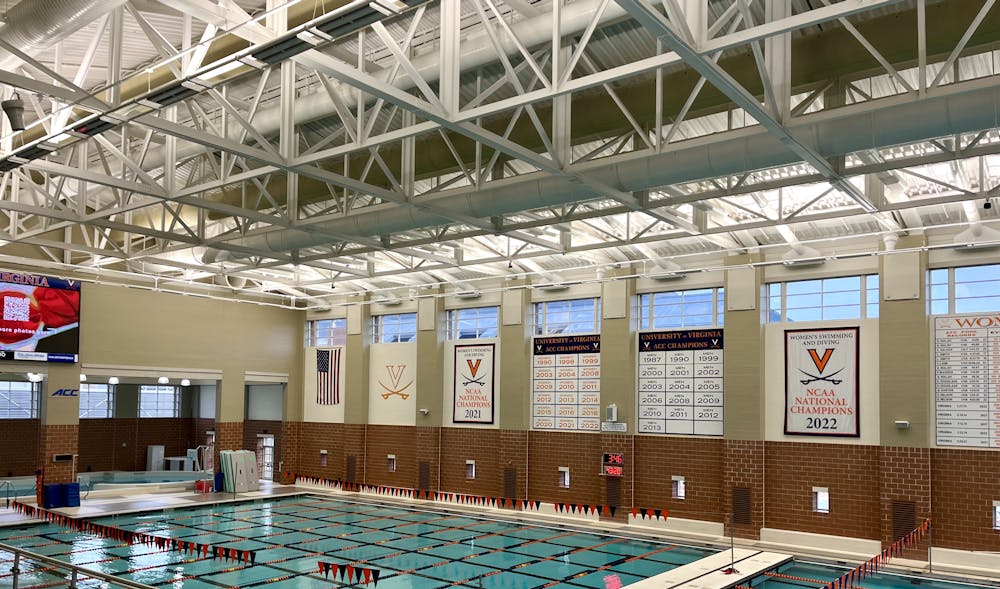
For Class of 1988 alumnus Trevor Freeland, the dividends of a collegiate swim career are measured far beyond the 1987 ACC Championship trophy. A product of the legendary Philadelphia Department of Recreation swim club, he navigated being the only Black swimmer on the pool deck at the University to become an impressive student-athlete and an exceptional individual far beyond.
Today, Freeland reflects on how the resilience forged in the water became the foundation for a decades-long career as a financial executive and philanthropist.
According to Freeland, his introduction to swimming in the early ‘70s was a matter of safety rather than sport. On the heels of integration, swimming as a mere skill was largely inaccessible for many, particularly for Black communities. However, when Freeland's family had moved into a Philadelphia neighborhood filled with backyard pools, his mother, Ernestine, was determined her sons would learn to swim, unlike she had.
“This is, mind you, back in the early ‘70s, which is just past segregation,” Freeland said. “Back in the day, Black people [and] white people couldn't swim in the same pools. It is harder to learn [to swim] because you won't go to certain places.”
The search for quality swim instruction initially took Freeland and his brother to the YMCA. When that program failed to provide sufficient swimming education, his mother redirected the family to a recreation center in West Philadelphia.
There, Freeland met coach Jim Ellis and joined the Philadelphia Department of Recreation's swim team — the same program later depicted in the 2007 film “Pride.”
“It was an all-Black team with a Black coach in the ‘70s, you know, that's unheard of,” Freeland said. “But in Philly, there were also three teams like that. Ours was the best, but we had others … We really had something very unique that we weren't aware of because we were just kids. And when you're kids, you’re just swimming."
On top of teaching technique in the pool, Ellis instilled a standard of self-assurance into his athletes that Freeland carried into every space he would eventually inhabit. Despite being somewhat of an anomaly in the then-homogenous world of competitive swim, Ellis made sure that his team knew they belonged.
“When we went to meets, Jim instilled a certain level of pride and authenticity of who you were,” Freeland said. “We didn't try to be something we weren't. We were going to be unapologetically ourselves.”
Not only would they compete as themselves, but they would win. As Freeland progressed to regional and national competitions, there was less of the “pretty Black paint,” how Freeland referred to Philadelphia’s larger proportion of Black swimmers. It instead gave way to predominantly white competition.
“When I went to the bigger meets … most of the time it would be myself, Jim, my mom and my mom,” Freeland said. “That's it — there’s no other Black people in the building.”
Freeland said the makeup of his opponents did not bother him. Instead, he just swam his hardest, and while there were moments that cut deeper, the lessons learned from Ellis had already taken root. Excellence, Freeland learned early, was the response.
“I felt like I should always represent where I came from and who I represent,” Freeland said. “Whether it's U.Va., whether it's PDR, there's my family, with the utmost of integrity [and] responsibility.”
His clear determination and athletic success caught the attention of then-Virginia head coach Mark Bernardino, who approached Freeland at a national meet when he was in high school.
“He came right up to me,” Freeland said. “He liked what he saw. He was like ‘I want you to consider coming to the University of Virginia.’ And that changed my life.”
While he took the offer to join the Virginia squad, when he arrived in Charlottesville in 1984, another form of solitude presented itself. The ACC of the mid-1980s reflected decades of exclusion in the sport and a pipeline that had long favored white suburban swim clubs. Alas, not only was Freeland the only Black male on the team for the entirety of his collegiate career, he was also the only one in the ACC.
“I go to a conference meet and it's just me,” Freeland said. “Imagine there's one white basketball player in the entire ACC for all four years. So that was the makeup.”
Still, Freeland remained largely unruffled, defining much of his experience instead by the community he found within his team. While he remembers a handful of derogatory comments from opposing teams, he remembers his teammates’ reactions more vividly — they rallied around him, reinforcing the belief that his team truly had his back.
When he was not in the pool, Freeland's focus was on working toward his Engineering degree. While others saw those simultaneous commitments as a hurdle, he saw it as a baseline requirement that he was fully capable of meeting.
“I was in the E-school, graduated in four years, I swam, and it was a lot to take in,” Freeland said. “And I did that. I was very proud of that. My expectations rise. People thought that was hard but I was like alright, that's what I'm supposed to do.”
In 1987, Freeland was the first African American athlete in the ACC to help Virginia earn an ACC Championship — the team’s first — marking a major milestone for the program Bernardino was building. But despite the accolades, looking back, Freeland believes the true value of the sport was the dividends it paid in character, instilling a resilience that he says cannot be lectured into a person.
Those lessons remained applicable as he transitioned into the next phase of his life. After graduating from the University and later earning his Master’s in Business Administration from Duke's Fuqua School of Business, Freeland built a career on Wall Street. Once again, he often found himself in the minority.
“I work [in] a business where I'm definitely [in] the extreme minority,” Freeland said. “The experiences that I had helped me grow and pushed me to expect excellence in everything that I do and to do it with a smile and to create great relationships.”
Today, the experiences he speaks of have translated into creating representation for others entering these historically homogeneous spaces. He serves as an executive sponsor of the Black Leadership Forum at Deutsche Bank and sits on the board of Make-A-Wish Metro New York.
Philanthropy is not the only way Freeland pays it forward. He has also spent decades mentoring younger swimmers, including Virginia All-American Jason Webb, whom he calls his “little brother,” having swam at both Virginia and PDR.
“Given what I've been through and my career path, I think you have to give back,” Freeland said. “You have to use your voice and your presence … You have to speak up and challenge them to make a change and support you.”
For the next generation of athletes, his advice is a reflection of the PDR mindset he never outgrew.
“Just continue to bust your ass and work as hard as you can,” Freeland said. “Whether you're trying to meet certain time goals or aspirations or win a championship, or just learn to work hard, that translates into your everyday life.”
From West Philadelphia to Charlottesville and beyond, Trevor Freeland has never stopped doing the same thing he learned as a child on the pool deck — step up, dive in and work to become better than he was the day before.
“Be present and be authentic,” Freeland said. “Take as much as you can every day, because you're not promised life. You're promised death, so live and be impactful.”
Read More

Virginia singes Flames, earns first win of the season
By Drew Dillman | YesterdayOn a hot and humid first day of September, the song of the same name by Earth, Wind & Fire played over the loudspeaker during pre-match warm-ups. The lyrics of that song go “Dancin’ in September,” and the Cavaliers (1-1, 0-0 ACC) had reason to by the end of the night, winning in four sets against Liberty (2-2, 0-0 Conference USA), 25-17, 26-24, 25-9 and 25-18.

The boys of summer: Virginia takes on summer leagues
By Drew Dillman | YesterdayThe Cavaliers spent their offseason improving their craft in wood-bat summer baseball leagues.

Discussing a Virginia men’s soccer team off to a rocky start
By Jordan Zimm , Michael Liebermann , Mofeoluwa Akande and Noah Cinel | 2 days agoDespite being off to a rough start, there are still plenty of things that make this Virginia squad both a candidate for redemption and an interesting watch.