Inside the University’s growing federal lobbying program
By Komal Reddymachu | 15 hours agoThe University spent roughly $250,000 on federal lobbying in 2025 — about 25 percent more than in each of the two prior years.
The University spent roughly $250,000 on federal lobbying in 2025 — about 25 percent more than in each of the two prior years.
Wamhoff is the third executive member to join the Manning Institute.
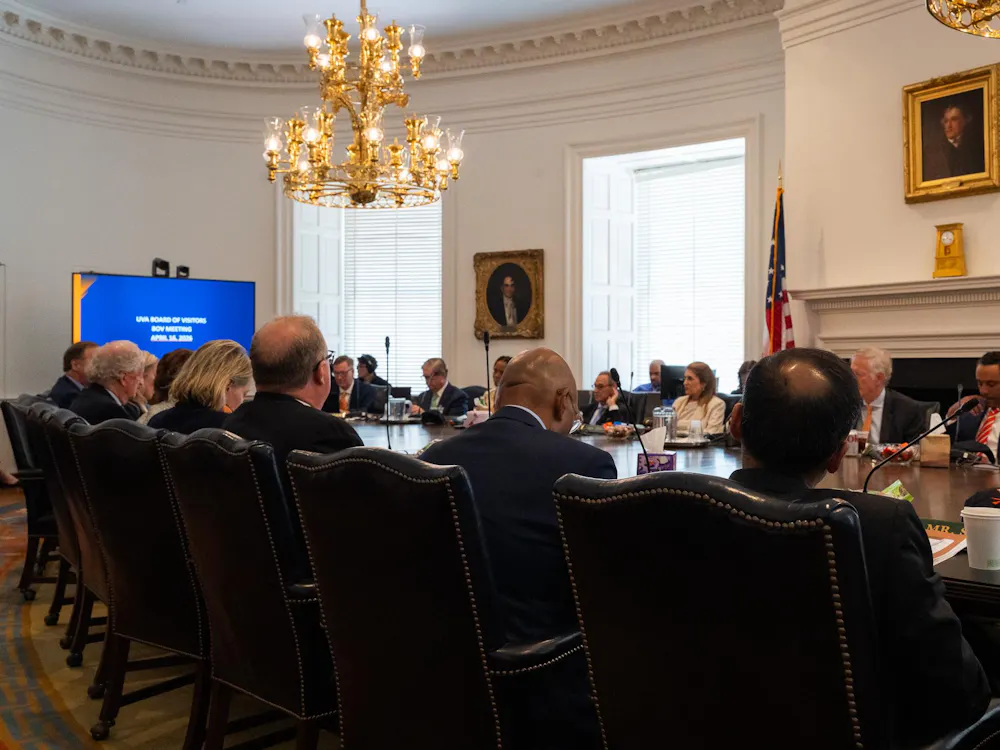
The University's Board of Visitors looks far different today than it did even two years ago.
Here is a look at changes made across multiple divisions and schools since the second compliance report, as outlined in the June 30 report.
Jim Ryan, former University president and School of Law professor, resigned as president June 27, 2025.
“The University is much more than its leadership writ large, and I think [that is] really important to remember,” Sullivan said.
Here is a closer look at how Beardsley’s early tenure compares to that of his predecessor, Ryan.
Solomon joined Batten in September 2019 as the school’s third dean, and in 2024, the University appointed him to serve a second, five-year term.
The Cavalier Daily asked University leaders and faculty from across Grounds — deans, executive administrators and governing leaders — to weigh in on the University’s institutional stability one year after former University President Jim Ryan’s announcement of his resignation June 27, 2025.
Grushka-Cockayne’s appointment succeeds Beardsley — who stepped down as Darden dean when he assumed the University presidency Jan. 1.
The Faculty Senate — a body of approximately 82 elected faculty representatives from across the University’s schools — represents faculty on academic matters affecting multiple schools such as degree programs and major curriculum changes.
The letter addresses “federal government overreach” as one of Wahoos4UVA’s motivations for higher education governing board changes.
In a statement to The Cavalier Daily, University Spokesperson Bethanie Glover described the initiative — Grounds for Conversation — as an effort to learn the University’s strengths and areas for improvement.
According to the meeting’s presentation, the Board covered seven topics — Virginia Athletics’ organization, value proposition, performance at a glance, peer benchmarking, House settlement and NIL, fiscal year 2026 highlights and economic impact.
Rosner also presented the issues still facing U.Va. Health, and posed six questions to Board members regarding how the University can work to ensure the Health System expands efficiently.