At 6:15 in the morning, the University sleeps. Streetlights illuminate sidewalks untrodden by students since the evening prior. The Lawn lies empty, and the Bodo’s Bagels on University Avenue has yet to open its doors. Buildings across grounds dwell in silence, patiently awaiting a day that has yet to begin. One of the exemptions from that list of dark, empty buildings, however, is the Hardie Football Operations Center.
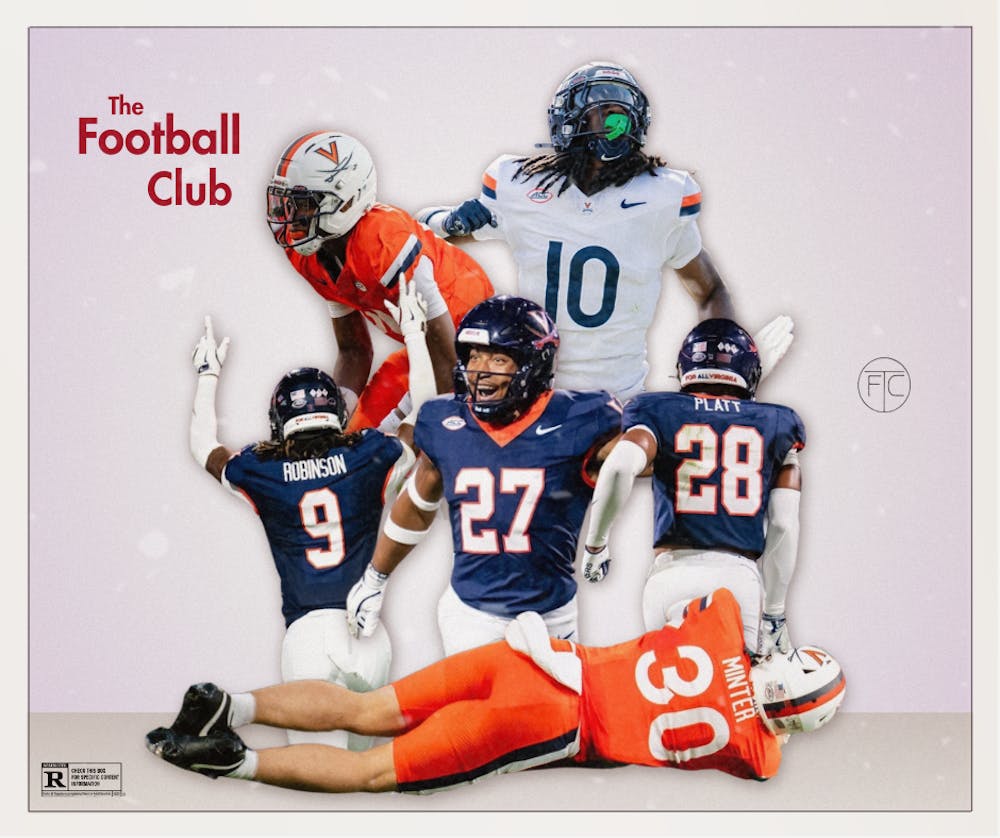
Most mornings this season, this facility has awoken before sunrise. The guilty party? Virginia’s defensive backs — present for their daily film review. Led by defensive passing game coordinator Curome Cox, the Cavalier secondary studies upcoming opponents each morning before practice. Those early film sessions have proven essential for Virginia’s defensive backs.
“It's really helpful, honestly, because with this sport and everything that comes with it, [success] doesn't just happen,” graduate safety Devin Neal said. “You don't flick it on like a light switch. Of course, it may seem like that to people on the outside. But it's a lot of preparation and things that go into it to really allow you to perform the way you need to.”
Neal, a transfer from Louisville before the 2025 season, is a key fixture of that secondary. Recently receiving Third-Team All-ACC Honors, the safety led the Cavaliers in tackles and finished second in pass-breakups. Perhaps more importantly, Neal is a veteran presence amongst one of Virginia’s younger positional units — a unit to which film study is paramount.
“As a [defensive back], there's so much to it,” Neal said. "There's so many routes. You’ve got to play the run and the pass. You can't just show up on Saturdays. You have to put that time in as if you're studying for a test. You would never show up to a test without doing a study guide.”
In honor of the early-morning meetings, defensive coordinator John Rudzinski has dubbed Virginia’s secondary study group “the Breakfast Club.” Much like the 1985 film, the Cavalier defensive backs entered meeting number one with very little experience together.
This past offseason, Virginia welcomed nine transfers in the secondary, more than any other unit. Those transfers filled most of the starting roles, with sophomore safety Ethan Minter and graduate safety Antonio Clary being the only returning defensive backs to receive significant playing time. That gave the Cavaliers a talented group of individuals — but one with little experience playing together. Given the roster construction, it is not entirely surprising that these meetings began to occur at a regular clip.
Further underscoring the need for the Breakfast Club, many of those transfers joined Virginia during the later “spring” portal window. That delayed timeframe gave newcomers a shorter period to become familiar with coaches, learn the defense and develop chemistry with teammates before week one. For the Cavaliers, those growing pains were evident.
“I think early on in the season, we were coming into our own on the back end,” Coach Tony Elliott said, prior to the ACC Championship. “That was the biggest transition post spring ball, was the number of guys that we brought in in the secondary. And I think early on, you saw a couple of miscommunications, big play busts.”
In game three of the season against William & Mary, the Virginia secondary surrendered a 79-yard passing touchdown. Just a week later, when the Cavaliers hosted Stanford, Rudzinski’s defense allowed 60- and 68-yard gains through the air. Though both contests ended in Virginia’s favor, Elliott and company played a dangerous game. But perhaps — much like the alarm before a 6:15 a.m. film review — those contests served as a wakeup call.
And luckily for the Cavaliers, the Breakfast Club is a motivated bunch.
“It's a fun group to work with,” Rudzinski said. “It's neat to see the hard work that those guys put in. Those [defensive backs], I mean, they're in the building at 6:30. They're like, ‘nope, coach, we need to meet.’”
Those early morning meetings did not merely teach the Cavalier secondary about its opponents — they allowed Virginia’s defensive backs to become more confident in themselves and reliant upon one another.
“When you're up in the morning with somebody and spend time watching film, you two know there's a level of trust,” Neal said. “You're like, ‘Hey, we’ve seen that. Be ready for this.’”
That increased trust began to yield major on-field results for the Cavaliers. Just one week after the Stanford game, Virginia recorded two interceptions — both courtesy of junior defensive back Ja’Son Prevard — against the nation’s then-most dominant offense.
One of those takeaways came on a Prevard blitz, when the junior batted a Florida State pass in the air and came down with it. The Breakfast Club might deserve some credit.
“We talked about matching the hand all week,” Prevard said postgame. “[Thomas Castellanos is] a shorter quarterback, so once he acts like he’s about to throw the ball, just match his hand.”
Those dawns spent studying a screen in the Football Operations Center were clearly paying dividends. A few weeks into the season, the Breakfast Club had helped secure one of Virginia’s most important victories in school history.
That defeat of Florida State would see Prevard engulfed in a sea of elated Cavalier fans following his second, game-winning interception. The upset of college football’s then No. 8 team, however, was far from the secondary’s peak.
“As we settled in, those guys became more comfortable communicating together to be able to stay on top of routes,” Elliot said.
That comfortability creates a positive feedback loop — one that starts with a film study at the crack of dawn and moves quickly to on-field performance. Through the Cavaliers’ first six contests, Virginia’s defense surrendered an average of 240 passing yards per game. Through the latter eight, that number is below 165.
“When it translates from the film room to the game, it really makes everything be like, ‘Okay, we're familiar with this,’” Neal said. “And you get more comfortable as a [defensive back], you trust your technique even more, and it allows performance to skyrocket overall, as a defense.”
Such improved performance would become crucial for the Cavaliers later in the season, particularly as injuries to graduate quarterback Chandler Morris heightened reliance on the Virginia defense. By that point, the Breakfast Club was well-prepared to step up.
Following a historic victory at Saturday’s TaxSlayer Gator Bowl, the Cavaliers stare down an offseason that will reshape the secondary — though likely one with fewer than nine incoming transfers. With that being said, dwindling eligibility requirements and the ever-prevalent transfer portal will force the Breakfast Club to change form, at least slightly. Prevard and junior cornerback Dre Walker have already declared their portal entries. But maybe, even if the faces in Virginia’s secondary change, the 6:15 a.m. meetings will not.
Xander Tilock contributed reporting.
Read More
Five takeaways from the first two Virginia men’s basketball exhibition showcases
By Jordan Zimm | 13 hours agoWith one more exhibition remaining at Villanova Thursday, here are five takeaways from Virginia’s first two preseason tests.

Virginia volleyball looks to extend historic winning streak to 10 against Virginia Tech
By Jonathan Altshuler | 14 hours agoWhile both teams have struggled recently, Wednesday’s result further strengthened the Cavaliers' advantage in the rivalry — which remains one-sided.

Virginia volleyball extends winning streak against Virginia Tech with four-set victory
By Jonathan Altshuler | YesterdayThe Cavaliers defeated the Hokies in four sets Wednesday night at Memorial Gymnasium with scores of 25-19, 25-19, 22-25 and 25-23. This was the Cavaliers’ first win since Sept. 25, extending a five-year winning streak against the Hokies since 2022.