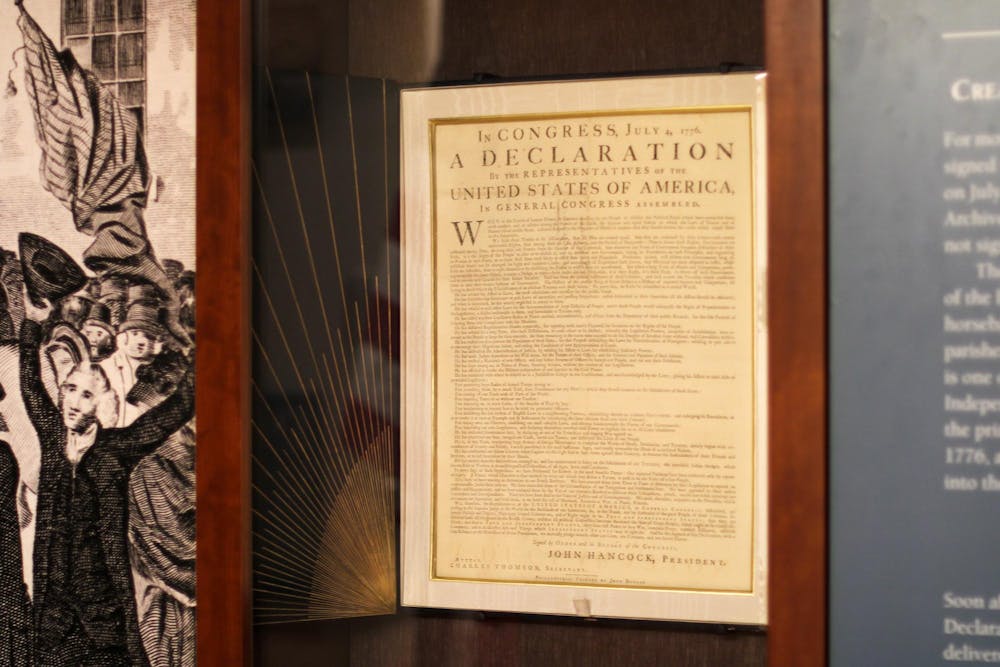
The Office of the President featured a display of one of the University’s original copies of the Declaration of Independence at an event Monday, at which University President Scott Beardsley delivered the opening remarks. In his address, Beardsley emphasized the lasting impact of the Declaration and Thomas Jefferson’s legacy.
The event, titled “Declaration Under the Dome,” took place from 1 to 5 p.m. to commemorate Presidents’ Day as part of UVA250 — a series of events on Grounds to celebrate the 250th anniversary since the signing of the Declaration in 1776. The University’s copy that is usually housed in a “secure vault” of the Albert and Shirley Small Special Collections Library was brought to the Rotunda for the first time since the University obtained the copy in 1956. There was also a podium where Beardsley and a variety of speakers took part in “flash seminars” throughout the day, to emphasize the importance of the Declaration.
Beardsley spoke to a crowd that filled the Dome Room to introduce several speakers who read other famous documents that were influenced by the Declaration’s language. Beardsley welcomed the audience to the Rotunda, which he called the “architectural and intellectual heart” of the Academic Village. He reflected on the enduring legacy of the document, and said that it was central in forming the United States’ national identity.
“The Declaration gave voice to principles that shaped a new nation and have echoed across generations,” Beardsley said. “Its words have been read aloud in moments of celebration and solemn reflection.”
The University also showcased the book, “The Greatest Sentence Ever Written,” by historian and author Walter Isaacson. The book is about the lasting impact of the second sentence of the Declaration, which states that “all men are created equal” and endowed with “life, liberty and the pursuit of happiness.” Beardsley asked the audience to reflect particularly on that sentence, emphasizing his belief that it has a lasting impact.
“These words have invited generations to reflect on human dignity, equality and the aspirations that unite us,” Beardsley said. “The pursuit of happiness — so simply phrased, yet so profound — speaks to the hope that each person may seek a life of meaning, purpose and opportunity.”
Beardsley also said that the University continues to exemplify the Declaration’s ideals — and the ideals of its founder, Jefferson — in its mission. He reminded the audience of the importance Jefferson placed on an educated populace.
“For Jefferson, education was inseparable from the health and vitality of a free society,” Beardsley said. “We continue to pursue what Jefferson called the ‘illimitable freedom of the human mind’ — the freedom to inquire, to learn and to contribute to the common good.”
Reflecting on Jefferson’s legacy and the importance that he placed on authoring the Declaration, Beardsley reminded the audience that Jefferson had just three of his accomplishments etched on his tombstone. The first of these accomplishments was that he authored the Declaration. The third, that he was the “father” of the University.
Afterwards, Beardsley spoke with The Cavalier Daily for the first time since his appointment Dec. 19, where he discussed the value of honoring the Declaration.
“U.Va. is very lucky, because … we’re the only institution with two copies of the Declaration,” Beardsley said. “I think it’s easy … to forget that the founding of our country came through this document.”
Beardsley also emphasized the close connections between presidents of the United States and the University.
“We’re blessed that … our first three rectors were Jefferson, Madison [and] Monroe — presidents that founded this University,” Beardsley said. “It's Presidents’ Day and we have the original copies … [so we said] ‘well, let’s celebrate this’ … we should never take our country for granted.”
Beardsley also noted the high turnout, saying that while many “believe in the project” of the Declaration, other attendees may not realize that a copy of the Declaration is always on display at the University. When it is not being showcased in the Rotunda, one of the University’s Declaration copies is kept in the University’s Special Collections Library.
The line, which extended downstairs and outside on the Rotunda steps, was composed of a mix of University students, elementary students and families. Graduate Arts & Sciences student Michael Beeli was in attendance Monday and said he felt like this was a rare opportunity that only the University has to offer.
“This is one of the original copies in the Rotunda,” Beeli said. “It’s all very Jeffersonian [and] seems like … a good way to … [make] the most of the school while I’m here.”
Graduate Arts & Sciences student Jackson Collie said that he was interested in the particular copy’s history, and was glad he could see it Monday because the display in the Rotunda only lasted a few hours. In his remarks, Beardsley noted that, before the copy of the Declaration on display was first purchased by the University in 1956, it was found in an attic in Albany, N.Y.
“This was [for] one day only on display [in the Rotunda],” Collie said. “It’s neat to see a copy of the Declaration of Independence.”
The Karsh Institute will continue to host events throughout 2026 in celebration of the 250th anniversary of the Declaration’s signing. The next event will occur Thursday at the University’s Bond House at noon — Jerome Copulsky, research fellow at the Berkeley Center for Religion, Peace and World Affairs at Georgetown University, will join Adam Jortner, history professor at Auburn University, for a moderated discussion on the influence of religion in American Democracy.
Correction: A previous version of this article stated that “Declaration Under the Dome” was sponsored by the Karsh Institute of Democracy. The event was sponsored by the Office of the President. The article has been updated to reflect this change.

Luca Bailey is a third-year College student majoring in politics from Free Union, Va. As a staffer on the news and video desks, he has covered topics ranging from the General Assembly and state elections to local politics and University governance. He is also The Cavalier Daily’s beat writer for the Charlottesville City Council.
Read More

Students, professors weigh in on the importance of letter grades
By Ruby Budetti | 40 minutes agoWhen thinking about letter grades for themselves, many University students and faculty said they prefer letter grading throughout all four years of college.
What services does the Student Health Fee provide for students?
By Melody Yuan | 49 minutes agoThe University Board of Visitors approved tuition and fees for the 2026-27 academic year in April, and the Student Health fee rose from $1,147 to $1,184 per student.
The ‘AI and Future of Work’ Series — How the University is preparing students for what is next
By Lidia Zur Muhlen | 2 hours agoIn a recent Gallup Inc poll, 79 percent of Americans believe that artificial intelligence will reduce the number of jobs over the next 10 years.