
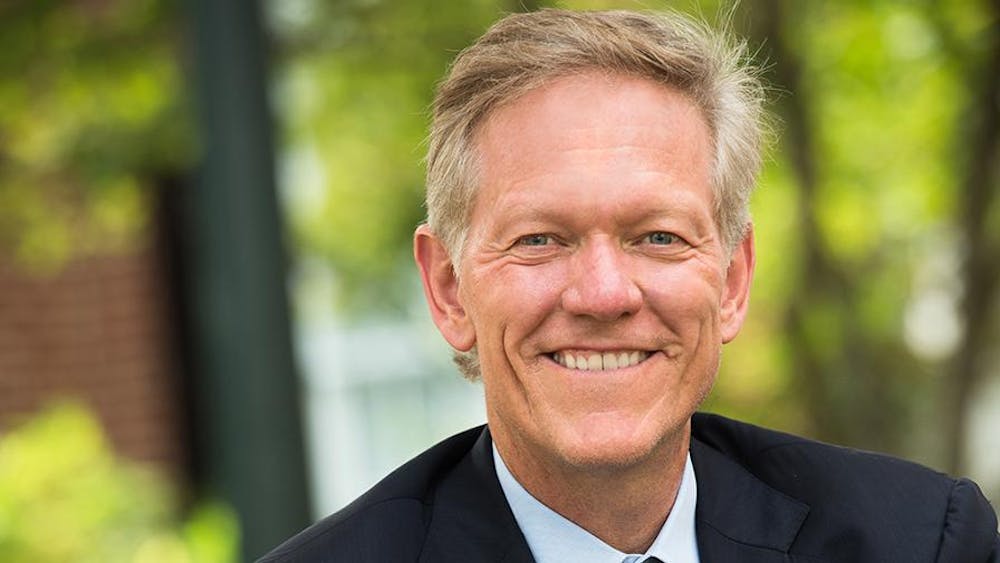
Scott Beardsley, current dean of the Darden School of Business, was selected unanimously in a special meeting by the University’s Board of Visitors Friday to serve as the University’s tenth president. Beardsley was chosen out of four finalist candidates, and his appointment follows the resignation of former University President Jim Ryan June 27 following pressure from the Justice Department.
Board Rector Rachel Sheridan praised Beardsley as a candidate with “leadership skills required to navigate the challenges facing higher education today.” Upon his appointment, Beardsley addressed the Board and members of the public who were in attendance — he thanked the Board, Interim University President Paul Mahoney and Ryan for their leadership and described the appointment process as “rigorous and thorough.”
“U.Va.’s strength has always come from the people who care so deeply,” Beardsley said. “It’s really one of the things that makes U.Va. so special.”
The Board released a statement to the University community around 3:30 p.m. announcing Beardsley’s appointment. The statement thanked those involved in the five-month search process and said that the University can anticipate future communication from Beardsley in the coming days about his plan for his upcoming tenure which will begin Jan. 1.
“We are confident that Scott’s leadership, vision, and commitment to the U.Va. community uniquely position him to serve as president at this moment,” the statement read. “He understands the breadth of the University’s responsibilities across education, research, healthcare, athletics, and public service, and he brings a steady, unifying approach grounded in respect for shared governance and academic excellence.”
Selected as dean of the Darden Business School in 2015, Beardsley is currently serving his third term in that role. Throughout his time as dean, he has spearheaded multiple projects for the school. These include the launch of an artificial intelligence institute in 2024 and the receival of the Board’s approval in 2022 for the implementation of a Darden master plan, to renovate study spaces and develop a central academic innovation hub for the school.
He currently chairs the 14-person search committee for the University’s next executive vice president and provost — a position characterized as “second in rank to the president” — after former Executive Vice President and Provost Ian Baucom’s departure in March.
Unlike many former University presidents, Beardsley does not come from an academic background as a professor. Ryan worked as a Law professor at the University, and his three predecessors also worked as professors at U.Va. or other universities prior to their presidencies.
Beardsley is also not an alum of the University. He attended Tufts University to receive his undergraduate degree in electrical engineering, and he got his MBA from M.I.T. and his doctorate in Higher Education Management from the University of Pennsylvania. His background is in business — prior to working for the University, he was a senior partner and global board member at McKinsey & Company and chair of the American Chamber of Commerce Board in Belgium.
In July, the University began the process for seeking the University’s tenth president with the appointment of the Presidential Search Committee, co-chaired by Board Rector Rachel Sheridan and Vice Rector Porter Wilkinson. Isaacson, Miller, an external search firm, was hired in August to assist with the search.
According to the email statement released by the Board following Beardsley’s appointment, the search process generated “intense interest,” including 100 nominations. The search committee ultimately reviewed 27 candidates.
As the search committee progressed, updates were published on their website which broke the process down into four phases. As of Oct. 7, the committee had just completed Phase 2, and upon the start of the Board’s special meeting Friday, the website had been updated to note the first step of Phase 4 was complete — identifying finalists for consideration by the Board.
“At every stage, the focus remained on identifying a leader prepared to guide the University through a period of change while preserving the values and traditions that define U.Va.,” the statement read.
With the speed in which the committee was moving through their phases, multiple individuals and University-affiliated groups spoke out, demanding that the process pause.
Immediately prior to Friday’s special Board meeting, protesters lined up outside to express their discontent with the Board’s decision to meet. In addition, when the Board called closed session, protestors were described to be “hissing,” with one saying “shame, honest shame.”
“We are going to fight and we are going to win,” a protester said after the closed session began. “We serve the truth.”
Three minutes before the start of Friday’s meeting, Student Council released a press statement calling for the suspension of the presidential search. Executive members wrote that the current pace of the search process would lead to an appointment “motivated by partisan interests,” rather than one that keeps the University and student body in mind.
“It is not too late to stop the current course of destruction,” the statement said. “The Board of Visitors should not be motivated by political influence, but rather by a commitment to the University.”
The statement also asked that clarification be provided regarding a timeline that reflects the University community’s interests and keeps students and the University its top priorities.
Del. Katrina Callsen, D-Charlottesville, spoke to protesters outside of the meeting and released a press statement afterwards, expressing opposition to the Board selecting a president. She wrote in her statement that the Board is illegitimate, having ignored calls from people across the Commonwealth of Va., as well as University constituents, to pause the search.
“To continue to ignore us all must be called what it is: a failure of leadership and a breach of their duty to do what is best for UVA and for the Commonwealth of Virginia,” Callsen wrote.
Walter Heinecke, immediate past president of the American Association of University Professors chapter at the University, released an AAUP’s statement at 1:40 p.m. calling on the Board to “immediately halt all deliberations” on selecting the University’s next president.
“Selecting a University president is the most consequential decision any governing board makes,” the statement said. “Proceeding while the Board remains in legal non-compliance would be a serious breach of public trust and would cast an avoidable shadow over the legitimacy of any appointment.”
The statement explained that the Board does not currently meet legal guidelines and therefore should not be authorized to make lawful decisions. Virginia state law requires the Board to include at least 12 University alumni and 12 Virginia residents — the Board currently consists of nine Virginia residents and nine University alumni.
Calls to pause the search process for the tenth president are nothing new. Gov.-elect Abigail Spanberger wrote a letter Nov. 12 to the Board asking to pause the search until she took office — she said that the Board’s actions to appoint a president were rushed and undermined the University community’s trust in the process.
“I urge you to refrain from rushing this search process and from selecting the finalists for the presidency or a president until the Board is at full complement and in statutory compliance, meaning that I have appointed and the General Assembly has confirmed new Board members,” Spanberger wrote in her letter.
Chair of Isaacson, Miller, John Isaacson, countered Spanberger’s and the community’s concerns, arguing that the committee had reached out broadly to hear from its University constituents, hosted listening sessions and was conducting the search in an expected fashion.
Ultimately, the search for a president did not pause after Spanberger’s concerns, nor after statements of resistance from the Faculty Senate, nine of the University’s 14 deans — notably, Beardsley was not among the nine signatories — and Student Council.
Correction: This article previously stated that the vice rector was Rachel Sheridan. Sheridan is the rector and Porter Wilkinson is vice rector. The article has been updated to reflect this.
Luca Bailey contributed reporting.
Lauren Seeliger is a news editor of the 137th term and enjoys covering U.Va. Health and University governance. Lauren is a fourth-year Behavioral Neuroscience student from Fairfield, Connecticut.

Grace Little is a news editor for the 137th term. She is a third-year student from Dallas majoring in neuroscience and the interdisciplinary major in public policy, politics and media studies. She enjoys writing about the shifting landscape of higher education, and you can reach her at g.little@cavalierdaily.com.
Read More

University launches new Program in Digital Humanities and AI
By Naren Senthilkumar | 21 hours agoAccording to the University’s website, the program is intended to function as a coordinating hub for the College's digital, computational and AI-based approaches to humanistic inquiry.

U.Va. Health Emergency Department among most expensive trauma centers in Virginia
By Michael Racz | 21 hours agoIn comparison to other nonprofit level 1 trauma centers in Virginia, the University Medical Center had the highest self-pay rate — the amount charged to patients who pay out-of-pocket rather than through insurance — for Emergency Department facility fees and was among the most expensive for other treatment services, including CT scans and various blood tests, based on published pricing data.

Mona Sloane joins U.Va. Law for a discussion of her book on AI and sociology
By Edward Christopher | 21 hours agoSloane runs the Sloane Lab at the University, an interdisciplinary research group focusing on the intersection of artificial intelligence and cultural, economic, material and political conditions.


