
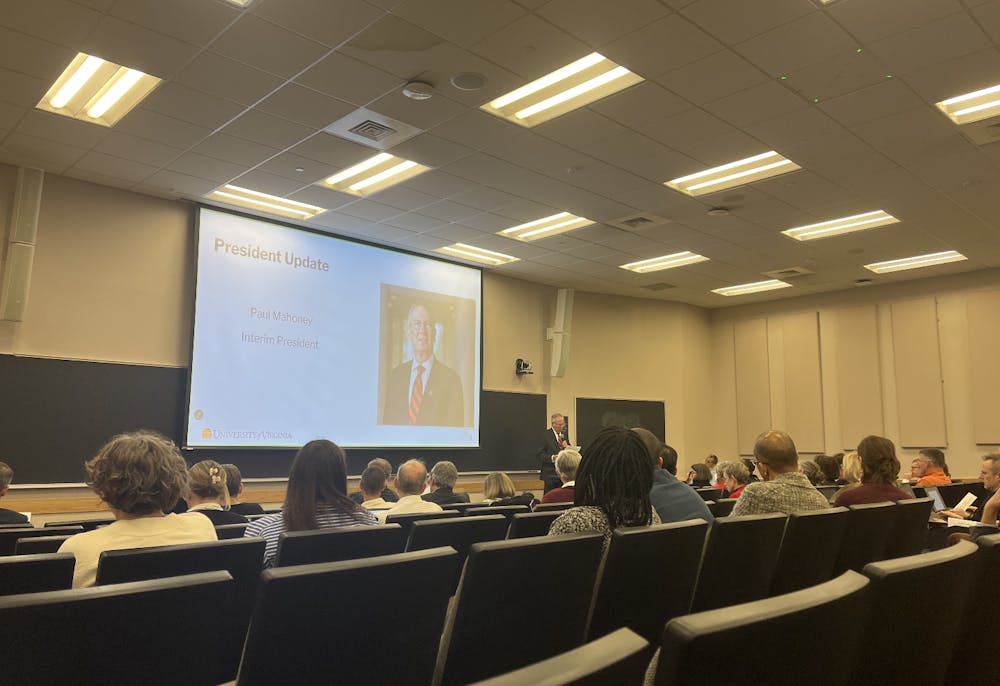
The Faculty Senate met Friday to discuss and pass a resolution expressing discontent with the timeline of the presidential search process. The resolution also called for finalist candidates to ask for a pause in the process, after a previous resolution had asked for a halt in the presidential search. Senators also heard updates from interim University President Paul Mahoney regarding an upcoming report to the Justice Department.
In his update, Mahoney shared that he is currently working on the first report which the University will provide to the Justice Department as part of the Oct. 22 agreement which suspended five investigations into the University’s compliance with civil rights law. The agreement requires that the University provide quarterly reports on efforts to comply with civil rights law as outlined in a guidance document issued to all recipients of federal funds by United States Attorney General Pam Bondi July 29.
Mahoney said that the first report will focus mostly on the U.Va. Health System and the McIntire School of Commerce, both of which have almost completed their reviews into compliance with civil rights law. A University-wide compliance review led by University Counsel began in late May to review all schools’ adherence to federal laws and the Board of Visitors’ vote to dissolve the Office of Diversity, Equity and Inclusion.
The report will also detail changes to policies and procedures that were made due to the findings of this review, according to Mahoney. He said that most of these changes involve removing language in program descriptions that previously discussed diversity, or including explicit statements that the University-sponsored program or activity does not discriminate on the basis of protected characteristics such as race, gender or ethnicity.
“To reiterate a point that I've made previously, diversity is a vague term, and the word itself doesn't convey illegality,” Mahoney said. “What becomes illegal is when a relevant program or activity treats people differently on the basis of protected characteristics.”
Mahoney also noted that employees actively involved in decisions regarding admissions, scholarships or student programs are receiving anti-discrimination training. Although he did not specify when this report would be submitted to the Justice Department, University Spokesperson Bethanie Glover said in a written statement that the University plans to submit the report in January. Mahoney noted that it will be made public following submission.
Law Prof. Andrew Block asked about the upcoming General Assembly session, which will begin in January, and whether decisions impacting the University will be affected by disagreements between the Board and state lawmakers. Gov.-elect Abigail Spanberger in November asked the Board to delay appointment of a president until she took office, and although the search has continued to move forward, it is unclear whether the Board plans to select a permanent president before her inauguration Jan. 17.
“Proceeding with the presidential search right now … seems like an unnecessary way to antagonize the new governor and legislators and [budget] appropriators,” Block said. “I just wonder what your view is? … What's the problem with waiting a couple months before we name a new person?”
Mahoney said that he has not and is not planning to advise the Board on the matter of the presidential search. He noted that although Spanberger has expressed that the Board should not use its authority to select a new president before she fills five vacant seats, outgoing Gov. Glenn Youngkin has publicly disagreed with her position.
“Anything that I would say would be interpreted as taking a stance politically on behalf of the University,” Mahoney said. “I think it is an extremely important thing for the president of the University of Virginia, whether it's interim or permanent, to focus on advancing our mission and staying out of politics. And I intend to stay out of politics.”
The Senate heard further updates on the ongoing presidential search from Faculty Representative to the Board Jim Lambert, who is also serving on the search committee. He noted that the search is in the hands of the Board but that during the search for former University President Jim Ryan, it took months to negotiate a contract following his selection.
“I don't see things developing in one day, one week, few weeks. Few months, maybe,” Lambert said. “But I don't have more data points than you.”
The Board has scheduled two meetings over the next month, one Dec. 19 and one Jan. 6, to discuss candidates for the position of president. The search committee also held a meeting almost entirely in closed session last Thursday.
The Senate later voted to pass a resolution on the presidential search timeline, which noted that the Board has continued the search despite requests from the Faculty Senate, nine University Deans and the General Faculty Council to pause. The resolution called for finalists in the search to ask for a pause in the process and passed with 44 in favor, 10 opposed and two abstentions.
“Any individual selected for the presidency under the current search timeline and by a Board that does not have its full complement of 17 members including 12 alumni and 12 Virginia residents should be aware they will not assume their position with the confidence of the Faculty Senate if hired as U.Va.’s tenth president,” the resolution read.
Currently, the Board has 12 sitting members after five Youngkin appointees were voted down by the State Senate Privileges and Elections Committee earlier this year. Currently, only nine of these 12 members are Virginia residents and only nine are University alumni, meaning that the Board does not meet requirements in the Code of Virginia.
Senators clarified that they were not asking candidates to publicly call for a pause, but instead to ask the committee and Board members to slow the search process. Assoc. Prof. of Data Science Brian Wright said that he hopes quality candidates are able to recognize the faculty’s calls for a pause.
“Those that likely have the most influence over whether this will continue or not are high quality candidates,” Wright said. “So I think [we] would want them to state to the search committee that if they were to take this job, that it would be better for them to wait.”
Block also expressed support for the resolution, calling the current search timeline “hostile” and said that the resolution asks candidates to ensure that the search process is consistent with the requests of University stakeholders.
It's almost like a hostile search process at this point,” Block said. “And the candidates for president are a party to it at this point.”
While many senators expressed support for the resolution, some voiced disagreement with the idea of passing it at all. Mathematics Prof. Peter Abramenko said that he felt the Senate had not spent enough time deliberating on whether they should move forward with the resolution.
“I just want to mention that I'm completely opposed to this resolution and that it is based on false premises,” Abramenko said. “It seems this body is so intent on criticizing everything with what the [Board] is doing that they even do not want to have a discussion about whether this resolution is adequate or not.”
The Senate additionally heard an update on the progression of the provost search which began in September from Scott Beardsley, dean of the Darden School of Business and provost search committee chair. The Senate passed a resolution Oct. 3 calling for a pause in the search until the University had a permanent president who could participate in the selection of a provost.
Beardsley said that the search is moving slowly, but that the committee’s collaboration is strong and that they have a good pool of candidates. Although initial interviews have recently begun, the committee is still accepting applications. Beardsley added that the committee had chosen not to pause the search because the current pace makes it likely that the next president will have the opportunity to participate in the process.
Two additional discussions focused on the extension of the Representation and Governance committee — a temporary committee established in Spring 2025 — and a new course materials platform the University plans to introduce, titled One Access.
The Representation and Governance committee was formed by the Senate to study how effective the Senate is as representatives for faculty and how it could play a stronger role in University governance. Judith Thomas, director of Faculty Programs at the University’s libraries, asked the Senate to extend the committee for a third semester, until May 2026, to finish its work and finalize a report on findings to the Senate. The extension passed with a vote of 57 in favor, four opposed and one abstention.
Thomas also discussed a new program proposed by the University bookstore, One Access, which would provide all required course materials in a digital format and at a flat price rate to all undergraduate students before the first day of classes. However, Thomas noted that she has concerns about pricing in the textbook industry.
“Publishers are moving to this model where they try to capture revenue from every school and every student who's part of this,” Thomas said. “So we have every reason to think the prices will go up no matter what they're like starting off [with the program].”
She noted that the Senate has collected questions from senators regarding potential implications of the program, which is currently planned for rollout in Fall 2026, which will be provided to the bookstore in the upcoming semester.
The Faculty Senate’s next meeting is scheduled for Jan. 23.
Read More

English department considers AI’s place in the classroom
By Lily Kostro | 2 days agoFor the University’s English department, some professors have chosen assignments that utilize AI in writing, while others take the approach of completely eliminating students’ access to generative AI in their writing process.

The Cavalier Daily joins amicus brief supporting student press at University of Alabama
By Jaylynn Perez | 2 days agoThe Cavalier Daily joined 39 other collegiate news organizations and 15 student editors from across the country in signing an amicus brief Sept. 2.

Student Council considers creating an ad hoc committee to review UBE proceedings
By Lucia Gambacini | 3 days agoConsideration of the bill was postponed until the next general body meeting.


