
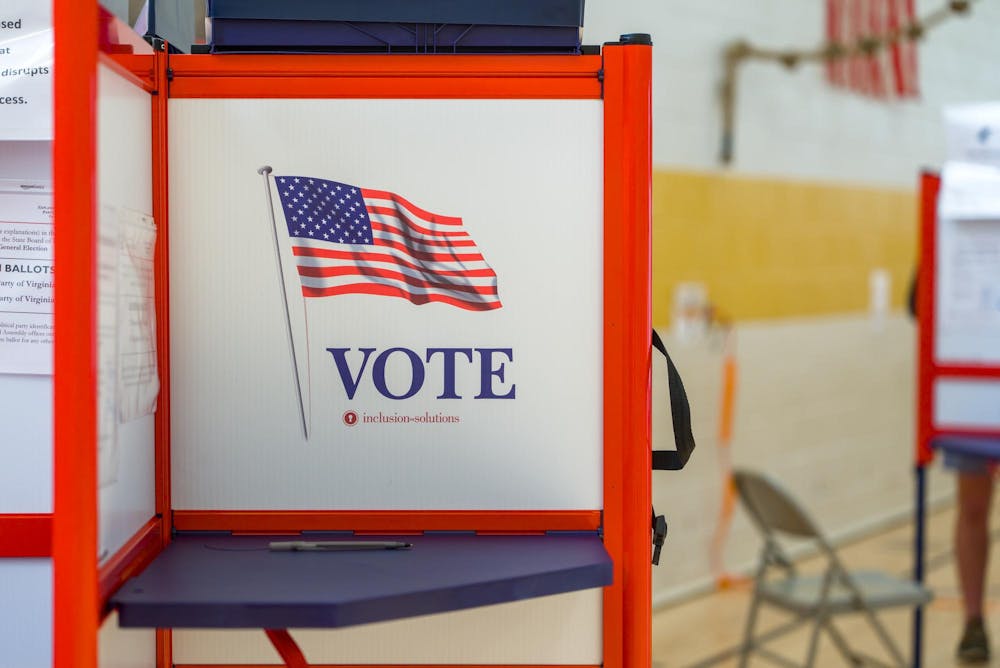
Early voting officially began Friday for the April 21 redistricting referendum, in which Virginia voters will decide whether the Commonwealth can join other states in a national mid-decade redistricting war. If voters adopt the amendment to Virginia’s constitution at the ballot box, it would allow a 10-1 Democrat-favored Congressional map the General Assembly unveiled last month to immediately go into law. However, the Supreme Court of Virginia has issued numerous rulings, affirming that while the vote can take place, the Court is reviewing the amendment’s constitutionality, and whether to nullify the result.
The amendment in question would give the General Assembly the power to bypass Virginia’s independent redistricting commission and pass new congressional maps of its own until 2030 in response to other states. The measure passed the Democrat-controlled General Assembly in January, but under Virginia law, voters now have the final say on its adoption. Proponents of the measure say that redistricting Virginia is essential to counteract mid-decade gerrymanders in Republican-led states at the urging of President Donald Trump.
Mid-decade redistricting efforts started in Texas, where Trump asked Republican lawmakers to redraw the state’s congressional map to disproportionately favor their party, in hopes that it would help maintain the narrow Republican House majority in the 2026 midterm elections. Democrats responded in California, where a state referendum passed in November that allowed the state to repeal its independent commission — the California Citizens Redistricting Commission — and pass a Democrat-favored Congressional map. Since then, Republican legislators in Missouri and North Carolina followed suit by passing Republican-favored maps of their own.
Senator Scott Surovell (D-34) said he sees the Republican gerrymanders as a direct attempt to silence the voices of voters in Democrat-leaning states like Virginia.
“President Trump and other conservative states have decided to turn the tables and weaponize redistricting in a way that … breaks the game … and marginalizes our state,” Surovell said. “I think the vast majority of Virginians want us to push back on that, which is why we want to give them the option to do so.”
Efforts to schedule the referendum, however, have been met with mounting legal challenges. Tazewell County Circuit Court judge Jack S. Hurley ruled with Republicans Jan. 27 in their lawsuit against House Clerk G. Paul Nardo and House Speaker Don Scott (D-88). Republican lawmakers argued that the General Assembly defied procedure as it advanced the amendment and put it to a statewide vote.
In Hurley’s decision, he ruled that Democrats in the General Assembly did not follow the proper timeline for passing a proposal. The Virginia Constitution says that in order for an amendment to be adopted, the General Assembly must vote to pass it before an election, then the newly-elected General Assembly must approve it again, at which point a referendum can be held. By the time the amendment first passed in October, Hurley agreed with Republicans that the election had already begun as millions of Virginians voted early. Hurley also found that Democrats incorrectly used a budget-focused special session to pass a constitutional amendment unrelated to that purpose.
Finally, Hurley ruled that Democratic lawmakers violated § 30-13 of the Code of Virginia, which required that Nardo send copies of the amendment to each city and county clerk three months before the 2025 elections so they could be displayed in public and in court. This did not occur given the amendment passed less than a week before Election Day.
The Supreme Court took up the appeal and ruled that the referendum could continue as it considers the amendment’s legality. The vote will therefore occur, but only on the condition that the Supreme Court could then nullify its results — which would happen if the “YES” option prevails, but the Tazewell ruling is upheld.
In a separate lawsuit, Hurley also found Feb. 19 that the language Virginia Democrats wrote for the referendum ballot is likely intended to mislead voters. The ballot question says that giving the General Assembly authority to pass new Congressional maps will “restore fairness in the upcoming [2026] elections.” Hurley granted a temporary injunction prohibiting Tazewell County election officials from preparing for early voting, but the Supreme Court lifted the injunction Wednesday.
Throughout the lawsuits, Democrats moved forward with efforts to draw and proactively pass a 10-1 Congressional map as part of the Virginia state budget, with Gov. Abigail Spanberger (D) signing it into law Feb. 21. This means that, if voters adopt the amendment, the map will go into effect immediately unless the Supreme Court intervenes.
The map, released by Democratic lawmakers Feb. 5, splits up traditional Democratic strongholds in Northern Virginia — which is now divided among five separate districts — and Richmond to ensure nearly every seat contains a large share of reliably Democratic voters.
The map would also change the Congressional District Charlottesville is located in, moving it from the current Republican-leaning Fifth Congressional District into the newly proposed, Democrat-leaning Sixth District — which would stretch from Charlottesville and Albemarle as far south as Roanoke. If the map is approved, the city will have a new U.S. Representative in 2027.
Both camps are already making their case to voters. Former Attorney General Jason Miyares (R) and former U.S. House Majority Leader Eric Cantor (R) are the co-leaders of the “Virginians for Fair Maps” campaign, the organization which is campaigning against the amendment at the ballot box.
“Virginians for Fair Maps” is a strong proponent of Virginia’s current independent commission, which places an even number of Democrat-backed and Republican-backed members on a special committee tasked with drawing new congressional and General Assembly lines every decade. Eight of the 16 members on the commission are legislators from either party and eight are citizens. The commission, however, was unable to pass new maps in 2020 due to deadlock and the Supreme Court drew the maps instead. VFM says the 2020 referendum, which overwhelmingly passed and created this commission, is a clear sign of voters’ wishes for independent redistricting in the Commonwealth.
Surovell, however, said that he believes the national redistricting scene has changed since the independent commission was first established. He argued that in 2020, Virginia was one of several states taking steps to adopt independent commissions, but that recent redistrictings in other states have altered how the Commonwealth should respond.
“When the commission was adopted, most Virginians thought that other states would treat us fairly,” Surovell said. “Many states were also moving towards adopting … non partisan commissions [of their own]. What we discovered was that in the meantime, President Trump … decided to turn the tables and weaponize redistricting.”
The case for the amendment is being made by the Democratic “Virginians for Fair Elections” campaign, which has a significant funding advantage after receiving $21 million in donations from Federal House Democrats’ House Majority Forward PAC and other nonprofit advocacy groups. VFM, in contrast, reported less than $300,000 in donations as of Wednesday.
In a statement released on X shortly after Democratic legislative leaders unveiled the map Feb. 5, Miyares expressed disapproval with the proposal, arguing that it was drawn in defiance of the initial Tazewell ruling.
“[Democratic legislators] have created this map illegally — in defiance of a court order,” Miyares wrote. “They have shattered communities, destroyed common interests and trampled state interests all to satisfy the radical left’s lust for power.”
Democratic lawmakers continue to argue that their new map is a way of “leveling the playing-field” on a national scale, including Sen. Creigh Deeds (D-11) who shared a statement with The Cavalier Daily in February.
“A gerrymander is in the eye of the beholder,” Deeds said. “The map is not pretty, but the stakes are high and we have to protect the Republic.”
There is no deadline to register to vote in the referendum and same-day registration will be available. Voters who register after April 14, however, must cast a provisional ballot.

Edward Christopher is a staff writer on the news desk as well as a member of the advertising team for The Cavalier Daily. He is a second-year Commerce student from Northern Virginia. Edward enjoys covering state politics and University developments.

Luca Bailey is a third-year Politics student from Free Union, Va. As a staffer on the news and video desks, he has covered topics ranging from the General Assembly and state elections to local politics and University governance. He is also The Cavalier Daily’s beat writer for the Charlottesville City Council.
Read More

University launches new Program in Digital Humanities and AI
By Naren Senthilkumar | 19 hours agoAccording to the University’s website, the program is intended to function as a coordinating hub for the College's digital, computational and AI-based approaches to humanistic inquiry.

U.Va. Health Emergency Department among most expensive trauma centers in Virginia
By Michael Racz | 20 hours agoIn comparison to other nonprofit level 1 trauma centers in Virginia, the University Medical Center had the highest self-pay rate — the amount charged to patients who pay out-of-pocket rather than through insurance — for Emergency Department facility fees and was among the most expensive for other treatment services, including CT scans and various blood tests, based on published pricing data.

Mona Sloane joins U.Va. Law for a discussion of her book on AI and sociology
By Edward Christopher | 20 hours agoSloane runs the Sloane Lab at the University, an interdisciplinary research group focusing on the intersection of artificial intelligence and cultural, economic, material and political conditions.


