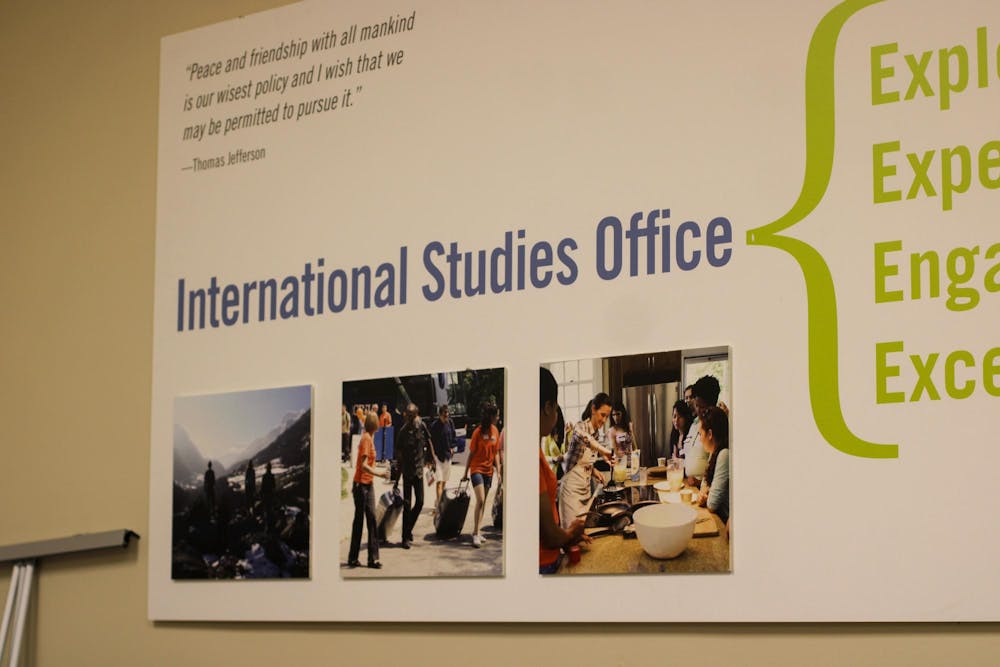
Numerous international Iranian students at the University have begun experiencing difficulties with their student visas due to a series of travel bans and the suspension of the issuance of student visas to Iranian citizens over the past few months. According to representatives from the International Studies Office, the ban on issuing student visas is prompting many students to consider extending their studies at the University to remain in the United States.
According to Adrienne Kim Bird, associate director for the International Students and Scholars Program, there are currently 49 Iranian international students enrolled at the University. 48 are in graduate programs, and one is an undergraduate student.
A travel ban on Iranian citizens has been in effect since Jan. 1, prohibiting entry into the U.S. for those without an active visa. Additionally, Jan. 1, the U.S. stopped issuing all F-1 and J-1 student visas — the specific type of student visa that the vast majority of Iranian national students have historically utilized to study at the University, according to the ISO.
On Feb. 28, the U.S. and Israel conducted a series of strikes on Iran, citing hopes of pressuring a regime change within the country. Strikes on Iran continued throughout March and into April before President Donald Trump announced a two-week ceasefire April 8 under the condition that Iran reopen the Strait of Hormuz. The ceasefire is still in place and does not have a set end date.
In a written statement to The Cavalier Daily, Reza Ghorbani, president of the Persian Students Association, said that for many Iranian international students in the U.S., immigration policy extends beyond an abstract idea presented as legislation in Washington, D.C. He said it affects how University students plan for graduation, look for job offers and plan trips to see their families.
Ghorbani wrote that for many Iranian international students in PARSA, having to travel home for events such as family emergencies, weddings or funerals has “become a one-way exit,” as students are unable to obtain a visa to reenter the country.
“The long-term effects are harder to measure but no less serious. A degree is supposed to open possibilities,” Ghorbani wrote. “For affected students, it may instead lead [to] a prolonged state of uncertainty — delayed work authorization, postponed residency or research positions, stalled green card applications, disrupted family reunification and fear that lawful presence still offers no reliable path forward.”
According to Kim Bird, Iranian students have historically had a more difficult time than other international students obtaining student visas — in part due to the absence of a U.S. Embassy in Iran. This means that in the past, students have had to travel to another country in order to apply for and receive a student visa.
Kim Bird also said that, in addition to having to travel to other countries to obtain visas, Iranian students have historically only been issued single-entry visas, so if they entered and left the U.S., they were unable to return to the U.S. without reapplying for a new visa.
However, following the travel and visa issuance bans, Iranian students can no longer receive F-1 or J-1 student visas regardless of whether they travel to a U.S. embassy in another country to apply for one, Kim Bird noted. Kim Bird also said that Iranian international students on F-1 visas can no longer receive Optional Practical Training benefits after graduation, as the paperwork for those students is no longer being processed.
OPT benefits allow students who have been studying in the U.S. on an F-1 student visa to work in the U.S. in a field related to their major after completing their academic studies.
Kim Bird said that the compounding effect of a halt in visa issuance and a pause in OPT processing puts Iranian students in a difficult position as they try to figure out how to remain in the U.S.
“These travel bans … and also [the fact] that they have stopped issuing visas at all to Iranian students, might have been less of a problem if they were also processing … OPT applications,” Kim Bird said. “But now there's been a pause on even that benefit, so it really puts those students in a difficult situation.”
Kim Bird also noted that the only feasible path the ISO has come up with to allow students to continue staying and studying in the U.S. is to extend their academic programs at the University for as long as possible. She said, that way, students maintain their immigration status because they are still enrolled in school.
One student graduated from their Ph.D. program and has a job offer, but cannot take it because the U.S. is not processing work authorization for Iranian international students, according to Kim Bird. She said that the particular student is considering pursuing another degree to remain in the U.S.
Kim Bird highlighted that the stress of trying to figure out how to legally remain in the U.S. is adding to Iranian students’ stress over the ongoing conflict in Iran.
“It's [a] really, really difficult and complicated situation for [Iranian international students], and this is, of course, compounded by the stress of having a war going on in their home country. It's very hard to communicate with family and friends [in Iran],” Kim Bird said.
Ghorbani also called for more institutional support for Iranian international students facing visa issues, citing international students as central to University life.
“Universities should not treat this as a niche immigration issue,” Ghorbani wrote. “International students are not peripheral to campus life — they teach, publish, conduct research, mentor undergraduates, pay tuition, build communities and strengthen the University’s academic reputation. When policy freezes their futures, the University loses too.”
In addition to challenges for students currently enrolled at the University, Kim Bird said that some Iranian international students admitted in the last admission cycle have had to defer their admission until they are able to successfully apply for and obtain student visas at a later, undetermined date.
The ISO is currently working closely with NAFSA — an international non-profit organization that works in international education exchange — to ensure the office fully understands the new and rapidly changing policy affecting international students, Kim Bird said. She also said the ISO works with immigration lawyers to ensure full compliance with the law when working with international students.
Kim Bird said she is hopeful that things will improve for Iranian international students in the future, but there is still much uncertainty ahead.
“I think it's going to be very challenging for a while. I think it's going to take some time … We'll see what happens at the midterm elections,” Kim Bird said. “All I can say is I really hope things improve in two or three years, but it's really hard to predict, and I think it's gonna take a lot of time to undo the damage that's already been done.”
Michael Racz is a staff writer on the news desk. He is a second-year College student majoring in biology with plans to go to medical school. He enjoys writing about health topics and student self-governance.
Read More

Tao Tan discusses financial future of U.Va., rising college tuition trend nationwide
By Lily Kostro | 14 hours agoTan explained how tuition costs will shape the future of academic institutions such as the University.

U.Va. Health cuts scribe hours as AI documentation tools expand across Health System
By Vrinda Vashisht | 14 hours agoScribes in the undergraduate medical scribe program said in interviews with The Cavalier Daily that a new emergency department schedule that began Sept. 15 has reduced or eliminated certain scribe shifts and has decreased scribe availability to clinicians in the Emergency Department.

How does the Honor Committee manage its endowment?
By Isabela Delgado | YesterdayThe Honor Committee manages an endowment upwards of $200,000, and for its 2026-27 academic term, it has budgeted $204,500 — just over its available endowment.