
Among the most consequential decisions a college student must make is selecting a major. Selecting the “right” major is often a stressful decision for many students, but besides its impact on one’s academic trajectory and future career opportunities, some major choices become a source of lasting scrutiny from peers and family alike.
Majors with clear career pipelines — particularly those in STEM fields — Science, Technology. Engineering and Mathematics — are generally praised as practical and lucrative. On the other hand, disciplines like the humanities are frequently dismissed as a waste of time, or even useless, due to their lack of direct career paths and lower immediate return on investment.
Because liberal arts and humanities degrees often focus on critical thinking, communication and analytical “soft skills” in lieu of more technical or easily quantifiable training, many humanities students feel compelled not only to defend the value of their education, but also to fight to be viewed as an essential field of study within the University.
Caroline Quiroga, fourth-year College student double-majoring in history and religious studies, chose her majors not for their marketability, but out of a longstanding fascination with the subjects and a deep appreciation for their intellectual rigor. Unfortunately, her decision to focus on these fields was not universally embraced by her community. She recalled the pushback she received from her grandfather — an engineer — about her choice of study.
“He used to say to me, if something has a ‘studies’ at the end of it, you can do it on your own. You don’t need it. You don’t need a liberal arts degree,” Quiroga said.
Beyond Quiroga, several of her counterparts also report feeling the need to justify their choice amid others’ concerns about its practicality. This widespread impulse raises a larger question — why does such a hierarchy of disciplines exist in the first place?
Eli Boone, fourth-year College student double-majoring in philosophy and English, attributes negative attitudes towards humanity majors largely to career anxiety — the growing uncertainty among students about post-graduate job prospects. Boone, who plans to attend law school after graduation, chose his majors out of a genuine love of reading, writing and grappling with complex ideas. Even so, he acknowledged that the humanities often lack the linear professional pathways that give other fields their perceived legitimacy.
“I think part of [the anxiety] is that there aren't really robust career outcomes tied to the major itself,” Boone said. “And part of that, I think, is there are ways to justify [humanities majors], by going to law school [or] by going back into academia, but I don't think you see immediately the same clear connection towards well-paid jobs.”
Quiroga noted that much of the blowback against humanities fields similarly stems from this pattern of unclear career and job outcomes.
She cited an interview she conducted with a professor at the University, in which the professor discussed his experiences teaching Engagements courses with first-year students.
“He was like, ‘It’s disheartening because you want to teach these kids how to want to learn and engage with an interesting thing. All they want is money. All they want to do is [investment banking],’” Quiroga said.
Beyond the career and financial anxieties Boone and Quiroga describe, Sophia Shearman, fourth-year College student and media studies major, said there is a significant misunderstanding of what skills are cultivated in the humanities. Drawing on her own experiences, Shearman said a hierarchy is sustained from a failure to recognize distinct, yet equally important, skills cultivated in the humanities.
“I think now there's a huge, almost miscommunication, between tangible skills taught through the traditional commerce [or] pre-med [tracks] as being somehow more worthy of a place in education than theory and critical thinking and philosophy, [where] you're building relationships between literature and theory in your mind,” Shearman said. “I don't think people can understand that unless they're studying it.”
Students taking advantage of the many humanities programs offered by the University are part of a thriving academic community, which ranks No. 1 in the nation for producing liberal arts degrees among R1 universities — institutions classified as conducting the highest levels of research activity. Additionally, several of the University's individual humanities programs have earned national recognition. The philosophy program, for example, has placed fourth in the United States for philosophy majors in some rankings, while the graduate English program placed 11th nationally in 2021.
Quiroga echoed Shearman’s sentiment, underscoring the importance of the non-tangible skills that can be gleaned from a liberal arts course of study. Rather than confining students to a single highly-technical track, she argued that a wide-ranging course load cultivates a deeper understanding of the world.
“Eventually you’re going to get to a point where you want to learn [about] the nitty-gritty of our world. … Eventually people crave to know about the world around them. And that’s not all driven through math and science,” Quiroga said.
Despite the personal and intellectual value students report gaining from studying the humanities, federal research funding remains disproportionately allocated to the University’s STEM programs over its humanities disciplines. The University received nearly $570 million in sponsored awards in 2025 alone. Because federal research dollars are largely directed toward science-based fields, there is greater external grant activity in STEM and health disciplines than in the humanities at the University. Shearman was candid about the message this sends to students.
“I think it's absolutely sending off a message loud and clear that these are the dominant programs that we will support securing funding,” Sophie said. “These [STEM programs] are the institutions that we will consider valuable funding. And these [humanities programs] are just the other things that we have at the school … [this] is so exhausting sometimes when you're just shouting through this void to be noticed and to be taken seriously.”
Similarly, Claudia Hunn, third-year College student majoring in drama and English, noted a significant disparity between arts buildings and sites of other disciplines — like the sleekness of the new Contemplative Commons, new McIntire School of Commerce buildings and the School of Data Science. Hunn mentioned specifically that some classrooms and facilities in the U.Va. Drama Department building are extremely outdated in comparison, with 1970s-style wood paneled walls and crumbling infrastructure.
“It makes you wonder what those resources [could] do if funneled into a [Drama] program that, albeit small, has a really dedicated student base that can and does a lot for U.Va. and the Charlottesville community,” Hunn said.
Despite this difference of funding, students note the continued value of studying humanities subjects. Shearman, for instance, described some of the concrete skills and experiences she has gained in her upper-level classes in the media studies department.
“[In] class, I realized that I needed to get my research skills together fast, and I needed to sharpen them,” Shearman said. “I needed to know what to look for, what is scholarly, who I should trust and what kind of scholars I should really be seeking.”
Boone also noted the applicability of skills he has gained through his majors, particularly the ability to create a compelling argument and communicate effectively. He described the relationship between his fields as complementary, with each building off of and strengthening the other.
“Philosophy is kind of like the bones, and English is the rhetoric that puts it all together and makes it personal and … persuasive,” Boone said.
Such skills as Boone and Shearman’s ability to communicate, argue and adapt are becoming a “competitive edge,” perhaps underscoring a crucial workplace gap that scholars of the humanities may be able to fill. These “soft skills” are in high demand, especially in an age in which employers overwhelmingly seek employees with strong foundational and “people” skills.
“It starts in the classroom. I think it’s where you really learn how to formulate an argument, how to use evidence to analyze your evidence. That is also fundamental to everyday life,” Quiroga said.
Similarly, Hunn highlighted some of the benefits of competitive workplace skills gleaned from a liberal arts education, noting the unique blend of practical, quantifiable and soft skills that she has continuously developed within her education as a drama and English major.
“I think that the major has been invaluable, not only for the soft skills, but also the hard skills — I’m going to learn how to manage a timeline and set all of these action items and communicate with people [to] make this product happen,” Hunn said.
Despite the lack of linear outcomes, facing judgement from peers and continued funding imbalances, students like Boone, Hunn, Quiroga and Shearman said they find intense value and joy from their studies in the humanities field — pushing back on the idea of a “useless” major.
“Yeah, I just love what I study. And I think that kind of finishes the conversation — to be like, I have no doubts. Eventually, I know I will do something that I enjoy,” Quiroga said.
Read More
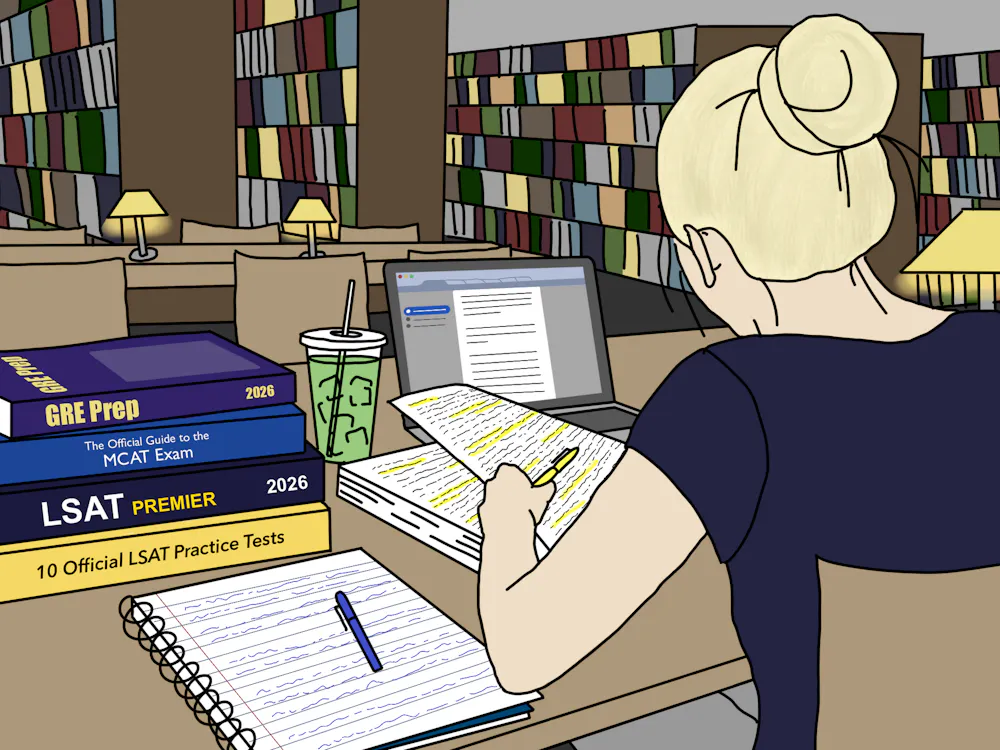
The graduate admissions exam grind
By Charley Thomas | YesterdayJust when University students think they have left the prep-work perils and score obsessions of standardized testing back in high school, entrance exams for graduate program applications ring in round two.

No longer the new kids on the block
By Phoenix Banks | 3 days agoAs second year begins, different pressures and stresses — from academic comebacks to harder classes — plague the Class of 2029.

After a year of tech, University students spend the summer offline
By Phoenix Banks | 3 days agoThese students felt that analog hobbies — passions that are independent of technology — not only bring entertainment, but also help relieve tension from the prior academic year while passing time over the summer.