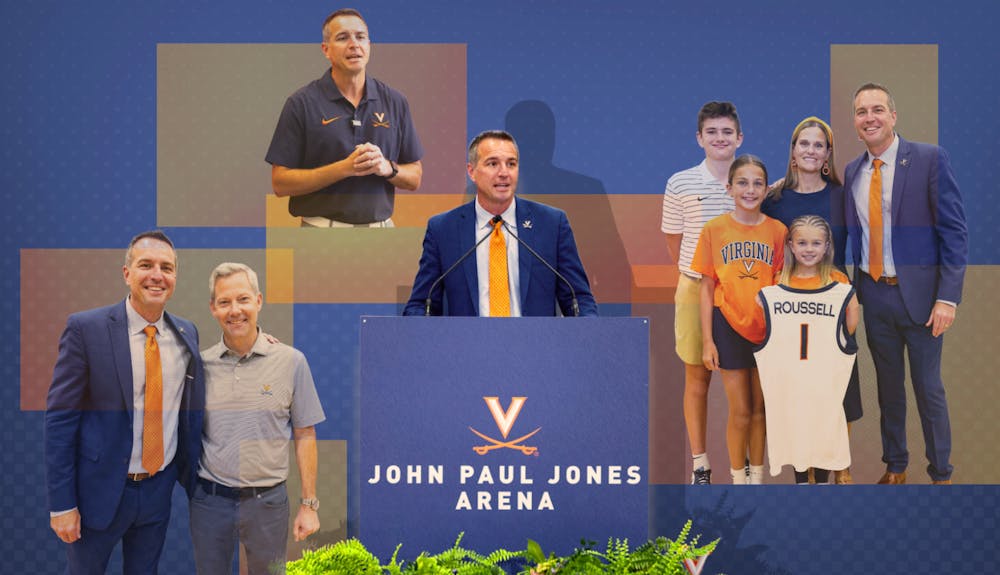
Virginia’s new women’s basketball head coach offered an unexpected concession when asked about sustaining a program’s success at his introductory press conference.
“I know that C-word is overused a lot, and it used to mean something different,” Roussell said, leaning over the podium as fans donning orange and blue watched with anticipation.
In the modern coaching lexicon, “culture” is the ultimate catch-all phrase — a convenient, if hollow, explanation for everything about a team from locker room dynamics to winning games. But for the program’s new figurehead, the word itself has lost its teeth. Rather than hiding behind a cliché, Roussell is stripping the term back to a more authentic version.
“You still need work ethic,” Roussell said. “You know, the standards that we allow, the expectations that we have … We're aligned on how quickly we want to [succeed], but I think you have to establish the expectations and standards right away.”
The term’s distinction to Roussell is operational. Building a program to its highest potential has little to do with a buzzword and everything to do with standards that actually hold. He frames it as a “parenting lesson,” in which players will meet the ceiling that is set for them — whether that goal is as simple as battling for a rebound or as lofty as winning a national championship.
For Roussell, sustaining those standards starts with the people positioned around him.
“[There are] no one-man projects, I'm just [like], ‘Hey, walk with me,’” Roussell said. “‘Write this stuff down, let's try to pursue this.’”
Roussell’s vision hinges on collective investment. During his Division III tenure at Chicago, he already faced the reality of operating with limited resources, which often required him to absorb a vast range of responsibilities. His Division I experience later on allowed those responsibilities to be distributed across a support staff. Roussell wants voices, delegation and people he trusts to share the load in a way that makes growth both expected and sustainable.
The challenge is executing that vision in an ultra-competitive conference and an era where patience is rarely afforded.
“I think the delegation and just having the right people, I'm very comfortable we have the right people that are making things happen,” Roussell said.
That same emphasis on collaboration extends to how Roussell builds his rosters. In a landscape where the transfer portal can alter a team’s entire makeup and trajectory overnight, Roussell seeks a more lasting formula. Rather than chasing the annual portal overhaul, he anchors his programs around “development and retention” — his two key words that describe not just recruiting players, but building them into professionals.
On the court, Roussell characterizes his teams’ play as a motion-based system built on constant movement and fluidity. He said that although the system may appear incomplete early in the season, the style sharpens over time as the team plays with more synergy, with its best basketball arriving in the season’s final stretch.
Roussell’s formula is already beginning to take shape in the roster. Two-time All-ACC junior guard Kymora Johnson’s decision to withdraw from the transfer portal and return to Virginia offers an early foundation — in both talent and continuity — alongside a growing group of returners, a transfer commit and an incoming freshman addition. Though a very early snapshot of the 2026-27 season, the roster already signals a program being deliberately layered.
“I think the selling point is the power to win here,” Roussell said. “The development that I think our staff feels comfortable doing to make people [professionals] … that’s something we really took to heart when [the NCAA] changed things the last three or four years. I want to develop [professionals].”
At Richmond, the model produced back-to-back Atlantic 10 titles, three consecutive NCAA Tournament appearances and two conference Coach of the Year awards. Moving to the Power Four, Roussell is betting it can scale.
“I think the best model that we would like to have is what we had going on at Richmond, getting good high school players in here and developing them,” Roussell said. “Once we navigate this season … let's supplement that with the portal, rather than feel like you're having to reconstruct the team in the program with the portal.”
His philosophy arrives at a Virginia program searching for enduring success in a highly competitive conference capable of unraveling years of progress. The expectations are immediate, though his vision is built on a longer timeline for development, which makes Roussell’s rebuild particularly difficult to execute. Even though relying heavily on the portal provides a quick fix to these expectations, Roussell is actively fighting the cycle of perpetual reinvention.
Perhaps more importantly, despite over two decades of head coaching, Roussell is not arriving at Virginia with a fixed blueprint. He is far more interested in evaluating what works right now than replicating what has worked for him before.
“I used the analogy last week … you're a restaurant owner, you're taking over a new business,” Roussell said. “You're not changing the whole menu, right? There's probably some things that worked a little bit … It was an assessment of what was working, what was great. It was very obvious from the student-athletes what was great.”
Roussell is selling the collective pursuit of winning potential, led by a coach who is willing to learn how to get there. That culture may not sound substantive, but its substance lies in enforced standards, shared responsibility and player development over time — all of which will be tested as the team takes shape in Charlottesville.
“Twenty-two years into this, there's nothing I'm married to,” Roussell said. “There’s nothing in order of business, of how I do this. You're supposed to be a lifelong learner in every business. That’s in college basketball to a T.”
Read More

While you were gone, Virginia sports kept moving
By Eleanor Lynch | 2 hours agoSo, if your mind was elsewhere this summer, consider this your Virginia Athletics catch-up — because the Cavaliers gave us a lot to talk about.

2025 was a banner year for Virginia football — what awaits the program in 2026?
By Ben McNiff , Theo Moll , Ryan Weiner and Drew Dillman | YesterdayThe Cavaliers are looking to repeat their successes from the previous year despite a new team and a new schedule.

‘Very uncharacteristic’: No. 11 Virginia men’s soccer drops second straight game to open season
By Michael Liebermann | 2 days ago“Sebastian Pop never makes that mistake,” Gelnovatch said. “Never makes that mistake. Never makes that mistake."