Correction: A previous version of the article incorrectly stated that the University-owned pocket park is located at the intersection of W Broad Street and Jefferson Park Avenue. The pocket park is located at the intersection of W Main Street and Jefferson Park Avenue. The article has been updated to reflect this change. A previous version of this article also incorrectly stated that Brodhead's Dec. 11 decision used a map of the University’s full property lines as the starting point for the radius. Rather, Brodhead used a map of the areas of the University that were excluded from the city when the 1948 City Charter was written, which is the land owned by the University as of Jan. 1, 1939. The article has been updated to reflect this change.
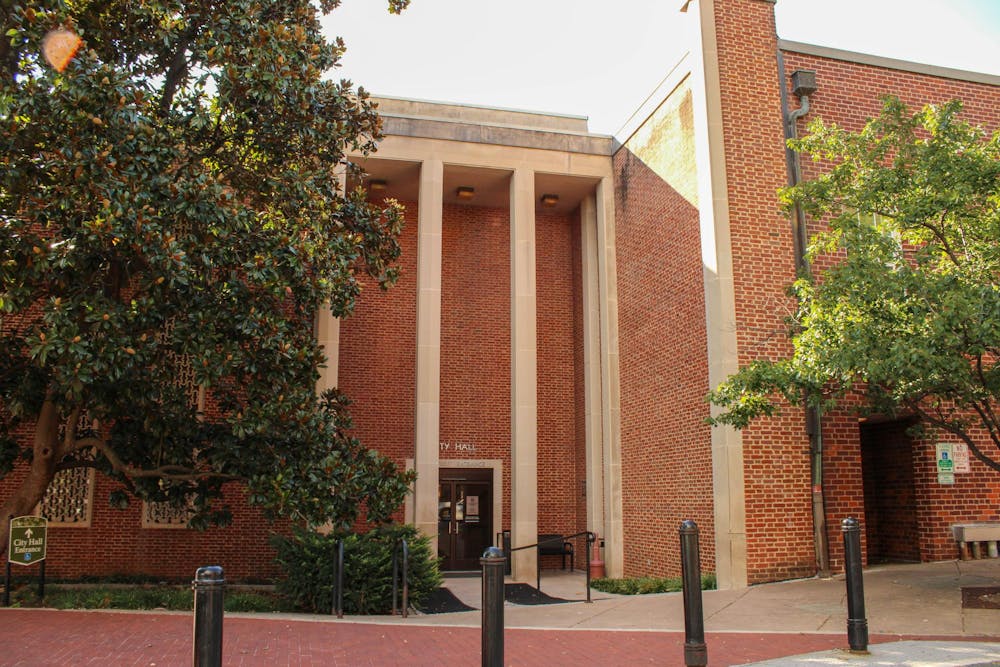
The Charlottesville Board of Zoning Appeals convened at City Hall Thursday and ruled that “The Mark at Charlottesville” — a proposed private apartment complex in the historically Black neighborhood of Fifeville — qualifies for student housing incentives. The BZA — a quasi-judicial city board composed of five members that considers appeals against the city zoning administrator — upheld a decision by Zoning Administrator Read Brodhead. He ruled that the project would be located within half a mile from Grounds, thus qualifying as a “student housing” project.
LCD Acquisitions — the private developer based in Athens, Ga. — will now be eligible to pay a reduced fee of roughly $149,000 per unit into the Charlottesville Affordable Housing Fund, a grant program that provides funding to nonprofits and developers “for the creation, preservation and rehabilitation” of affordable housing in the City. Had Brodhead’s determination been overturned, LCD would have either been responsible for paying an increased fee of roughly $337,000 per unit or incorporating affordable housing units into The Mark.
The BZA previously deadlocked in a 2-2 vote on the appeal at a meeting March 19. The appellant, Fifeville resident Paul Reeder, argued that under the City’s Affordable Dwelling Unit Monitoring and Procedures manual, a student housing project must be located within a half-mile radius of the “main campus areas” of North and Central Grounds. As a starting point for the radius, Brodhead’s Dec. 11 decision used a map of the areas of the University that were excluded from the city when the 1948 City Charter was written, which is the land owned by the University as of Jan. 1, 1939. Reeder argued that the language “main campus areas” meant certain University-owned parcels — such as a 15-acre pocket park located at the intersection of W Main Street and Jefferson Park Avenue — should be excluded from the definition of Central Grounds and the radius should be contracted.
Had the pocket park not been considered part of “Central Grounds,” The Mark would not have fallen within the half-mile radius. In response to the deadlock, Reeder asked to have his case deferred to Thursday until all five BZA members could be present.
BZA Member Elizabeth Lynn, who was absent from the previous meeting, was present Thursday, which put an end to the deadlock and allowed her to cast the deciding vote. She expressed agreement with fellow BZA members Hosea Mitchell and Joshua Krahn that Brodhead’s determination of the main campus areas was defensible. While Lynn said that she believed the previous meeting illustrated there are “many reasonable ways” of interpreting the University’s main campus areas, she stressed that as per §15.2-2309 of the Code of Virginia, the burden of proof fell on Reeder to prove Brodhead’s determination was incorrect, which she did not believe Reeder did.
“I did not find that Mr. Reeder rebutted the presumption of correctness in Mr. Brodhead’s determination,” Lynn said. “For this particular parcel, I think that Mr. Brodhead made a reasonable determination.”
However, Lynn expressed hope that Reeder’s appeal could draw attention to a “larger question” about how the Charlottesville City Council designates which parcels fall within the radius to ensure “greater clarity” for concerned residents moving forward.
The appeal took place amid concerns from community members that private student housing projects like The Mark and the LV Collective proposal on West Main Street contribute to gentrification of historically Black neighborhoods nearby by attracting subcommunities of students and raising the cost of living. City residents are also concerned that the seven- and 11-story projects will block sunlight from residents of Fifeville and 10th & Page. In his appeal, Reeder said that he believes measures like the half-mile radius are meant to discourage private student luxury housing sprawl.
Several Fifeville and 10th & Page residents appeared March 19 to speak in support of Reeder’s appeal, echoing these concerns. Speakers, including University students and faculty, also told the BZA that they do not believe members of the University community would regard the pocket park as part of Central Grounds.
Some, such as Fifeville resident John Mason, argued that historical considerations, such as the gate Thomas Jefferson had built at the end of the “Long Walk” — a historic walkway from the Rotunda to the Corner — should inform the definition of Central Grounds. Others, such as fourth-year College student Abba Kodiaga, noted spatial factors, such as The Mark's distance from actual classes for potential residents as a primary concern with Brodhead’s ruling.
The other four BZA members present indicated that their positions had not changed since the March 19 hearing. Chair Genevieve Keller, who voted against Brodhead’s decision to classify The Mark as student housing, read a prepared statement explaining her vote. In the statement, Keller said she agreed that the public comment last month highlighted there is “no consensus” among community members about what constitutes Central Grounds. Noting that the City does not have an official map of Central Grounds, Keller said that she believes it is ultimately an internal term used by the University that is easily subject to change. Unlike Lynn, Keller indicated this ambiguity convinced her to vote against Brodhead’s decision.
“[Central Grounds] appears to be a generic term that means different things in different places to different people and in different usages,” Keller said. “As I consider this case, I've come to the conclusion that there is no clarity about what Central Grounds means in a land use context [for] the city of Charlottesville.”
Lynn, Mitchell and Krahn voted for a motion to uphold Brodhead’s determination classifying The Mark as student housing. Keller and Vice Chair Sakib Ahmed voted against the motion. After the meeting, Reeder told The Cavalier Daily that while he was “disappointed” by the outcome of Thursday’s vote, he is considering options to further appeal Brodhead’s decision. Under §15.2-2314 of the Code of Virginia, Reeder may appeal this decision to the Charlottesville Circuit Court and has 30 days to file with the court’s clerk if he wishes to do so.
LCD must also successfully appeal a decision by the Board of Architectural Review to the Council in order to build The Mark. The BAR denied the project a Certificate of Appropriateness — which it must obtain to build the project next to two historic buildings — in December amid concerns about the project’s potential to displace Fifeville residents.

Luca Bailey is a third-year Politics student from Free Union, Va. As a staffer on the news and video desks, he has covered topics ranging from the General Assembly and state elections to local politics and University governance. He is also The Cavalier Daily’s beat writer for the Charlottesville City Council.
Read More

U.Va.’s planned data center expands $30 million amid statewide debate over energy use
By Jaylynn Perez | YesterdayThe project has grown since it was initially approved by the Board of Visitors in June 2025 as a $72 million, two-story data center facility.
School of Medicine welcomes Class of 2030 with annual White Coat Ceremony
By Michael Racz | YesterdayThe ceremony is a longstanding tradition in medical schools across the country in which incoming first-year medical students receive their first white coat as they enter the medical profession.
From the Archives: 1990s
By Tori Vonderheid and Livia Shrednick | 2 days agoUniversity physician Dr. Joel Trugman discovered that some children who had been diagnosed with cerebral palsy, an incurable movement disorder, instead have a rare biochemical disorder that is treatable.