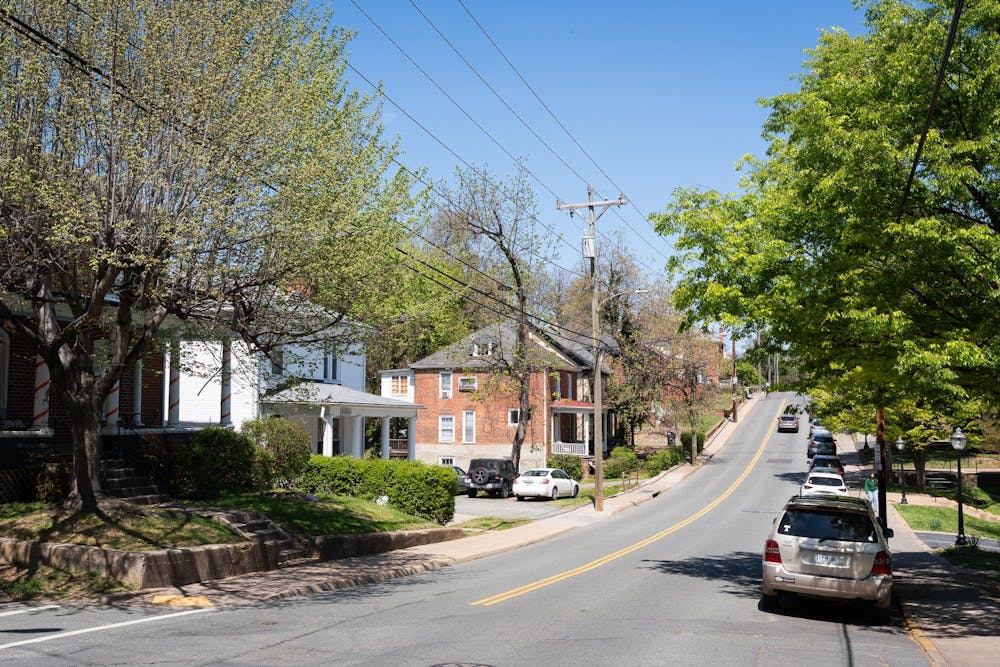
For the more than 10,000 undergraduate students who live off Grounds, privately-developed “luxury student apartments” are among an expanding set of housing options. Examples include the Flats at West Village, built in 2014, the Lark on Main built in 2016 and Yugo Crestline, constructed in 2018. All are located on West Main Street — roughly half of a mile from Grounds. With total rent and fees ranging from anywhere between $800 to over $2,000 a month, these apartment options feature student-focused features such as fully furnished apartments with individual leases, and luxury amenities include gyms, clubhouses and pools.
Tucked away behind the six-story Yugo Crestline building sits the community of Westhaven — Charlottesville’s oldest public housing site. The city government built the 126 affordable apartment units in 1964 to house displaced residents of Vinegar Hill — a majority Black neighborhood which the Charlottesville Redevelopment and Housing Authority demolished as part of post-World War II urban renewal efforts to revitalize American cities. Westhaven is also located within the broader 10th and Page neighborhood — Charlottesville’s largest continual African American community.
Joy Johnson, founder of the Charlottesville Public Housing Association of Residents, has lived in Westhaven for 43 years. She is among a growing number of residents expressing concerns with the onslaught of private student housing projects nearby. Johnson told The Cavalier Daily that the structures are imposing, encroaching into Westhaven and gentrifying the 10th & Page neighborhood — changing its character such that wealthier residents are attracted to the area, increasing the cost of living and forcing working-class residents to move.
“I feel like we have lost the 10th and Page neighborhood,” Johnson said. “It’s like U.Va. is a cancer … it just metastasize[s].”
Concerns about gentrification in the city are not a new development. Amidst a city-wide affordability crisis, 10th & Page, Fifeville and other historically Black neighborhoods in Charlottesville have experienced rapid declines in their numbers of non-white residents.
Charlottesville City Council Member Michael Payne told The Cavalier Daily that he views concerns from community members about displacement as “very legitimate” and “important.” He explained how this “gradual economic transformation” of student-related gentrification occurs in the city. He added that the trend occurs when private student housing encroaches into the local neighborhoods and creates business incentives to cater to University students instead of working locals.
“The highest and best business use will become things that cater to U.Va. students,” Payne said. “You'll see the price point and type of businesses change.”
In an interview with The Cavalier Daily, Charlottesville resident Ben Heller also pointed out that Charlottesville, like many college towns, has a population of students whose “spending power is disconnected from the labor market.” This means that higher-income students can support expensive housing projects that would otherwise struggle with a lack of demand.
“In a normal place, you live there, you work there [and] if the wages don’t support the housing prices, [then] prices can’t be high,” Heller said. “[Charlottesville has] a lot of people who are retirees or remote workers … or … students, and none of these people are connected to the labor market.”
PHAR Executive Director Latricia Giles said that the presence of luxury student apartments near 10th and Page incentivizes landlords to drive up the cost of rent and increases property taxes in the neighborhood.
“[Residents] want to continue to live and pass down wealth to their families,” Giles said. “But many of them are concerned. How can I … stay here with [even] the potential of our property taxes increasing?”
The Zoning Code
In 2023, the city underwent a rezoning process to tackle the housing affordability crisis. The new zoning code, which Council unanimously approved Dec. 18, 2023 effectively encouraged the development of missing middle housing options like duplexes and triplexes, thereby ensuring a greater variety of price points for buyers. It also increased the allowed housing density on particular lots.
While the new zoning code placed Westhaven in a residential district with a maximum build height of five stories, the community sits on the border of a Corridor Mixed-Use 8 district. CX-8 districts, as described in a 2023 City zoning rewrite module, are designed to encourage construction of “residential, retail, service and commercial” projects, which can be up to 11 stories tall and have unlimited density “by right” — which means they do not require Council’s approval.
In light of the upzoning — the relaxed regulations on density and height — plans for a private student housing project were filed near Westhaven in August, almost twice as tall as the Yugo Crestline. The proposal by LV Collective — an Austin, Texas based real estate development firm that specializes in student housing — would place an 11-story apartment in a parking lot next to Yugo Crestline. Aside from its potential to contribute further to the displacement of residents, advocacy groups and residents have argued that the LV Collective proposal would block sunlight, as well as access to their neighborhood from West Main Street.
Giles and Johnson explained that they learned of the LV Collective proposal shortly after the community reached a consensus on the Westhaven Redevelopment plan — a plan crafted by 30 Westhaven residents over the course of three years to improve “the health and safety of the community” — in April. The plan will construct new senior and multifamily apartments, increase accessibility for disabled residents and create a health clinic, green spaces and recreational areas.
“LV Collective took that [work] and [decided] what they [were] going to build to block us in and to me, that's disrespectful,” Johnson said. “All they had to do was say, ‘Okay, we are proposing to build something there, let’s work with you and see if we can come up with some kind of community agreement.’”
According to Giles, representatives of PHAR met with LV Collective at the request of the Board of Architectural Review — which must certify projects proposed in the corridor for historical preservation purposes. Giles said PHAR and LV Collective are currently in talks to decrease the height of LV Collective’s proposal to eight stories facing West Main Street and six stories facing Westhaven. LV Collective did not respond to a request for comment on their community outreach efforts.
A similar project known as The Mark at Charlottesville — a proposed seven-story apartment complex that LCD Acquisitions submitted to the City Oct. 7 — will also be marketed towards students and would be built in the historically Black neighborhood of Fifeville under the 2023 zoning code. Unlike his neighbors in 10th & Page, Fifeville resident Paul Reeder expressed surprise that a private student housing project was proposed in his backyard, more than a mile from the Rotunda. Reeder explained that while Fifeville has experienced displacement pressures in the past, “student housing has not been a factor” in displacing his section of the neighborhood up until now.
Reeder said that if The Mark — which will house over 700 students — is constructed, he believes it will contribute to Fifeville’s displacement pressure in ways the community has not yet seen before. An example he pointed to was that The Mark will include roughly 250 parking spaces, leaving an increase in residents who will need to park within the broader neighborhood, which is already experiencing traffic pressures, according to Reeder.
“What might have happened to date on displacement and gentrification … is as nothing compared to what will happen with [The Mark],” Reeder said.
According to Reeder, The Mark’s proposed distance from the University illustrates a failure of protective measures of the code meant to help contain student housing and alleviate displacement pressures. These measures include the implementation of a “Core Neighborhood Overlay District.” The district includes Cherry and Preston Avenue and mandates developers obtain a special permit to build projects higher than seven stories.
To more clearly delineate where the Council hopes to see the development of private student apartments, it also created a half-mile radius from the “main campus areas” of North and Central Grounds in which development projects can pay a discounted fee into the affordable housing fund. The specific dimensions of the radius are currently being litigated by Reeder in an ongoing Board of Zoning Appeals case, but he said he believes the intention of the policy is clear — to discourage the spread of student housing into neighborhoods like Fifeville, which it has failed to do with the development of The Mark.
“The half mile was passed in the first place, one assumes, to try to keep these kinds of developments out of the core historic neighborhoods,” Reeder said.
Payne, who helped craft the new zoning code, explained that while he voted for the proposal when it passed Dec. 18, 2023, which he called “an improvement” over the previous code, he believes its handling of student housing leaves much to be desired. He said provisions of the new zoning code are “flawed on multiple dimensions,” including the fact that private apartment projects marketed to students can be built outside the student housing radius. If built outside the radius, apartment projects are ineligible for a decreased fee, but otherwise are regarded as identical to non-student apartment complexes.
“I don't think enough thought and care went into thinking through the implications of 11 stories of student housing in historic Black neighborhoods,” Payne said. “Student housing is one of the areas where we didn’t give enough time and attention to getting [things] right.”
Another flaw of the code, according to Payne, is the exclusion of Westhaven and the relevant portions of Fifeville and 10th & Page from the Core Neighborhood Overlay District.
Payne also argued that zoning districts of 11-story height effectively invite just the development of private student housing projects. When a project such as the LV Collective proposal grows to more than six stories, the economics change — the developers must use steel frames instead of wood frames, doubling the cost of construction and leading to higher rents in those apartments. According to Payne, only apartments marketed towards students are profitable enough to recover from the increased cost of steel.
“So the issue is, anywhere we’re allowing by-right [development] above six stories, basically we’re saying the highest and best use is student housing,” Payne said.
Looking forward
A March 30 protest organized by the Low-Income Housing Coalition — a group of activists “deeply concerned” by the affordability crisis — that took place demonstrated continued pressure from residents and local organizations for City Council to amend the zoning code to explicitly indicate which areas of Charlottesville may contain student housing, create more stringent affordable housing requirements and to expand the Core Neighborhood Overlay District.
Payne said that he would be open to extending the Core Neighborhood Overlay District to include new portions of Fifeville and 10th & Page and creating a student housing overlay to which student housing should be restricted, while ensuring that other large-scale housing projects in the City will not be solely marketed to students.
Giles and PHAR continue to advocate for greater access to housing for low-income residents as a solution to the affordability crisis, but Giles said that it must be affordable for all residents as opposed to “luxury housing” just for students.
“I cannot say that I logically … understand luxury student housing when we have people sleeping on the downtown Mall,” Giles said. “[Even] the students that I know, that I've talked to, cannot afford [the luxury apartments] … we want housing but we need deeply affordable housing.”
Residents also stressed that the University’s enrollment strategy and the number of students it houses on Grounds could play a major role for the future of affordable housing in the City. Reeder noted that the University has “espoused an ambition” to house second-year students on Grounds, pointing to its 2030 Plan, in which this is a goal.
“[The University] really should go, bolder than that,” Reeder said. “I think it should try to go for three years of housing on Grounds.”

Luca Bailey is a third-year College student majoring in politics from Free Union, Va. As a staffer on the news and video desks, he has covered topics ranging from the General Assembly and state elections to local politics and University governance. He is also The Cavalier Daily’s beat writer for the Charlottesville City Council.
Read More

Tao Tan discusses financial future of U.Va., rising college tuition trend nationwide
By Lily Kostro | 8 hours agoTan explained how tuition costs will shape the future of academic institutions such as the University.

U.Va. Health cuts scribe hours as AI documentation tools expand across Health System
By Vrinda Vashisht | 8 hours agoScribes in the undergraduate medical scribe program said in interviews with The Cavalier Daily that a new emergency department schedule that began Sept. 15 has reduced or eliminated certain scribe shifts and has decreased scribe availability to clinicians in the Emergency Department.

How does the Honor Committee manage its endowment?
By Isabela Delgado | YesterdayThe Honor Committee manages an endowment upwards of $200,000, and for its 2026-27 academic term, it has budgeted $204,500 — just over its available endowment.