It has been more than six years since the Board of Visitors approved the 2030 “Great and Good” Plan in August 2019 under former University President Jim Ryan. Since then, the University has undergone significant leadership changes and restructuring — here is a look at the progress towards initiatives and goals originally outlined in 2019.
The 2030 Plan is a detailed list of four goals and 10 initiatives that the University hopes to achieve and make progress towards by 2030. It intends to establish the University as the leading public institution in the country, with the four overarching goals of the plan — strengthening the foundation of students, faculty and staff of the University, cultivating a vibrant community, enabling innovation and promoting service.
In an email statement to The Cavalier Daily, University Spokesperson Bethanie Glover said that the University “remains committed to meeting the goals and initiatives outlined in the 2030 Plan.”
Glover affirmed the plan is on track even after multiple administration and policy changes that have occurred throughout the past year. The University was ordered by the Justice Department in late April 2025 to dismantle its diversity, equity and inclusion policies and initiatives, President Ryan resigned in June and in mid-December, University President Scott Beardsley was appointed as the next president.
The appointment of Beardsley, the former dean of the Darden Business School, came after a seven-month search. Just a few weeks later, Gov. Abigail Spanberger (D) reconstituted the Board — she requested five Board members resign and appointed 10 new members.
The U.Va. Health System has also implemented their own set of goals in extension of the University’s greater 2030 Plan, with the timeline for this plan being from 2022 to 2032. Their first enterprise-wide strategic plan, the “One Future Together | Health and Hope for All” plan commits the U.Va. Health System to be “Great and Good” by transforming patient care, research, education and engagement with the community.
2030 University Plan
Academic excellence
The 2030 Plan’s overarching goal is to become the first-ranked public university in the country. The plan details how the University will achieve academic excellence and impact through investment in research infrastructure, and as a whole, the University is ranked fourth in the U.S. News & World Report 2026 Top Public Schools list.
The Darden School of Business, however, has already achieved the goal of being ranked first amongst other national graduate business programs. In December 2025, Darden ranked first among public, full-time MBA programs in the United States, according to the 2025-26 Poets & Quants ranking. Poets & Quants is a news source dedicated to graduate business news, and their ranking is derived from five different evaluations of MBA programs around the country. This year marks the third consecutive year that Darden has ranked first among public institutions on their ranking.
In their assessment of candidates for this ranking, Poets & Quants stated that “no other top business school has made global learning this accessible, academically structured or connected to leadership development.”
The University’s School of Law is additionally ranked highly, and for 2025, sits at fourth out of 195 law schools around the nation — both public and private — according to the U.S. News and World Report. Further, the School of Law is ranked first among public law schools in the U.S.
Access
In order to achieve academic excellence and attract a diverse population of students, the 2030 Plan outlines how the University will increase financial access to prospective students. The first initiative of 10 in the Plan, SuccessUVA, aims to significantly expand financial aid to low- and middle-income students and attract more underrepresented students.
According to Glover, many of the goals outlined in the SuccessUVA initiative have already been achieved. Most significantly, Glover said that the 2023 expansion of the AccessUVA financial aid program made attending the University possible for more students.
AccessUVA is the result of the December 2023 Board of Visitors’ approval of a new financial aid program, which provides the full cost of tuition and fees for in-state undergraduate students with a family income less than $100,000. The threshold was increased from $80,000 and the program also covers the full cost of tuition, fees, room and board for in-state undergraduate students with a family income less than $50,000, up from the previous $30,000 threshold.
Glover also said that efforts to attract underrepresented groups to the University are still a priority despite the dismantling of the Diversity, Equity and Inclusion office.
“The University’s All Virginia program engages Virginia high schools with high rates of socioeconomic disadvantage and low rates of U.Va. applications and enrollment,” Glover said. “Students who may not have believed college was an option are encouraged to apply to U.Va. thanks to this program.”
According to an email statement to The Cavalier Daily from All Virginia Director Tomika L. Brown, the All Virginia program began in 2023 as a pilot initiative supported by the State Council for Higher Education for Virginia’s Pell Initiative for Virginia. The Pell Initiative encourages public institutions to improve recruitment and retention of Pell-eligible students, and the All Virginia program is still being expanded and developed.
“One exciting new focus this year is early awareness,” Brown said. “The University is hosting three visits from local middle schools this year to introduce them to college life and give them an early opportunity to explore our Grounds.”
Another University outreach program, AdviseVA, formerly known as the Virginia College Advising Corps, is a division of the Provost’s Office that aims to expand postsecondary access for students across Virginia. The program celebrated its 20th anniversary in the Fall 2025 semester and has since advised more than 100,000 high school seniors in exploring options after high school, like applying to the University.
In the Class of 2028, the percentage of students that used AdviseVA grew from prior years, with 6.8 percent of the Class of 2028 having used AdviseVA assistance, according to a statement Glover made to The Cavalier Daily in 2024. The percentage is up from the 5.3 percent and 4.2 percent of the Class of 2027 and Class of 2026, respectively, that used AdviseVA assistance.
Housing
Housing is another focal point of the 2030 Plan, with the second initiative of the Plan — Citizen-Leaders for the 21st Century — stating that the University intends to house all first- and second-year students on Grounds by 2030. The 2026-27 on-Grounds housing application, which concluded in late January, marked the first year that rising second-year students were given first priority in the process rather than returning upperclassmen residents.
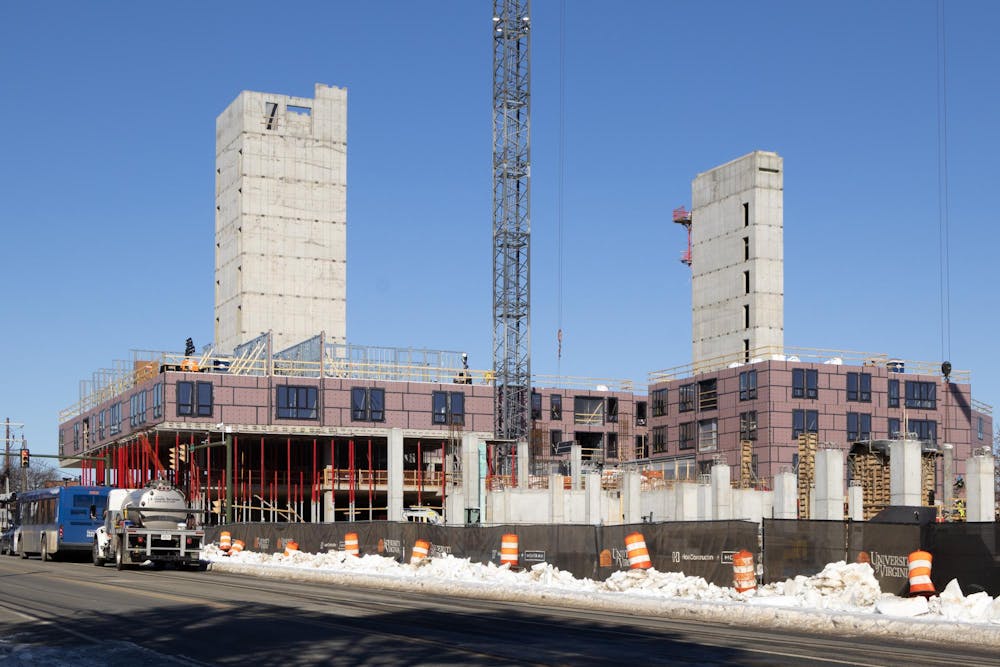
The University has made progress towards this initiative with the construction of the Ivy Corridor, located at the intersection of Emmet Street and Ivy Road, which is set to be complete by 2027. Planning for the Ivy Corridor began in 2016 and will expand not only the number of academic buildings, but also upperclassmen housing options, with two six-story buildings and a total capacity of 750-800 beds.
These on-Grounds student housing buildings will offer dining and retail options and increase the total upperclassmen housing capacity to 3,577 beds, a more than 1000-bed jump from the 2,409 on-Grounds housing capacity when the Plan was created in 2019.
Strengthening Faculty and Staff
The third initiative of the Plan — the Third-Century Faculty Initiative — details how the University will recruit the “best researchers, teachers and mentors,” and that the faculty will be “diverse by every measure.”
In March 2025, the Board voted to dissolve the University’s Office of DEI, which included removing DEI initiatives from the staff hiring process. The University did not share an update on the dissolution of the DEI policies for more than a month after the Board’s vote, leaving questions about the future of diversity at the University.
However, according to Glover, the University is still working towards the goals outlined by the Third-Century Faculty Initiative.
“The goals listed in the Third-Century Faculty Initiative are fluid and ongoing,” Glover said. “We continue to recruit a diverse, world-class faculty and recognize current faculty for the outstanding research and teaching environments they curate for, and with, their students and colleagues.”
The fifth initiative of the Plan — Cultivating Staff Success — details the University’s priority of a “diverse workforce and the creation of an inclusive and supportive environment.”
“Efforts to recruit, retain and support our talented workforce are also ongoing,” Glover said.
In her email, Glover mentioned how the Pipelines & Pathways career placement program — specifically designed for students seeking entry-level positions — continues to connect job seekers to opportunities at the University. Glover also highlighted the positive work environments at both the University and the U.Va. Health System.
“It’s also worth noting that U.Va. and U.Va. Health frequently receive top rankings as one of the best places to work in Virginia, and as one of the best employers for women,” Glover said.
2022-2032 U.Va. Health Plan
Expanding access
The three mission areas of the 2022-2032 Health Plan include “cultivating healthy communities and belonging for all,” "strengthening our foundation” and “expanding our excellence and enabling discoveries for better health.”
In an email statement to The Cavalier Daily from U.Va. Health Public Information Officer Eric Swensen, U.Va. Health has made progress towards the goal transforming health and inspiring hope for all Virginians and beyond by opening and expanding care sites across the Charlottesville area.
“[Access was improved] across Charlottesville, Zion Crossroads, Culpeper, Haymarket and surrounding counties,” Swensen said.
Throughout 2025, new care sites were launched and expanded upon in these regions. U.Va. Health also launched a Mobile Care Unit in January 2025 that provides care services directly to neighborhoods with limited access.
According to Swensen, other signs of progress towards expanding access include the initiation of the South Tower expansion of the U.Va. Hospital, which will add inpatient beds and enhance critical services by 2027 to 2028, and the relaunch of the U.Va. Health and U.Va. Children’s Health websites, which improves online access to care.
Clinical excellence
Another one of the four mission areas of the 2022-32 Plan is research, committing the U.Va. Health System to transforming discoveries into new therapies for patients.
In 2025, the U.Va. Health Children’s hospital was ranked first in the U.S. News & World Report’s ranking of children's hospitals in Virginia for the fifth consecutive year.
In his email, Swensen mentioned how the statewide clinical trials network launched in September 2025 is “bringing cutting-edge care closer to home for more Virginians.” The clinical trial centers were opened in the Culpeper and greater Prince William areas and allow patients to access potential treatment that is still being researched and not yet released.
Additionally, Swensen noted the announcement of the opening of a new nationwide program focusing on Ehlers-Danlos syndromes and other hypermobility disorders in June 2025. The announcement mentions that with only 15 treatment programs for the condition in the country, U.Va. Health leaders hope the program will expand access to those seeking care for the condition in Virginia, expecting it to open by early 2026 in the Fontaine Research Park.
The Manning Institute
The Paul and Diane Manning Institute of Biotechnology was first announced in January 2023 and backed by a total $300 million in gifts and investments. Former Board members Paul and Diane Manning, who are healthcare entrepreneurs and active University community members, donated $100 million of that gift. The Institute aims to transform healthcare and be the forerunner of new biomedical discovery and treatment, particularly focusing on the University’s existing strengths in cancer, neuroscience and immunology research.
The 350,000-square-foot facility is located in the Fontaine Research Park and reached a major construction milestone in October 2025, according to Swensen. The milestone involved a “topping out” ceremony at which the final steel beam of the building was placed.
According to Swensen, the facility is expected to open in 2027 and has already entered a research agreement with healthcare industry leaders like AstraZeneca to offer their new technology capabilities in developing treatment.
In the October 2025 announcement of the institute’s construction milestone, U.Va. Health stated that some of the new hypermobility treatment plans will be launched in conjunction with the official opening of the institute to make further progress towards a statewide clinical trials network.
Looking forward
Despite changes in University leadership and expectations of its operations, the University is still dedicated to carrying out the 2030 Plan, Glover said. The U.Va. Health System has made significant progress on its strategic plan with expanded care and construction on the Manning Institute.
More information on the progress of the 2030 Plan can be found on its official website.
Melody Yuan is a staff writer on the news desk. She is a second-year College student studying economics and statistics from Richmond.
Read More

Tao Tan discusses financial future of U.Va., rising college tuition trend nationwide
By Lily Kostro | 11 hours agoTan explained how tuition costs will shape the future of academic institutions such as the University.

U.Va. Health cuts scribe hours as AI documentation tools expand across Health System
By Vrinda Vashisht | 11 hours agoScribes in the undergraduate medical scribe program said in interviews with The Cavalier Daily that a new emergency department schedule that began Sept. 15 has reduced or eliminated certain scribe shifts and has decreased scribe availability to clinicians in the Emergency Department.

How does the Honor Committee manage its endowment?
By Isabela Delgado | YesterdayThe Honor Committee manages an endowment upwards of $200,000, and for its 2026-27 academic term, it has budgeted $204,500 — just over its available endowment.