
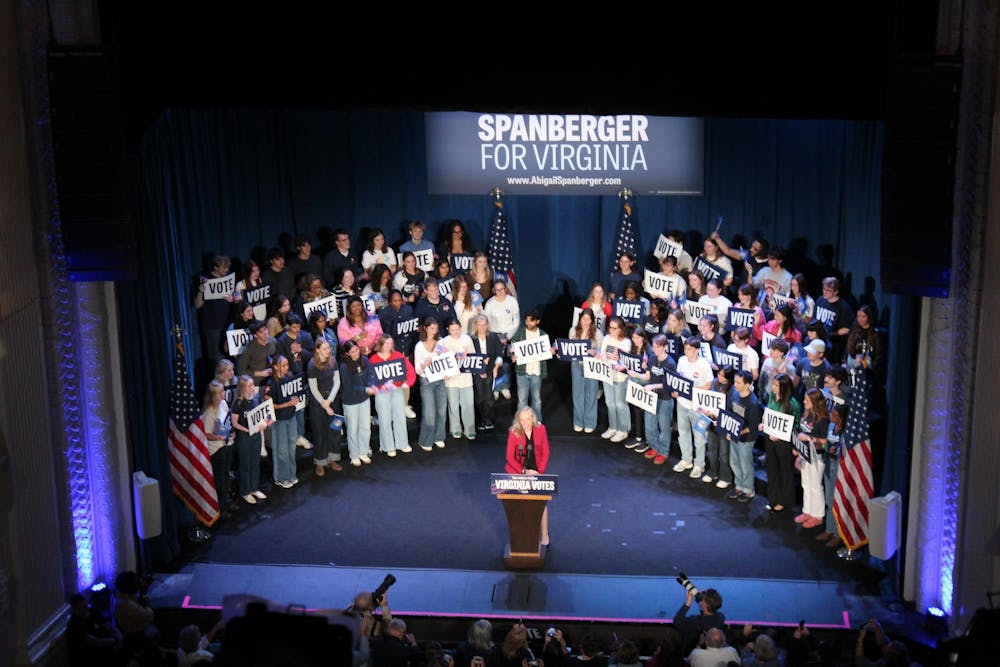
With Gov.-elect Abigail Spanberger (D) set to take office Saturday, three University Board of Visitors members resigned Friday, including Rector Rachel Sheridan and Vice Rector Porter Wilkinson. According to reporting by the New York Times and the Washington Post, Spanberger called on at least five members to resign.
Board Member Paul Manning — the donor behind the Paul and Diane Manning Institute of Biotechnology who gave a $100 million dollar gift to the University to fund the project — was also asked by Spanberger to resign. Manning resigned Friday, and Board members Douglas Wetmore and Stephen Long were also asked to resign, according to the Washington Post. According to the New York Times, Wetmore — a University alumnus appointed to the Board in 2022 — resigned Saturday morning, as did Long.
Sheridan provided The Cavalier Daily with both hers and Wilkinson’s resignation letters, both dated Friday and sent to former Gov. Glenn Youngkin (R). Sheridan confirmed Manning’s resignation, and she said that two other Board members are likely resigning as well, but she has not received confirmation.
Sheridan’s letter informed Youngkin of her decision to resign effective Jan. 16. In her letter, Sheridan said that “political warfare” has paralyzed the Board’s ability to stabilize and strengthen the University. Sheridan wrote that she has always been guided in her leadership by an aim to serve the best interests of the University, but national politics “converts every disagreement … into a pitched battle of competing camps.”
Despite challenges posed by politics, Sheridan wrote about the successes of her two-year period on the Board. She listed the recruitment of leaders to the Health System and the University, the creation of a compensation committee on the Board, advocacy for athletics programs, a greater focus on research and the maintenance of the University’s AAA credit rating as successes of her time. In addition, Sheridan said that the Board worked to promote the University’s independence and academic freedom.
“The University desperately needs stability and the ability to focus on the many challenges it faces,” Sheridan wrote. “We have placed incredible people in important University roles, including the 10th President and the head of the U.Va. Health System. I sincerely hope that they will be allowed to do their jobs without political interference.”
Sheridan ended her letter expressing gratitude for the time she was able to spend as a leader of the University. Looking forward, she hopes that members of the community will focus on unity, and she said that she will continue to serve the University in ways that she can.
In Wilkinson’s letter, she laments that Spanberger does not intend to allow her to finish her term as Vice Rector, which usually lasts two years. Sheridan and Wilkinson began their terms as Board leaders July 1, just days after Ryan announced his resignation. Wilkinson recalled the positive impact she had on the University during her time — greater stability among U.Va. Health leadership, affordability for students, minimal cuts to research and a successful agreement with the Justice Department, among other achievements.
“I am proud of what [the Board has] done and how we’ve done it. I would love to continue serving our cherished institution, but in deference to the Governor-Elect’s request, I hereby resign,” Wilkinson’s letter reads. “My only wish is that the differences of the present moment will not impair the brightness of this great University’s future and that leadership of the University will be able to build constructively on our accomplishments.”
All members of the Board had been appointed by Youngkin. Prior to the resignations Friday, the Board had 12 of its 17 voting-member seats filled after Senate Democrats rejected five members this past fall.
The University redirected The Cavalier Daily to the governor’s office for questions regarding the resignations. Spanberger’s office did not respond to comment at the time of publication.
During Sheridan and Wilkinson’s time in leadership, the Board saw the appointment of former Interim President Paul Mahoney, a lawsuit against U.Va. Health leadership alleging illegal efforts for the sake of revenue and a “hostile” work environment, many calls by University-affiliated groups to pause the search for a permanent president and ultimately, the appointment of University President Scott Beardsley Dec. 19.
Some groups have criticized the Board for the “rushed” process to appoint Beardsley before Spanberger’s term began, and condemn the Board for acting behind closed doors since Ryan’s resignation. With the start of Spanberger’s term Saturday, incoming state leadership will constitute a trifecta of control by the Democrats — a majority in both legislative chambers, plus control of the Governor’s office.
In a letter sent Friday to all Board members, 201 faculty signatories condemned the Board for “improperly” communicating with Youngkin. The letter cited texts obtained through Virginia’s Freedom of Information Act by Richmond-based author Jeff Thomas, as reported by the Washington Post, which show that Youngkin was involved in Board activities.
After the resignation of at least three members, the Board’s headcount has dwindled to nine, at a maximum, and seven if all five members asked by Spanberger resigned. There is also a faculty and student representative to the Board, but neither are voting members. A two-thirds vote is needed to appoint or remove the University President, according to the Board’s manual.
The governor holds the power to appoint members to the Board. Should Spanberger use this power to fill the remaining eight — or greater — voting seats, these eight would still be four members short of reaching the two-thirds vote necessary to remove the president. Faculty groups, student groups and alumni groups alike had called for a pause to the presidential search and expressed discontent with Beardsley’s appointment. Spanberger joined in this sentiment with her own statement asking for the Board to refrain from appointing a president until she came into office.
All Board appointments are subject to confirmation from the General Assembly, according to Virginia law. The Democrats hold the majority in both chambers of the Assembly.
Sheridan's resignation letter
Wilkinson's resignation letter

Grace Little is a news editor for the 137th term. She is a third-year student from Dallas majoring in neuroscience and the interdisciplinary major in public policy, politics and media studies. She enjoys writing about the shifting landscape of higher education, and you can reach her at g.little@cavalierdaily.com.
Read More

English department considers AI’s place in the classroom
By Lily Kostro | 2 days agoFor the University’s English department, some professors have chosen assignments that utilize AI in writing, while others take the approach of completely eliminating students’ access to generative AI in their writing process.

The Cavalier Daily joins amicus brief supporting student press at University of Alabama
By Jaylynn Perez | 2 days agoThe Cavalier Daily joined 39 other collegiate news organizations and 15 student editors from across the country in signing an amicus brief Sept. 2.

Student Council considers creating an ad hoc committee to review UBE proceedings
By Lucia Gambacini | 3 days agoConsideration of the bill was postponed until the next general body meeting.


