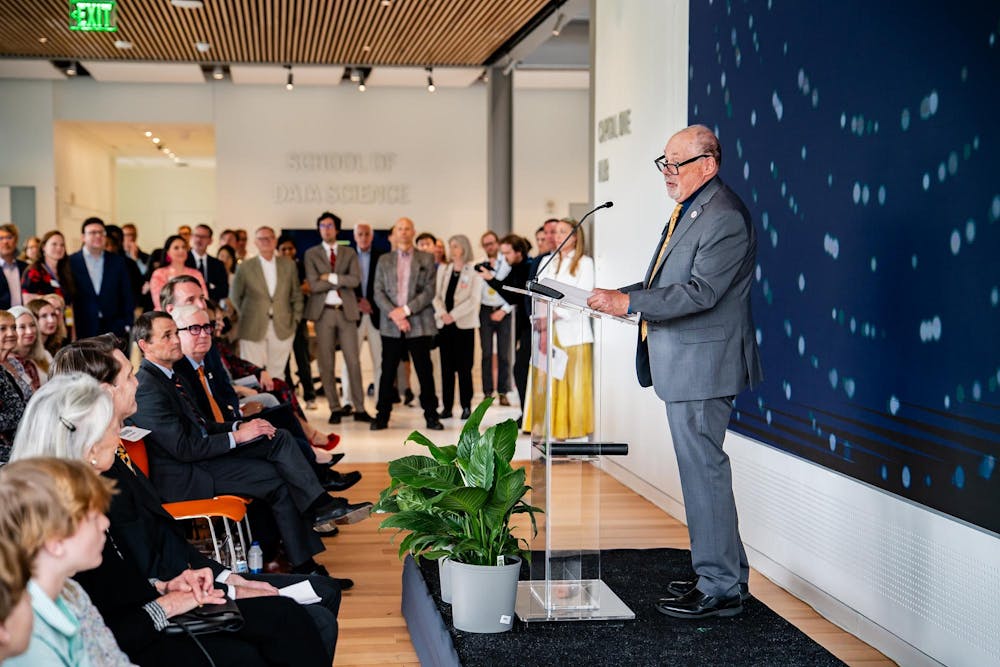
Philip E. Bourne served as the first Stephenson Dean of the School of Data Science from SDS’s founding in 2019 until his passing Sunday. Prior, Bourne had arrived in Charlottesville in 2017 to lead the then-Data Science Institute, before the University became the first university nationally to establish a stand-alone school dedicated to data science.
Bourne passed away at 72 after a battle with mesothelioma. Colleagues have said they will remember him for his passion, collaborative spirit and transformative aspirations for the field of data science.
Aside from his accolades as dean, Bourne is a world-renowned biomedical and data science researcher, author and leader. According to Google Scholar, Bourne ranks as one of the most highly-cited scholars in the University’s history, having written over 400 papers and five books that are often quoted by fellow scholars.
Bourne earned his doctorate in chemistry from The Flinders University of South Australia before transitioning to focus his work in biology and computational science. Bourne worked as a principle architect in the development and establishment of the Protein Data Bank — a tool that provides access to experimentally-determined and computed models of 3D proteins and is one of the most widely used scientific resources globally for drug discovery and research.
Additionally, Bourne’s professional experience includes serving as founding editor in chief of PLOS Computational Biology, professor and associate vice chancellor of innovation and industrial alliances at University of California San Diego, associate director for data science at the National Institutes of Health and in leadership roles in scientific groups at Columbia University.
Throughout his academic work, Bourne emphasized the importance of science as a service to the betterment of society — a framework that guided his vision for SDS as an ethics and justice-centered institution.
SDS was founded with a $120 million gift from Jaffray Woodriff through the Quantitative Foundation — which Bourne played a pivotal role in securing — and over the past nearly seven years of SDS, the school has operated as one “without walls.” It focuses on interdisciplinary research and education, rather than remaining siloed in its focus, with an aim to serve as a leader in responsible data science, according to the SDS website. Bourne oversaw SDS’s initiatives that focus on working together, leading by example, being good and great, sharing knowledge, building leaders and pioneers and pursuing quality, not quantity, in SDS’s work.
Having developed significantly since its founding, SDS now offers events focusing on the intersection of AI and sectors — such as ethics and governance — and initiates projects exploring topics including ghost forest detection, medical applications and U.S. Presidential Election campaign speeches.
SDS has grown into a thriving school that offers undergraduate, master’s and doctoral programs and employs over 100 faculty and staff. Most recently, the University Board of Visitors approved the schematic design for SDS’s Entrepreneurship Building — a five-story structure with classroom, research and seminar spaces.
Outside of work, Bourne was known for his refusal to follow academic, straight-laced stereotypes. For example, he co-led a group called “Hell’s Administrators” — a motorcycle club with Ian Solomon, dean of the Frank Batten School of Leadership and Public Policy. The pair embarked last summer on a motorcycle ride on Colorado’s Trail Ridge Road.
Bourne is survived by his wife, Roma, his children, Scott and Melanie and his granddaughter, Jessica. Jeffrey Blume has been named SDS’s interim dean.

Grace Little is a news editor for the 137th term. She is a third-year student from Dallas majoring in neuroscience and the interdisciplinary major in public policy, politics and media studies. She enjoys writing about the shifting landscape of higher education, and you can reach her at g.little@cavalierdaily.com.
Read More

From the Archives: Fraternity life
By Maisy Callahan and Emily Conway | 13 hours agoMore fraternities decide to partner with the Historic Renovation Corporation, a University-affiliated agency that provides tax credits for the restoration of historic buildings.

Center for Politics hosts Tom Perriello to discuss AI, congressional responsibilities
By Melody Yuan | YesterdayAt the event, titled “The Deep Divide Between How the People and the Powerful Are Thinking About AI,” Perriello also referenced his Sept. 22 article “To Wary Working People, AI Preemption Is the New Nafta” in The New Republic during his discussion.

U.Va. Health’s telehealth program approaches 1 million visits
By Vrinda Vashisht | YesterdayThe program arose from the challenge of U.Va. Health physicians traveling to communities across Virginia to treat patients who could not easily reach Charlottesville.