
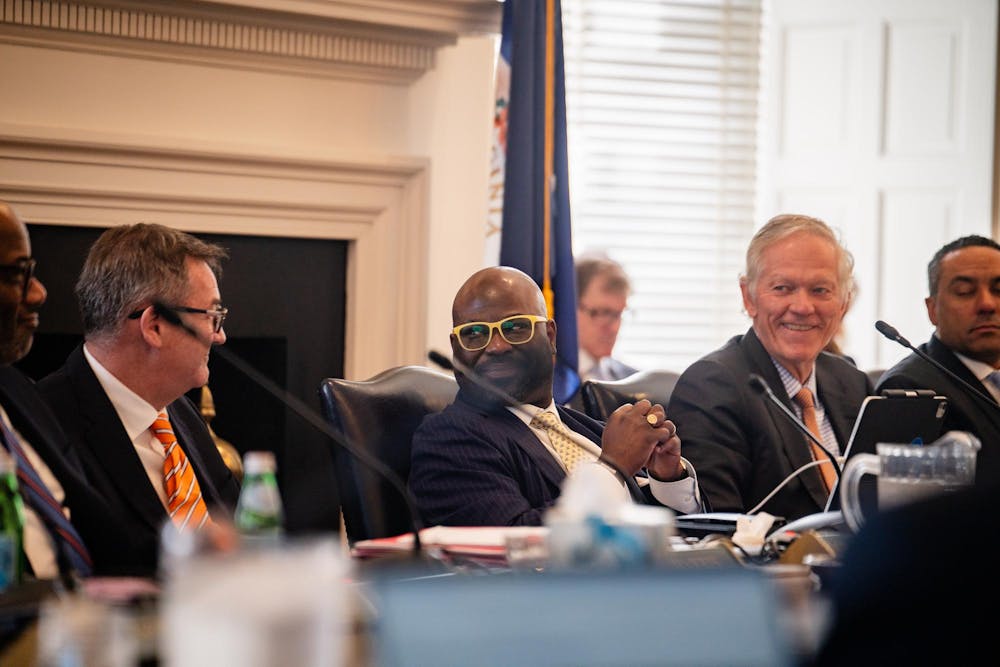
The full Board of Visitors met Thursday afternoon for the first time since the appointment of Rector Carlos Brown, Vice Rector Victoria Harker and eight other new Board members by Gov. Abigail Spanberger (D). After an over two-hour long closed session, the Board passed a resolution charging the Audit Committee with a review of the five-month presidential search process for the 10th president of the University, which culminated in University President Scott Beardsley’s appointment Dec. 19.
Board Member Mohsin Syed explained the resolution, stating that the Board is responsible for ensuring that University leadership decisions are made through rigorous processes and that the University’s presidential search process should be reviewed and compared to those of peer universities.
“The Board affirms the outcome of the election of [Beardsley] … [and] believes that a comprehensive, fair-minded and rigorous review of the presidential search process is appropriate and prudent to identify whether there are opportunities for improvement in future searches,” Syed said.
The Board also heard a macro financial overview of the University, an endowment update from University of Virginia Investment Management Company and new information regarding the University’s core academic mission of research and teaching.
J.J. Wagner Davis, University executive vice president and chief operating officer, presented to the Board on the University’s macro finances. She began by giving the Board macro data on the University, including employee and application counts and an operating budget of $6.4 billion. Davis also reviewed the University’s value proposition, backed up by 100 percent of financial need met, a 14-to-one student-faculty ratio and a 94.4 percent six-year graduation rate, among other data points.
According to Davis, the University is currently focused on implementing OneUVA Workday across the entire health system, which will serve as a modernized, comprehensive platform for health system employees and should be fully functional by 2028.
As the University enters its third quarter of fiscal year 2026, Davis also said that patient service remains the largest source of revenue, followed by tuition and fees. Compensation increases for University employees mark the largest cost for the University, which follows Commonwealth compensation increases. Davis explained that the Commonwealth mandates merit-based compensation increases of 3 to 5 percent, but that the University has increased pay by 5 to 7 percent in recent years. Davis said that employees deserve the raises, but costs to compensate are significant. To cover these costs, Davis said the University turns to tuition increases to fund state pay increases — there will be a Board meeting April 16 to approve tuition and fees for the next school year.
Acknowledging the ongoing General Assembly Session which began Jan. 14 and will conclude March 14, Davis said that the University lobbies with legislators and is closely monitoring various pieces of legislation that could impact University operations. Davis listed pay raises, legislation involving the Center for Performing Arts, minimum wage increases and collective bargaining policy as key issues the University will continue to keep a close eye on.
In connection with the discussion on legislation and its impact, Brie Gertler, University interim executive vice president and provost, said that federal cuts to research have been relatively minimal in consideration of the current federal administration’s messaging. However, she said uncertainty continues for researchers at the University.
“We are very encouraged by the fact that although the [Trump] Administration suggested deep, deep cuts in most of the federal funding agencies, in fact, they're largely flat,” Gertler said. “Long term, we're very encouraged. I think the most difficult thing at this point is uncertainty, both about the number of dollars that will be available, [but also] what the priorities are and what the indirect costs will look like.”
Moving forward, Gertler noted the University and its research groups are shifting to design proposals to fit the needs of funding agencies, and they are also increasingly turning to alternative funding sources.
Looking to capital planning and leveraging debt financing, Davis said the University’s budget is constrained by the current economic environment, federal policy changes, compensation increases, NCAA policy changes and efficiency initiatives. To meet these challenges, Davis said the University will employ strategies including reduced discretionary costs and hiring review, budget reductions for central units and careful evaluation of opportunities to reduce mandatory costs. In summary, the University’s approach to its FY27 budget will be similar to its approach for its FY26 budget.
“At a high level, we pulled lots of levers to build out a balanced budget for the current fiscal year that we're halfway through,” Davis said. “Key for the coming couple of years is really prioritization of key initiatives and implementing things that are already underway and … continuing to try to reduce discretionary costs.”
While considering the University’s budget, Davis said that goals of affordability, accessibility and high quality academics remain at the forefront of planning, even as they can exist in tension with each other.
“There's tension within those three to maintain quality. Obviously you need investment, particularly in your faculty and the research, and yet, [you need] to be affordable and accessible,” Davis said. “Sometimes you want to keep costs down. So it's a really fun and challenging three-dimensional chess that we're trying to put together for the budget.”
Following Davis’ presentation, Robert Durden, CEO and chief investment officer of UVIMCO, presented to the Board on UVIMCO’s work and plans for future investment decisions. Durden began by praising the leadership team of UVIMCO for aligning around the University’s “energizing” mission within higher education. UVIMCO is a 501(c)(3) non-stock corporation that provides investment management services for the University, and Durden clarified that three Board members sit on the UVIMCO Board of Directors at any given time.
UVIMCO’s core objective, according to Durden, is to generate the University’s acquired return and maintain the purchasing power of the University’s endowed assets. Durden said UVIMCO primarily achieves this through manager selection — UVIMCO currently maintains about 85 active manager relationships in its portfolio.
Board members probed Durden specifically about investments in artificial intelligence. Durden said that AI poses both great opportunity and great uncertainty as an investment option, and he said members of UVIMCO retain close ties to San Francisco and the tech industry to make informed decisions in this sector.
“[AI’s future] is deeply uncertain, and you've seen that in this year's … equity market performance, where the market is almost like a heat seeking missile, seeking out uncertainty,” Durden said. “We've spent a lot of time internally talking about AI, and we do have managers who we think are the best in the world at forecasting [its future] … so technology and understanding its impact is incredibly important to us.”
Beyond the University’s budget, Gertler provided the Board with updates on the core academic missions of research and teaching. She reflected that U.Va. Health CEO Mitch Rosner has now served in his role for a year, and she will also reach one year in her role Sunday. Gertler praised University leaders who have worked to be steady forces for good in their roles through this past year, and she highlighted the University’s 12 deans as both “fierce advocates” for their own schools but also “institutionally-minded” for the betterment of the whole University.
Gertler updated the Board that the search for the next dean of the School of Architecture is well underway — School of Architecture Dean Malo André Hutson announced in June 2025 that he would be resigning at the end of the 2025-26 academic year. Additionally, a search for the next dean of the Darden School of Business has also launched to replace Beardsley.
Shifting to the subject of research, Gertler said that federal funding makes up 75 percent of the University’s total research portfolio of $570 million, with the Department of Health and Human Services serving as the largest contributor. She said the University is currently experiencing delays for grants due to the record-breaking government shutdown from Oct. 1 to Nov. 12, staffing cuts at HHS and uncertainty about the federal landscape moving forward. Accordingly, Gertler said that the University is diversifying its funding portfolio by expanding industry partnerships.
Gertler updated the Board on enrollment — total undergraduate applications were up about 26 percent, which comprises an “enormous jump” from the previous year. The University received about 82,000 total applications this year, which she said can be attributed to outreach into Virginia high schools with historically low rates of applicants and the elimination of the supplemental essay in the undergraduate application. According to Gertler, increased interest raises questions around the effects of increasing total enrollment numbers.
“We are incredibly fortunate that we have no shortage of very talented students who want to come here, and the difficulty is deciding among the very talented students who apply here,” Gertler said. “It does affect our thoughts about future enrollment plans … if we were to grow enrollment … we want to be mindful about the downstream effects for universities and colleges across the state.”
Gregory Perryman, student representative to the Board and fourth-year College student, spoke to the Board on spring happenings on Grounds and how the University is making itself “synonymous with public service.”
To walk the Board through the University’s public service focus, Perryman expanded upon three initiatives — the Public Service Pathways Program, Madison House and everyday engagement opportunities inside and outside of the classroom. The PSP Program aims to bridge students’ studies with social impact, and Madison House is a community of student volunteers.
“Students are working to make U.Va. synonymous with service through their coursework, club involvements and perhaps most crucially, through defining their future professional and personal aspirations,” Perryman said. “We must remain committed to supporting students in this effort as a tenant of our ongoing strategic vision.”
Jim Lambert, Engineering professor and faculty representative to the Board, also presented to the Board with an update on faculty governance — elections for 84 new faculty senators will be underway in April — and the University’s mission of “doing good.”
“The University amplifies itself and the Commonwealth of Virginia, which began as a company or enterprise in helping the world navigate circumstances through teaching and imagination,” Lambert said. “[University academic roles] are not only about advancing knowledge. They're part of the project of helping society grow in wisdom, resilience and humanity in its flourishing.”
Brown followed the faculty and student representatives’ remarks by speaking to the broad goals he puts forth for the Board’s leadership. He emphasized the need of the Board to work with stakeholders of the University to rebuild trust, and commit to “shared goals and values.”
“We [must] address the fact that there's hunger around Grounds for stability and normalcy, and I think that this Board shares and understands that, but there also is a strong desire among many for greater transparency and accountability around the events of the past year,” Brown said.
Brown specified seven goal areas he has for the University — academic excellence, patient care, accessibility, affordability, accountability, aligned governance and athletic competitiveness.
Beardsley followed Brown by saluting the leadership of the University over the past year. He re-emphasized the goals that Brown specified, and said he has spent his first couple months in office building trust with the University community.
“Having served as the Dean of Darden for 10 and a half years … I'm not new to it, but I know that trust is something that's not given to you … it's earned,” Beardsley said. “I assume I'm starting at zero. I have to re-earn anything in the new role … but I will work as hard as I did at Darden, or harder, to do the best I can to advance this institution.”
According to Beardsley, he will focus on bringing back stability and building upon University success. Beardsley said former President Jim Ryan’s Great and Good Plan has served the University well, and the Board will come up with a new plan to build on its progress. He spoke on expanding study abroad options, amplifying new research initiatives, achieving ROTC’s full potential and improving student career outcomes.
The Board also approved meeting minutes for the Board meetings over the past year and two new professorships — the Coogan Family Bicentennial Professorship in the Darden School of Business, and the Sarah A. and Frank M. Hamlin Directorship and Professorship of the Causeways Program for Civic Engagement and Social Entrepreneurship in the College of Arts and Sciences. The chairholder of the latter will direct the Causeways Program, which aims to “build bridges or causeways” between disciplines and with the Charlottesville community. Lastly, the Board voted to approve the U.Va. College at Wise Master Plan, which was approved earlier that day by the Board’s Buildings and Grounds Committee.
The next scheduled full Board meeting is set to occur June 4-5.
Grace Little is a news editor for the 137th term. She is a third-year student from Dallas, Texas majoring in Neuroscience and the Interdisciplinary Major in Public Policy, Politics and Media Studies. She enjoys writing about the shifting landscape of higher education.
Read More

English department considers AI’s place in the classroom
By Lily Kostro | 2 days agoFor the University’s English department, some professors have chosen assignments that utilize AI in writing, while others take the approach of completely eliminating students’ access to generative AI in their writing process.

The Cavalier Daily joins amicus brief supporting student press at University of Alabama
By Jaylynn Perez | 2 days agoThe Cavalier Daily joined 39 other collegiate news organizations and 15 student editors from across the country in signing an amicus brief Sept. 2.

Student Council considers creating an ad hoc committee to review UBE proceedings
By Lucia Gambacini | 3 days agoConsideration of the bill was postponed until the next general body meeting.


