
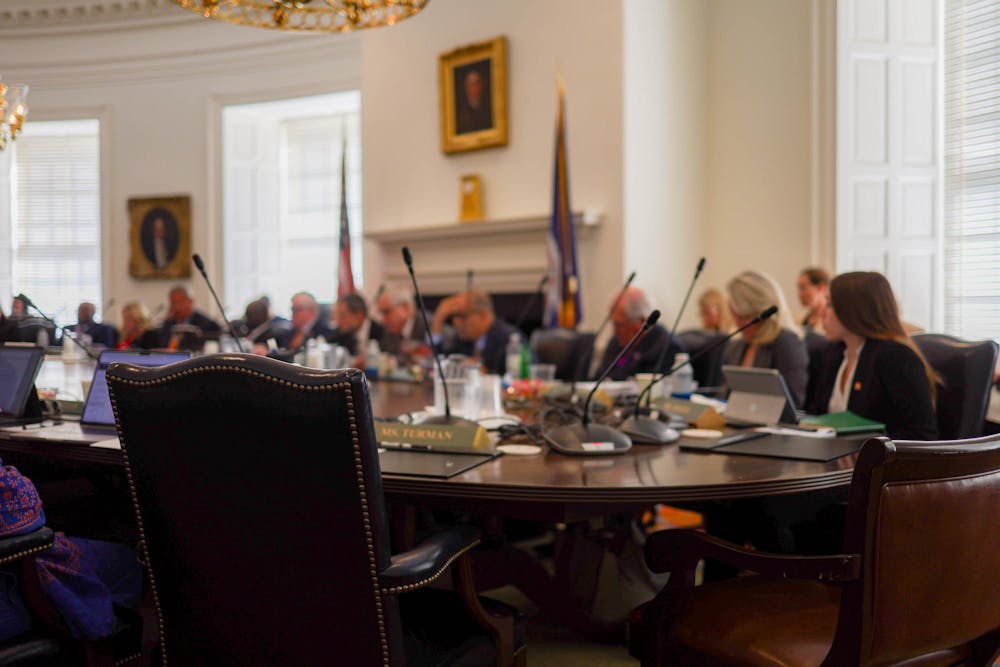
The University Board of Visitors appointed Carlos M. Brown to serve as Board rector Feb. 20. As he enters his term, Brown said his primary mission is to focus on academic excellence, and his secondary goals include creating accountability, community trust, affordability, accessibility and aligned leadership.
Brown previously served on the Board from July 2021 to June 2025 under former University President Jim Ryan, and he served as vice rector from June 2023 to June 2025. Additionally, Brown is an alumnus of the University, and his professional experience includes work as a business executive and lawyer. He currently serves as the executive vice president, chief administrative and projects officer and corporate secretary of Dominion Energy. Brown said he brings all of these professional experiences to his role as rector.
Acknowledging divisions sewn between the Board and University-affiliated organizations over the past several months, Brown said that some bonds of shared trust have been broken. Various University stakeholders — including faculty, student and alumni organizations — took issue with Ryan’s resignation and the Board’s process of appointing University President Scott Beardsley, citing a lack of transparency and responsiveness from the Board. To proceed in improving relations, Brown said the Board and University stakeholders must work together to realign towards a common mission of improving the University.
“Some may feel that trust of the shared governance model has been broken, and so we have to work to rebuild that. There has to be accountability on all parts of the institution — the Board, the administration, the faculty [and] our other stakeholders,” Brown said. “We have to create accountability to one another … [to] make the institution better and … have good governance.”
To rebuild trust, Brown said the full Board must work to reestablish a stable connection by holding productive conversations and presuming that others are coming into the collaborative leadership process with goodwill.
“I understand … frustration that exists … [among] stakeholder populations, and so that needs to be acknowledged. Things were not perfect,” Brown said. “There were opportunities to do things better and differently and more inclusively, and we ought to talk about how that happens going forward.”
Brown said that for the University to succeed in moving forward, stakeholders, including the Board, must recognize that each institution within the University contributes a unique role. For example, according to Brown, the Board must respect the faculty’s responsibility around academics and managing hiring. Likewise, he said that University constituents should recognize the role the Board plays in leading the University and respect that model.
In the vein of academic independence, the University’s agreement last fall with the Justice Department requires the University submit quarterly compliance reports to ensure civil rights laws are adhered to. The University’s first report to the Justice Department, released publicly Jan. 29, detailed changes to diversity, equity and inclusion programming in admissions and programming. Brown said that although reactions to the agreement were mixed — some praised the agreement for maintaining academic independence, while others reprimanded the University for capitulating — he said he believes the agreement did not sacrifice academic integrity.
“While compliance with the agreement imposes a duty on the University, we are able to continue our mission and to pursue excellence and knowledge wherever it may exist,” Brown said. “While some might have preferred that we did not have such an agreement in place, the University is committed to make sure that it does not impede its academic purpose or limit free expression."
As another one of his five goals for his time as rector, Brown said the Board must prioritize affordability to ensure that the University’s offerings are available to students of all backgrounds.
“We want U.Va. to be open and available to everybody, to continue to be a ladder of opportunity for this generation of students and stakeholders and/or employees and people that want to work at the University, or scholars that want to teach,” Brown said.
Referencing his past experience on the Board under Ryan, Brown said his approach to leadership of the Board will be similar. According to Brown, his previous time taught him that work on the Board requires members to respond to unexpected circumstances.
“There were a number of events that we confronted during the last two years [of my previous term] that I could not have anticipated,” Brown said. “You approach [unexpected events] presuming that everyone, all the stakeholders involved, want the same thing that you want, which is we want U.Va. to be successful.”
Ryan spearheaded the University’s Great and Good 2030 Plan and U.Va. Health’s 2022-2032 Plan during Brown’s time on the Board. Brown said the Board will meet to discuss the continuation of these initiatives. Additionally, he said he supports the goals of the plans, and he believes the new Board and the administration will undertake efforts to adopt a new strategic plan.
Prior to his work on the Board, Brown graduated from both the University’s College of Arts and Sciences and School of Law. During his time as a University undergraduate student, Brown involved himself in student self-governance, culminating in his time as Student Council president. According to Brown, his experience as a student leader has informed his leadership work for the Board.
“[Student leadership experience] informed and shaped how I approach leadership, how I approach organizational design, how I literally, deliberately manage and run meetings,” Brown said. “I've actually brought those skills to my day job, and I think I can credit them for a lot of the success that I've had in my professional environment.”
Reflecting on the University’s pillar of student self-governance, Brown said he learned during his time as a student to take initiative — he said that if an issue matters enough to students, they have an obligation to engage with the issue to incite change.
“It is incumbent upon each generation of students to make those traditions and [self-governance] culture their own,” Brown said. “What makes U.Va. great is that each student … engage[s] in that conversation very deliberately … part of our job as a Board is to encourage students to own the University in the real way.”
In regards to student self-governance, Student Council, in conjunction with the College at Wise Student Government Association, issued a proclamation Dec. 3 requesting a student voting member to the Board — the current student representative serves as a non-voting member, as does the faculty representative. Brown said that he will not speak to what the Board’s response will be to this request, but he said that non-voting members can still have a significant impact on decision-making.
“At the end of the day, it's not the vote that matters, it's the effectiveness of the person in the role and how they communicate,” Brown said. “We've had student members who have been very, very effective at impacting the outcome of issues, and whether they voted or not would have not mattered.”
Brown said he is looking forward to meeting with the Board for the first time since his appointment — the Board will convene March 5.

Grace Little is a news editor for the 137th term. She is a third-year student from Dallas majoring in neuroscience and the interdisciplinary major in public policy, politics and media studies. She enjoys writing about the shifting landscape of higher education, and you can reach her at g.little@cavalierdaily.com.
Read More

English department considers AI’s place in the classroom
By Lily Kostro | 2 days agoFor the University’s English department, some professors have chosen assignments that utilize AI in writing, while others take the approach of completely eliminating students’ access to generative AI in their writing process.

The Cavalier Daily joins amicus brief supporting student press at University of Alabama
By Jaylynn Perez | 2 days agoThe Cavalier Daily joined 39 other collegiate news organizations and 15 student editors from across the country in signing an amicus brief Sept. 2.

Student Council considers creating an ad hoc committee to review UBE proceedings
By Lucia Gambacini | 3 days agoConsideration of the bill was postponed until the next general body meeting.


