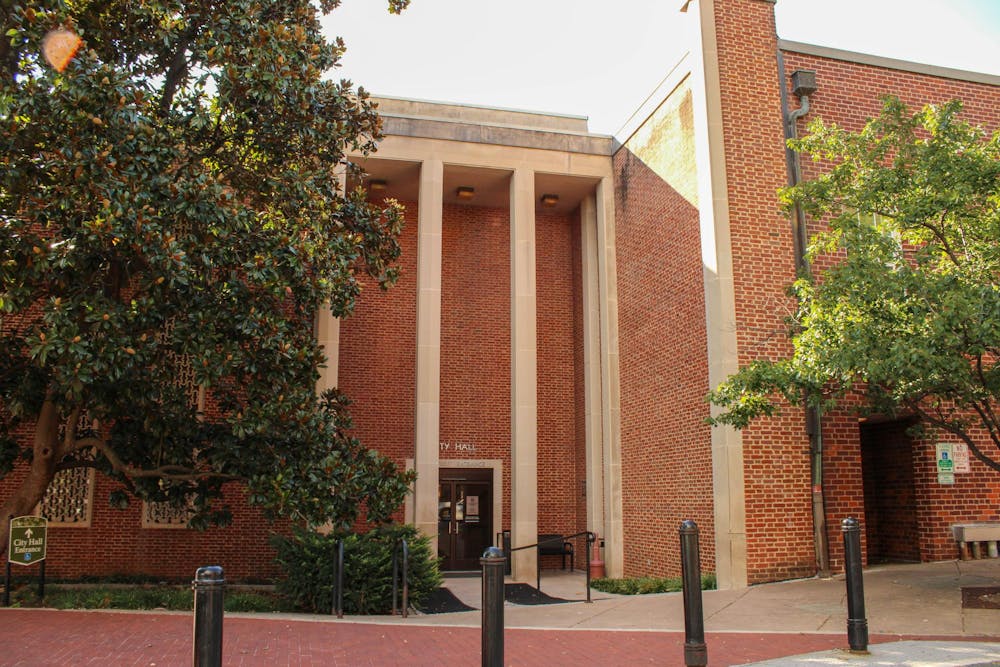
The Charlottesville City Council convened for a bi-weekly meeting Monday — shortly after the conclusion of the weekend’s graduation ceremonies at the University — to discuss potential rule changes for short-term rental options like Airbnbs in the City. Monday also marked the first regular meeting after the Council voted to award “The Mark at Charlottesville” a necessary Certificate of Appropriateness for construction. Some community members voiced continued outrage with the decision during public comment.
A regular work session took place at 4 p.m. Monday, where the Council heard a report from Neighborhood Development Services on a study assessing short-term rental regulations in the City.
According to the City of Charlottesville, STRs are homes rented out to guests for less than 30 days. Currently, the City mandates that owners of STRs in residential areas must live in the homes for at least 185 days of the year, provide proof of ownership and residence to the City and pay a $100 fee in order to apply for a year-long STR permit.
Council member Michael Payne indicated that the logic behind requiring proof of residence is to ensure that Charlottesville residents can rent out their homes for parts of the year for supplemental income, while those who use Airbnbs purely as investment opportunities cannot do so.
A significant number of Airbnbs in Charlottesville were marketed towards families staying in the City for last week’s graduation ceremonies, which took place Friday through Sunday. Many listings highlight their short distance from the University for visiting guests specifically interested in staying close to Grounds.
Missy Creasy, deputy director of Neighborhood Development Services, told Council members that the current STR rules were crafted in 2015, and the number of STRs in the City has increased “significantly” since then. Accordingly, NDS undertook the study to reconsider how the current rules impact the community.
Creasy’s presentation said that as part of the study, which began in March of 2025, NDS has researched the STR requirements of other major cities, conducted community surveys and prepared a new “Granicus” system. The system allows Charlottesville to track all STRs advertised in the City on a single platform.
NDS considered a number of potential rule changes as part of its study to better align regulations with new City priorities. These changes include stricter requirements to demonstrate proof of occupancy for those renting out STRs and switching to a $500 three-year permit.
Creasy noted, however, that such changes would also lead to increased processing times for permit applications. She also explained that the General Assembly has required localities to allow long-term tenants to rent out their homes as STRs with permission from their landlords — something currently not allowed in Charlottesville. Thus, the next time the City changes its STR regulations, the Council will also be obliged to allow tenant-operated STRs for the first time.
Ultimately, Creasy recommended no changes to STR rules at the present time, suggesting that NDS should continue to monitor the present situation and the success of internal efforts.
Payne said that he believes greater enforcement of the requirement, including taking Airbnb owners not abiding by the City’s rules to court, could be necessary to ensure investors are not needlessly driving up costs. This is especially important for Charlottesville’s historically Black neighborhoods like Fifeville and 10th and Page, he said, because of the unique situation where Airbnbs in those neighborhoods are likely profitable given that they are a short distance from the University.
“I think [Airbnbs near the University are] a significant part of the dynamic of … those places becoming places that are purely of, by and for U.Va.,” Payne said.
During the “Community Matters” segment of the meeting — the portion in which up to 16 members of the public can address the Council for three minutes each — residents also voiced disapproval with the Council’s May 4 vote to award The Mark a necessary Certificate of Appropriateness for construction.
The Mark is a proposed, private apartment complex which will be built in the historically Black neighborhood of Fifeville and marketed to University students. Residents of the neighborhood have expressed concern that the project is imposing, and that the presence of such a large apartment complex marketed to students will raise living costs in the area and contribute to their displacement.
The appeal the Council heard May 4 hinged on whether the Council should uphold a decision by the Board of Architectural Review, which previously determined the apartment building would not be visually and historically compatible with two historic cottages on the site. Mayor Juandiego Wade, Vice Mayor Natalie Oschrin and Council member Lloyd Snook voted to reverse the BAR’s decision, paving the way for construction of the project.
On Monday, Charlottesville Resident Don Gathers told the three Council members who voted to override the BAR’s decision that he believes the “egregious, horrific vote” could be their lasting legacy.
“You all routinely and systematically go against the very direction of the boards and commissions that you’ve impaneled,” Gathers said. “Your … actions will surely drive up the homeowners’ costs in taxes, causing many of them to have to leave their family homes. This, at best, is backdoor gentrification. These developers are Charlottesville’s weapons of mass destruction.”
Gathers and Alicia Lenahan, executive director of Common Ground Healing Arts — a nonprofit which seeks to provide “affordable and accessible complementary health practices” — accused the City government of “redlining” in its BAR decision, or systemically denying financial services to certain neighborhoods and communities on the basis of race, at Monday’s meeting.
According to Lenahan, the City’s half-mile radius for student housing is an example of this practice. Under Charlottesville’s Affordable Dwelling Unit Monitoring and Procedures Manual, development projects located within a half-mile of North and Central Grounds qualify as “student housing projects,” which pay a reduced fee into the City’s Affordable Housing Fund. Regular projects, by contrast, must either set aside 10 percent of units for affordable housing or pay a significantly higher fee.
Lenahan noted that this rule is estimated to allow the private developers of The Mark and LV Collective project on West Main Street to pay an estimated $10 million less into the fund that could have supported residents in historically Black communities to build wealth and afford homes.
“In Charlottesville, redlining is alive and well,” Lenahan said. “You could implement more ambitious development strategies that intentionally try to rectify the negative impacts of urban renewal … instead, you are leaving $10 million on the table … The repeated displacement of Black Charlottesville did not happen by accident. It happened through public decisions, public neglect and public willingness to call harm by other names.”
The Council is currently considering recommendations to eliminate the half-mile radius, leaving all private housing development to either include affordable units or pay the full fee.
In other matters, Sadhbh O’Flynn, climate justice policy manager at the Community Climate Collaborative — a nonprofit climate advocacy group — also noted during the Community Matters portion that the collaborative has received grant funding to lead a utility decarbonization study in collaboration with the University’s Center for Community Partnerships and the Southern Environmental Law Center.
O’Flynn said that the study is currently one-third of the way complete and the Center for Community Partnerships is leading public engagement opportunities in the community — including focus groups and workshops — to inform decarbonization pathways for Charlottesville.
The Council’s meeting schedule can be found on the City’s website. Its next regular, bi-weekly meeting will take place June 1.

Luca Bailey is a third-year College student majoring in politics from Free Union, Va. As a staffer on the news and video desks, he has covered topics ranging from the General Assembly and state elections to local politics and University governance. He is also The Cavalier Daily’s beat writer for the Charlottesville City Council.
Read More

Students, professors weigh in on the importance of letter grades
By Ruby Budetti | 5 hours agoWhen thinking about letter grades for themselves, many University students and faculty said they prefer letter grading throughout all four years of college.
What services does the Student Health Fee provide for students?
By Melody Yuan | 6 hours agoThe University Board of Visitors approved tuition and fees for the 2026-27 academic year in April, and the Student Health fee rose from $1,147 to $1,184 per student.

The ‘AI and Future of Work’ Series — How the University is preparing students for what is next
By Lidia Zur Muhlen | 8 hours agoIn a recent Gallup Inc poll, 79 percent of Americans believe that artificial intelligence will reduce the number of jobs over the next 10 years.