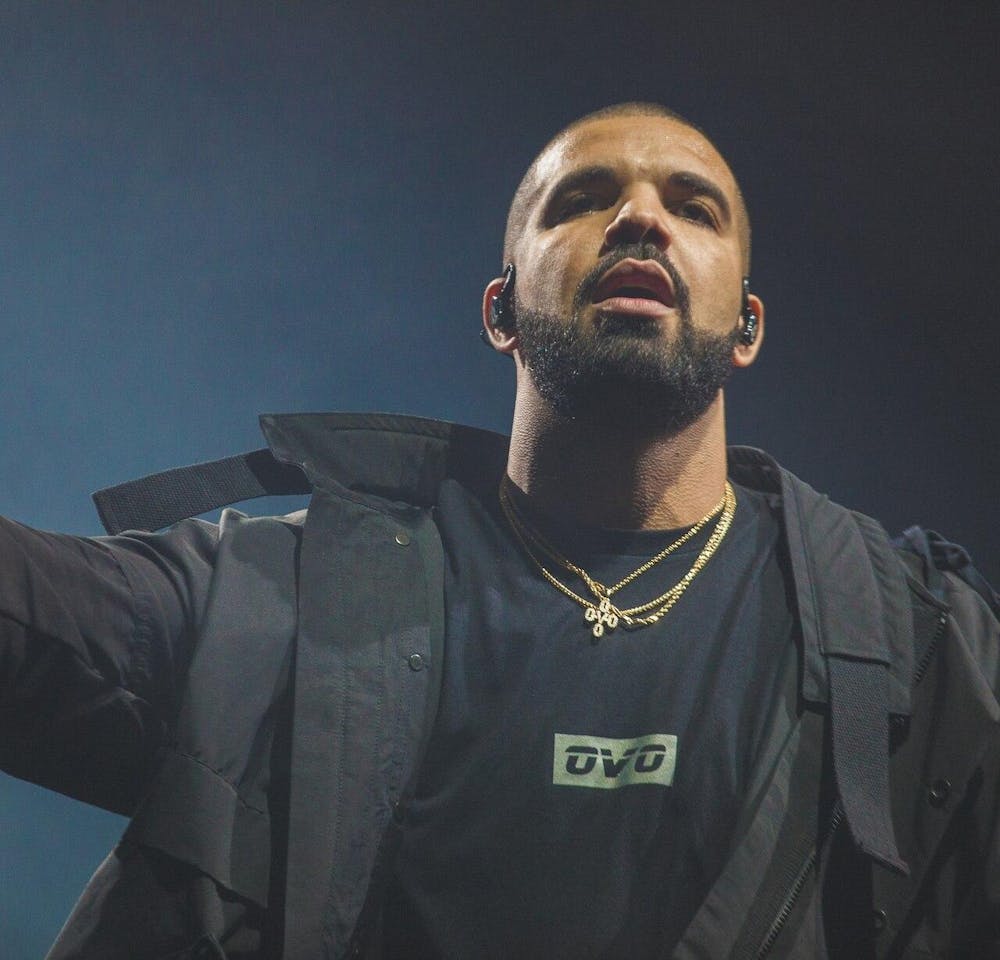
Drake’s ninth studio album “ICEMAN” doubles down on the thematic weaknesses and lack of structure that have marred his recent releases. Though the Canadian rapper has long been cemented in the pantheon of 2010s hitmakers, his last five years have been defined more by his controversial conduct than any artistry. Whether due to the explosive beef with Kendrick Lamar that defined 2024, or the legal battle with his record label Universal Music Group, his image was left in a polarizing position. “ICEMAN” was therefore seen by many as an attempt to reaffirm that he is still a cultural force and revitalize his image.
The reception from the general public to the album’s rollout was a testament to his continuing relevance, as the single “What Did I Miss?” was released in July of last year and debuted at number one on the Billboard Hot R&B/Hip-Hop Songs chart. Snippets of music continued to appear online, but the defining moment of the promotional cycle was the installation of an ice sculpture April 20 in Drake’s hometown of Toronto. The large crowd of fans that appeared at the sculpture found a hidden message in the ice revealing May 15 to be the release date for “ICEMAN.” Drake also announced two additional surprise album releases on a YouTube livestream — “HABIBTI” and “MAID OF HONOUR” — which released on the same day as “ICEMAN.” Drake effectively set the stage for a new era in the wake of his image struggles, yet “ICEMAN” is built off of the same immature disses, bleached out R&B grooves and inconsistent performances that have led to mixed reception for his recent releases.
The first song “Make Them Cry” is a refreshing track from Drake and features some of the strongest lyricism on the album as he muses about lovers, friends and recent frustrations. Clever lines like “They know you thorough with bread, but there’s some s—t you / gotta pony up to” combine with the smooth instrumental in a stylistic callback to previous albums like “Take Care.” Unfortunately, any form of introspection and maturity ceases there.
The next track “Dust” starts with a spoken monologue and some standard autotuned crooning before a beat switch into an industrial instrumental. Drake flexes his wealth before taking shots at an unnamed artist, presumably Kendrick Lamar, with lines like “I don’t remember one word in your raps,” which is ironic given that one of the next songs is titled “Ran to Atlanta” similar to a lyric from Lamar’s diss track “Not Like Us.” “Ran to Atlanta” is a welcome change both in terms of the more inspired instrumental as well as the sharp appearances from Future and especially from underground rapper Molly Santana. However, it also introduces the beat switches that are a recurring, and potentially grating, feature of the album from this point.
The attempt to keep songs fresh is admirable, but the execution feels like a half-hearted stab at recreating the viral appeal of songs like “NOKIA.” The beat switches continue on songs like “Shabang” and “Burning Bridges” that combine with a return to the stripped back lo-fi beats that are prevalent through the album. Along with the song “Janice STFU,” these songs also highlight a trend of bland choruses uncharacteristic of Drake. The effect of this compounded with the lack of variation in production is that many songs on “ICEMAN” blend into one another.
“National Treasures” is one of the first moments on the album that showcases a hungrier and more aggressive sounding Drake. He also brings out some of the punchlines he is known for like “R.I.P. Kobe, but y'all n—s brokie / That's probably why y'all be shackin' together” in reference to professional basketball teammates Kobe Bryant and Shaquille O’Neal. After the strong first half though, the song quickly runs out of ideas, switching the beat again as the lyricism gets progressively worse. The track ends disappointingly with the much ridiculed line “Ironic cause the Iceman was a nice man, now I’m hot and cold,” panned by critics and the public alike for its simplicity and corniness.
The aforementioned song “What Did I Miss?” is arguably the best moment on the album, finally nailing down the essence of Drake’s most memorable songs. The roaring horns and the refrain of the track complement the braggadocious and triumphant lyrical themes to capture the best of the man who ruled the charts in the late 2010s. The rest of the second half of the album is likewise more polished in its sound but songs like “Plot Twist,” “2 Hard 4 The Radio” and “Little Birdie” sound overly sanitized to the point where they feel suited for an Instagram caption over anything else.
A memorable moment for the wrong reasons is “Make Them Remember,” which features shots at Lamar once again. The disses on the song rely primarily on Drake’s commercial success with lines like “They only know your name in the bigger markets / Never in the little markets, B markets, C markets, all of those is D / markets” and might have been impactful two years ago. As it stands, these lines fall flat given that he was widely accepted by the rap music community as the loser of the 2024 beef. His conduct afterwards, particularly in his lawsuit against UMG, has only weakened his position in the public eye.
Furthermore, the track is a microcosm of an issue that pervades much of “ICEMAN” in that much of the lyricism lacks much impact and hinges entirely on petty, juvenile insults. Instead of the emotional coming-of-age lyrics and R&B influences that characterized earlier albums like “Take Care,” “ICEMAN” exemplifies all that has been negatively received about Drake’s recent work. That includes the lackluster beats, inflated tracklist and the cringeworthy bars like “I was aidin’ Ross with streams before Adin Ross had ever / streamed” on “Make Them Pay,” that have been recurring for close to a decade.
These issues are compounded by his insistence on rekindling his lost feud with Lamar, and his unsettling obsession with Rihanna marked by insults towards her partner A$AP Rocky on “Burning Bridges.” Albums like “$ome $exy $ongs 4 U” or “Certified Lover Boy” made up for some of these problems with their proliferation of irresistibly catchy hits, but even in that department “ICEMAN” falls short.
In spite of these problems, the album still set multiple single-day streaming records on Spotify. However, that may be indicative of the problem, as Drake seems to have reached a point where he is practically too big to fail, reflected in the superficial and unimaginative nature of “ICEMAN.” Most of the album’s memorable moments rely on shock value and these too are offset by the repetitive structure and deteriorating lyrical quality. The lack of artistic maturity across these songs makes it easy to forget that Drake is almost 40 years old, and as his contemporaries — like J. Cole — are bowing out of the scene, “ICEMAN” presents an artist in danger of the culture passing him by.
Read More

An essential guide to the Charlottesville music scene
By CC West | YesterdayWhether someone is a composer, a dedicated listener or looking to grow their music knowledge, here are some ways to find new harmonies throughout a student's years on Grounds.

Bebe Stockwell’s sunny disposition shined at The Southern
By CC West | YesterdayFor the third show of her first headlined tour, Bebe Stockwell graced The Southern Café and Music Hall Saturday with her upbeat attitude and optimistic lyricism.

‘Final Friday’ at the Fralin brings an opportunity for hands-on engagement with the arts
By Amelia Lucien | YesterdayThe majority of Final Friday events also include free food and student-led tours of the museum via the Fralin Student Docent program.