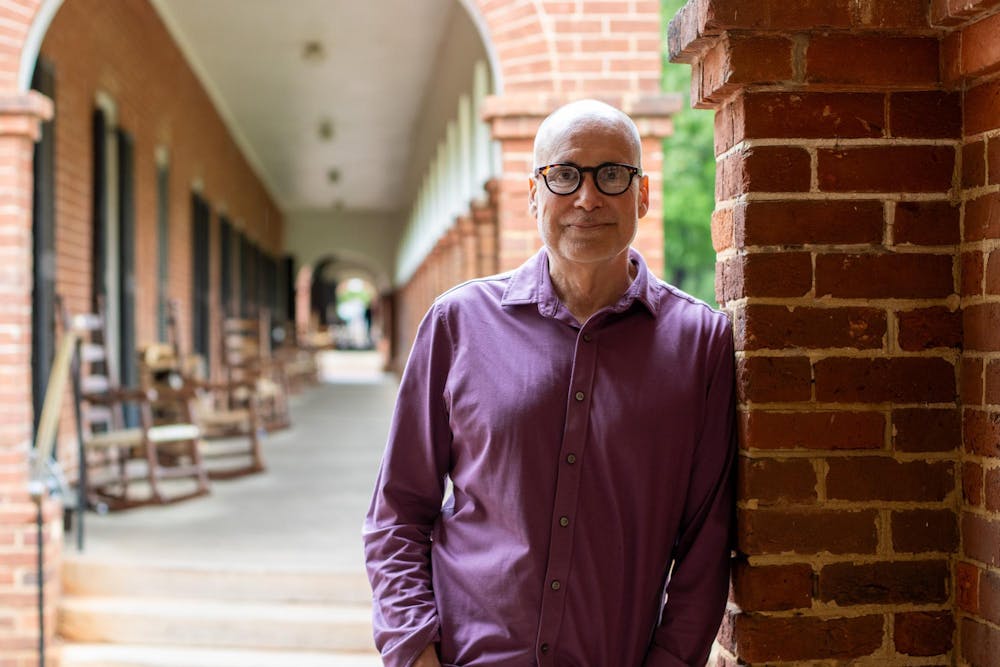
Assoc. Media Studies Prof. William Little has spent nearly 20 years teaching his students how to analyze film and draw deep connections to wider cultural and political contexts. To the dismay of many students — both those who have taken and who have yet to take one of his famed classes alike — Little taught his final class at the University in the Spring 2026 semester. After teaching wide-spanning genre courses from the gangster flick to the Western, Little later gained his notorious “cult following” of students from his seminar on the hit television show “Breaking Bad.”
This spring, Little taught his final course before retirement, MDST 3559, “What's The Deal?: Movies and the Make-Up of Trump’s America.” The class examined President Donald Trump and his relationship to media, synthesizing themes and ideas from his previous courses. Class of 2026 alumna Molly Canipe, who had not taken any of Little’s previous classes, found herself in the minority of a classroom filled with students who had taken — and loved — several of the professor’s courses in prior semesters.
“If you're a William Little fan, you've taken everything he's ever taught,” Canipe said.
Little’s transition into teaching media studies was gradual but essential to the development of his interdisciplinary teaching style. Moving coasts after attending Williams College in Massachusetts, he worked as an English teacher at the Harvard School — now known as Harvard-Westlake School — in Los Angeles. After getting his PhD in English from Indiana University, Little was coincidentally offered a job in Indiana at DePauw University, where he taught a range of primarily American-literature-focused classes for about 10 years.
A pivotal moment occurred during his time at DePauw, in which Little taught an entire course about “The Sopranos,” which was still airing at the time, that Little said opened his horizons beyond exclusively literature-based teaching.
In 2007, he moved to Virginia, and began working in the newly created Media Studies major at the University. He immediately began teaching genre courses in film — an area of deep knowledge for him — but had to educate himself on the broader discipline of media studies. According to Little, that year was auspicious timing for a deep dive into the study of media because the digital media landscape was growing more rapidly than ever before — Facebook was introduced in 2005 and the launch of YouTube and the iPhone came in 2007.
“I kind of went through a second graduate school [by teaching in the Media Studies department] almost, as I was finding my legs … I [began] … studying media history and media infrastructures and media audiences, and I’m just trying to learn as much as I can, and that’s separate from my study of film but related,” Little said. “Because … in the big scheme of things, it's not long before all of this innovation and change affects the film industry.”
The first class Little taught at the University evolved from his DePauw course on “The Sopranos,” and was called MDST 3640, “American Gangster Film.” The course reframed the genre as a way of talking about the history of modern America, bringing in cultural issues such as immigration, assimilation and the interplay between criminality and business and analyzing films including “Pulp Fiction,” “The Godfather” and “Goodfellas.”
As he spent more time at the University, his courses continued to evolve, looking at the interplay between genre and American history and culture. His class, MDST 3630, “Screening Terrorism,” explored the relationship between media and terrorism in a post 9/11 era. Another class, MDST 4660, "Watching the Detectives,” connected sleuth movies to the dawn of surveillance culture and issues of privacy and interrogation, analyzing films like “Mulholland Drive” and “Chinatown.”
He cited his course MDST 3650, “Shooting the Western,” as pivotal for the evolution of his teaching career. Going into its formulation, Little said he was not intimately acquainted with the genre, as he had not grown up loving the “Western” genre of films and did not have family who held a particular interest towards them. He said that unfamiliarity, however, drew him towards the topic.
“I often will go towards something that I don't know much about because I want to learn about it,” Little said. “This is a recurring … aspect of my whole career. I often find I want to teach about what I just want to learn about which makes for a really rewarding calling or professional experience, because I'm a perpetual learner.”
He said he developed a mantra he repeated at the beginning of every new semester of the course, insisting that knowing something about the Western was essential to understanding America. In the wake of the popularity of the television show “Yellowstone” and the blockbuster movie “Avatar” — a Western narrative set in space — Little said he saw these examples as proof that the genre thrived in the minds of Americans. Little said he was fascinated by looking at the evolution of the genre and how modern interpretations challenged the genre’s foundational problematic politics.
His course on the Western was pivotal for several reasons, notably for its influence on his “Breaking Bad” class — MDST 3115, “‘Breaking Bad’: Once Upon a Time with the Pests” — which became one of the most popular and high-demand courses in the Media Studies department. According to Little, “Breaking Bad” was the perfect synthesis of the Western and the gangster film.
The “Breaking Bad” class was Little’s first full course at the University to cover a singular television show, and Little said it took considerable effort to construct. Not only did Little pick specific episodes for students to discuss each week based on a particular theme or idea, but he also assigned texts to be read in conjunction.
“The reading is as important as the viewing,” Little said. “We can sit around and say, ‘hey ‘Breaking Bad’ is a cool show’ … but we can’t really do rigorous, analytical work unless we’ve got these readings.”
The readings inform Little’s interdisciplinary classroom model, covering topics from feminist studies to psychoanalysis to political theory. According to Little, he often intentionally chose readings that did not relate to the film or show to give his students room to draw their own connections.
One book that Little extracted readings from for his “Breaking Bad” class is titled “The Gift: Imagination and the Erotic Life of Property,” by Lewis Hyde. The book describes gift-giving as cross-cultural and universal, while emphasizing that a true gift is given without any expectation of return. Little said this idea of genuine gift-giving connected to Walter White, whose initial altruistic intentions as a teacher devolved into his role as a drug kingpin, devoid of any traditional conceptions of gift-giving.
Little’s career has been characterized by making connections between the written and observed, and the theme of genuine gift-giving has come up both in and outside of the classroom.
“The students I've taught … have given me incalculable gifts at every turn in every course, every semester, through what they've labored to cultivate in the way of their writing and their thinking and their innovative interpretive work on the films and the shows,” Little said. “I've just been really fortunate to be on the receiving end of those gifts.”
One gift appeared in spring 2022 when, after finishing Little’s “Breaking Bad” course, a student approached him, telling him that he wanted to be a teacher. Little invited this student to help him develop a sibling course to his “Breaking Bad” class. The co-designed course focused on “Better Call Saul,” a follow-up prequel series covering the origins of Saul Goodman, Walter White’s criminal lawyer.
Little would go on to co-design multiple courses with students, including this semester with “What's The Deal?: Movies and the Make-Up of Trump’s America,” his final class before retiring. The class, co-designed with fourth-year College student Nicholas Sutherland, synthesized a number of Little’s past courses while focusing on Trump in an era inundated with media engagement. The class looked at films that Trump has specifically referenced, as well as those that encapsulate the prototypical Trumpian figure or the complexities of the “Trump world." Students, such as rising third-year College student Aidan Goldberg, credited Little’s intertextual approach to helping them draw connections and provide clarity in a rapidly changing, seemingly senseless era.
“I think he fundamentally altered how I watch movies,” Goldberg said. “With [Little’s class] you can watch that movie and read … a French philosopher or an academic who writes in a completely different field, not in media studies, and you can connect that to the interdisciplinary, intertextual, genuine thirst for answering questions that you think films are … bringing up.”
Several students mentioned that one of Little’s unique qualities as a professor is the care and attentiveness he pays to both his students and the curriculum, with the reciprocal gift-giving of knowledge and critical analysis between student and teacher.
“I think he kind of inhabits every space he's in with all the effort he has to give,” Canipe said. “And he really cultivates a sense of expecting that from you as well, in a way that's really gratifying … He believes in your capacity to be an analytical thinker … and I think it's rare to feel like a professor believes in you in the same way that he does. I think it makes you want to be better.”
Little said he plans on continuing to write creatively and critically after he retires, and will remain intellectually curious. Although he has been teaching through many different eras of America — and his most recent class has explored current cultural issues such as domestic terrorism and white supremacy — Little said his classes have given him hope, not fear, for the future.
“I always go back to this. It's the art, it's the artists, it's the art communities that create these works that are so powerful and so rewarding,” Little said. “I know outsiders could say, ‘Well, what difference does a film make? Film doesn't make any difference. You can't change the world with a film.’ But I do think it can.”
Read More

The Virginia Dance Company trades competition for community
By Eloise Diffley | 7 hours agoThe Virginia Dance Company is composed of a tight-knit group of dancers, most of whom have danced competitively and consistently throughout childhood and high school.

Hoo’s Watching: Anatomy of a teen TV show
By Caroline Lee | 2 days ago“Crew Girl” is not reinventing the wheel, nor is it particularly interested in doing so.
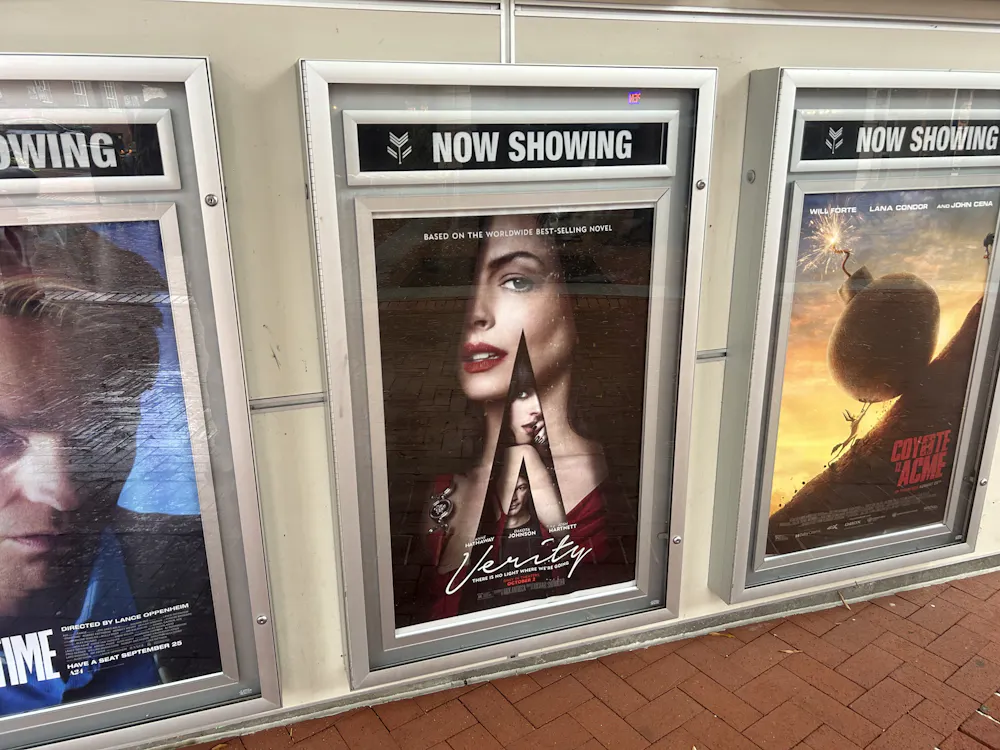
‘Verity’ falls short on its psychologically thrilling promise
By Julia Prevost | 2 days ago“Verity” is entertaining in moments, particularly when its dialogue becomes so outrageous that disbelief gives way to amusement.