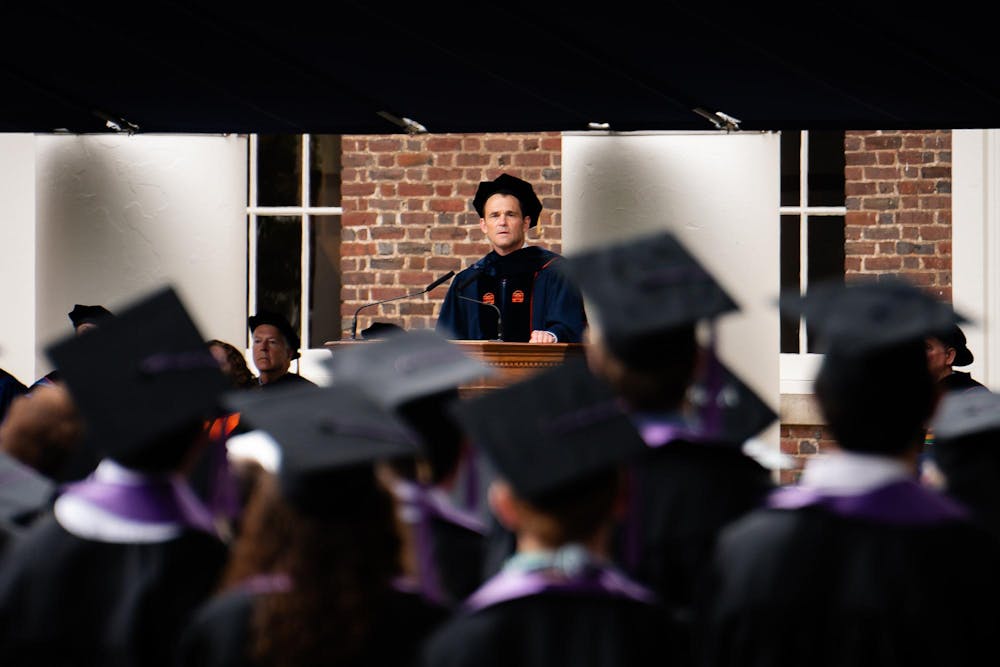
On May 16, Scott Beardsley will preside over Finals Weekend as the 10th president of the University of Virginia. The graduating class will hear from former University President Jim Ryan, who was removed from the position almost a year ago.
This is not a protest. Nobody organized it as a rebuke. Instead, the Fourth-Year Trustees chose Ryan because they believed he was the most qualified and appropriate candidate — a move that was met with overwhelming support throughout the community. The subtext is hard to ignore. Even out of office, Ryan continues to command the kind of legitimacy and affinity that the presidency itself is supposed to confer.
As every student here feels in some way, Ryan somehow gave the office of president a specific gravity that is difficult to articulate but hard to miss. Most students at other schools feel distant from their leadership, but Ryan was, and still is, embedded in the community in a special way. Whether it was the recent Run With Jim with the Class of 2026 or the ceaseless appreciation for him manifested in this Valedictory Exercises selection, what Ryan represents is a University leader whose legitimacy was earned through presence and connection, rather than conferred by title alone.
This May, he is speaking to a class that knows him, has woken up uncomfortably early to run with him and in many ways experienced the University through his leadership. That familiarity collapses the usual distance between speaker and audience, and in doing so, changes the meaning of the speech itself from a sendoff to a continuation of a relationship that has not fully receded. Admittedly, this is nontraditional. Unlike most Valedictory Exercises speakers, who arrive as accomplished outsiders delivering wisdom from a distance, Ryan is returning as someone the graduates already know, which will inevitably change the tone of the message being delivered from an abstraction to something more grounded and honest.
That is what makes the visual of this year’s ceremony so charged. Ryan will stand at the podium delivering the final words to a class shaped during his tenure, while Beardsley presides over the event in a quieter, more symbolic capacity. The arrangement is not intended as commentary, but it functions as one nonetheless — placing both presidencies in direct proximity and juxtaposing their degree of leadership over the people in front of them.
That proximity does not create tension so much as it creates comparison between the two. Ryan’s presence reinforces a particular model of what that office looked like. By giving him the microphone at one of the University’s most visible moments, the University is implicitly elevating that model, making it the version of leadership most freshly remembered and most publicly affirmed. Still, all of this does not preclude Beardsley from defining his own approach, but it does mean he will do so in the shadow of a very recent and very specific standard. Leadership transitions are supposed to offer a reset and a chance for expectations to loosen before they are redefined, but this moment does the opposite. It sharpens expectations immediately and ensures that the evaluation of what comes next will be shaped, at least in part, by what came just before.
With these final words from Ryan, the bar is permanently raised. Students and the University community will implicitly expect more from our leadership, especially in the kind of visible, day-to-day engagement that students have come to see as normal. As a result of Ryan’s leadership, that level of presence has shifted from being an added bonus to something closer to a baseline expectation. As a result, future leadership will not be evaluated solely on decisions or long-term outcomes, but also on the consistency and authenticity of its connection to the student body. Beardsley has made efforts to engage with the community, but the expectation of accessibility is no longer aspirational. It is now a baseline, and it will shape how his presidency is received going forward.
Finals Weekend is not just a ceremonial formality. It is the moment when the University presents itself to its newest alumni and to the world, making a statement about what it is and what it values. This year, the University will make that statement with Jim Ryan's voice and Scott Beardsley's presence, and the juxtaposition will be visible to everyone in attendance.
Ryan Cohen is a senior opinion columnist for The Cavalier Daily. He can be reached at opinion@cavalierdaily.com.
The opinions expressed in this column are not necessarily those of The Cavalier Daily. Columns represent the views of the authors alone.
Read More

HAWKINS: Florida gets education affordability right — Virginia does not
By Joshua Hawkins | 12 hours agoFlorida already has better weather — we do not need to let them beat Virginia at education affordability as well.
ANDERSON: Why I am ‘dark woke’ — and you should be too
By Beckett Anderson | YesterdayArising from an internet meme, dark wokeism offers Democrats a youth-powered way out of the hole they find themselves in.

HASNAIN: The mental health taboo and its many adverse effects
By Zehra Hasnain | 2 days agoYet, I write this not to propose some novel solution on finding inner peace and instead hope to push students to capitalize on existing reliable resources.