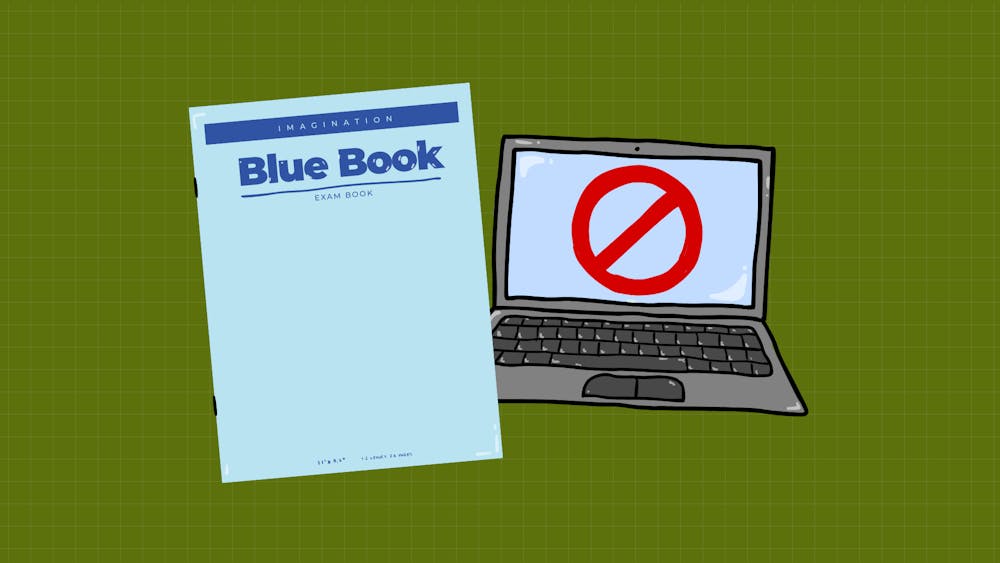
According to the Summit Educational Group — a company that provides private tutoring services — blue books are resurfacing on college campuses. Professors in the University’s history and politics departments are experimenting with different ways to evaluate students, with an emphasis on in-person examinations where the student — not artificial intelligence — must show up and display their knowledge.
Roaring Spring Paper Products — one of the main manufactures of blue books — told the Wall Street Journal that blue book sales have increased largely since COVID-19 in 2020 and 2021 due to the rise of AI use by students. Blue books are small, staple-bound booklets with blue paper covers used by students for handwritten essays or exams. According to the University Bookstore Executive Director Cristy Huffman, the University has seen a roughly 27 percent increase in blue books sales from April 2024-25 to April 2025-26.
The Wall Street Journal also reported last spring that blue book sales were up more than 30 percent at Texas A&M University and 50 percent at the University of Florida for the 2024-25 academic year. Sales also increased 80 percent at the University of California, Berkeley, over the 2023-24 and 2024-25 academic years.
Several University professors — especially those who teach in larger lecture settings — have increased their requirement of blue books for in-person written exams. Jennifer Lawless, politics professor and chair of the politics department, said within the department, blue books had been sitting dormant for years and now have quickly made a comeback due to the challenges posed by AI.
“I think there are other professors that have decided we're just going straight to blue books and there's no way around it,” Lawless said. “I think some people are being more creative, and some are being more reactive.”
Lawless said there is not just one response to current technological advancements — according to Lawless, AI policy in the classroom is becoming part of her teaching. She said blue books offer a “reactive” solution to avoiding AI for some professors, but she is trying to be “proactive” to better understand how AI can be integrated in a way that does not undercut the learning experience.
Assoc. History Prof. Jennifer Sessions said she made the transition to blue books in her classes this semester, which she had not used in a decade. Sessions said lately, many students have expressed worries of being falsely accused of using AI, so having in-person blue book assessments is a way to avoid that situation.
Second-year Commerce student Jordan Quint said he participated in an in-class blue book essay for his history course about The Cold War. He said he thinks blue books are the best way to currently assess students on college campuses if professors are not able to use other forms of technology like lockdown browsers, which lock the online testing environment to ensure students are not using AI tools during online examinations. Quint said he believes that blue books will likely be a long-term solution to combat AI.
“I understand that technology is constantly changing, but I do think that blue books are probably here to stay,” Quint said. “I think that they're effective and a consistent way to evaluate kids without any fear of external resources being used to impact our thoughts.”
Simultaneously with the rise of blue books, the University has seen a rise in no-technology classes. Fourth-year College student Peter McHugh said classrooms that prohibit the use of laptops force students to think without the influence of the internet or AI. He said that while both blue books and no-technology classes are engaging, they are only a temporary solution to combat AI.
“I feel like [using blue books] is a system that is postponing the inevitable, where classrooms will have to eventually adapt to the AI environment,” McHugh said. “They don’t really know how to do so at this point, so they’re just switching to [a] purely physical curriculum.”
Todd Sechser, politics and Batten professor, has recently shifted the curriculum of his politics course PLIR 3080, “International Politics in the Nuclear Age,” to combat AI by incorporating more interactive, in-person assignments, rather than making the shift entirely to blue books. This semester, he implemented a live in-person debate about a policy memo between students.
“One thing that AI cannot do is impersonate you,” Sechser said. “It cannot substitute for in-person interactions, and I think … that’s where we’re seeing assignments start to drift toward."
Sechser said he quickly realized that AI was going to be something nearly impossible to regulate because of the difficulty in distinguishing what is written by AI versus what is not. According to Sechser, writing “well” used to be a rare skill to come across, and now anyone can produce strong writing with various AI tools. However, he also said while AI can produce good writing, the student is ultimately the one taking the class, and without specific prompting, the AI model will not be able to hone in on key concepts explored in class.
“AI can do the writing for you, but it's not sitting in class, and, at least right now, we still have to give it some guidance on what to write,” Sechser said.
Lawless said that overall, she believes it is important to retain the process of writing. She said in smaller seminars, traditional essays are easier to assign than in larger lecture courses. According to Lawless, seminars often offer students the opportunity to produce writing over the course of the class, revising and incorporating feedback throughout the semester.
Sessions said she has also begun thinking about larger questions — beyond AI and the use of blue books — about the purpose of writing and why students should write essays.
“What is most upsetting to me personally, both intellectually and maybe ethically, is this idea that AI companies and AI boosters are promoting that writing is an obstacle to getting things done,” Sessions said. “In history, and I think this actually applies much more broadly, even in the sciences — the fact of the matter is that writing is thinking.”
According to Lawless, professors have not reached a complete consensus on how to approach technology in education. She said many professors are still learning and adapting their approach as they go.
“[Professors] want to make sure that when students leave our class, regardless of the tools that are out there, compared to five years ago or 10 years ago, they [learn] just as much … and different people arrive at that in different ways,” Lawless said.

Lidia Zur Muhlen is a staff writer for the news desk and frequently covers artificial intelligence for The Cavalier Daily. She is a third-year College student pursuing an interdisciplinary course of study examining the politics, ethics and economics of emerging technologies.
Read More
Student Council appoints members to election reform commission
By Lucia Gambacini | YesterdayStudent Council also announced several other cabinet appointments and discussed concerns surrounding parking on Central Grounds.

Students, professors weigh in on the importance of letter grades
By Ruby Budetti | YesterdayWhen thinking about letter grades for themselves, many University students and faculty said they prefer letter grading throughout all four years of college.
What services does the Student Health Fee provide for students?
By Melody Yuan | YesterdayThe University Board of Visitors approved tuition and fees for the 2026-27 academic year in April, and the Student Health fee rose from $1,147 to $1,184 per student.