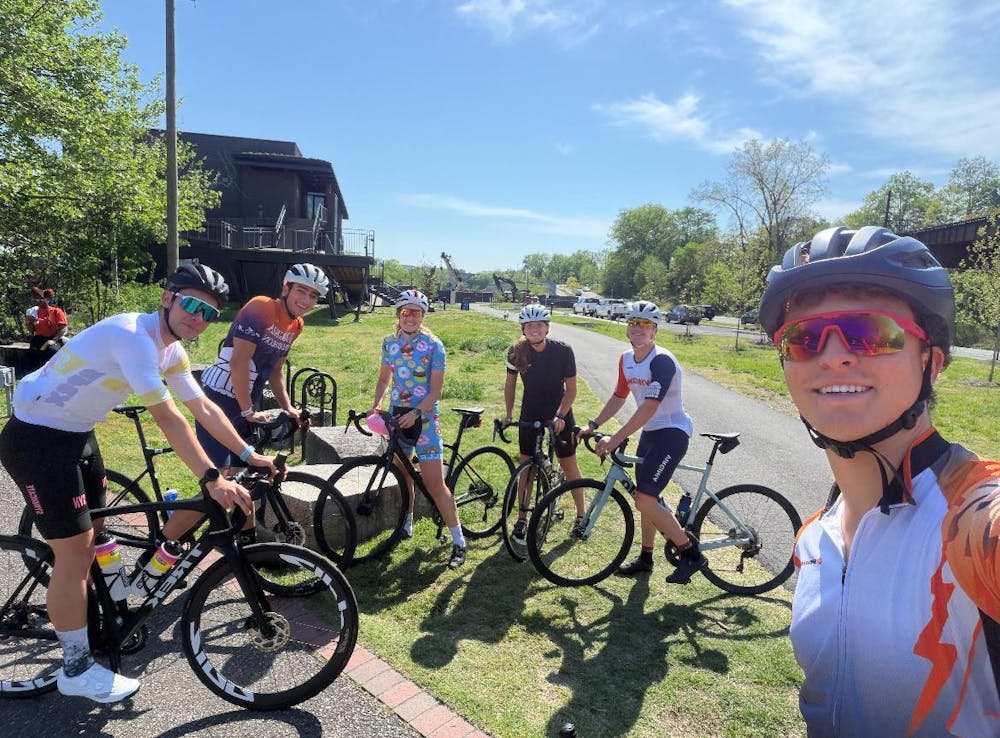
On May 9, three University students began their journey alongside three other college students on a 29-day-long, 3,700-mile bicycle journey to answer one question — what does the future of food look like? As they pedal from Seattle, Wash. to Washington, D.C., the Roots on the Road team aspires to learn and document how individuals nationwide understand food systems.
The team includes second-year Commerce student Augusta Halle, first-year College student Molly Moore and second-year College student Stephen Wolf — along with Benjamin Meinert, sophomore at North Carolina State, Georgetown University alumna Eve McBride and Gavin Patterson, freshman at the University of Mount Union.
Roots on the Road centers around regenerative agriculture, an approach that prioritizes the restoration of soil health, biodiversity and ecological resilience. Regenerative agriculture is about more than sustainability — it actively seeks to restore and improve the health of ecosystems, rather than simply maintaining them.
The project is grounded in the idea that every act of eating is also an act of participation in the agricultural system, and the team hopes to bridge what they see as a growing disconnect between producers and consumers. Moore explained how the project aims to spark conversation about the agricultural and food industries, as well as consumer interaction with them.
“Roots on the Road is, I would like to say, a starting line to opening up more conversations about what the future of food looks like across America, especially among people in our generation,” Moore said.
Along their route, the team plans to stop at farms, classrooms, kitchens, warehouses and farmers' markets. At these sites, they will speak with food entrepreneurs, chefs, restaurant customers and industry leaders to get a diverse range of perspectives regarding how Americans envision the future of food.
The project originated last summer during a research trip in the Bahamas, where Halle and a friend of hers completed a 200-mile bike ride spanning the entire Island. Traveling on beach cruisers with cardboard signs reading “Got snacks?”, Halle and a friend of hers wanted to minimize the amount of food they carried by relying on the help of strangers. On their ride, strangers gave them cantaloupes, chips, home-cooked lunches and even offered lodging in their homes.
“It was on that ride that we got to hear about people's perspectives of the food system, and we got to live through their experience, and we got to hear about the struggles and the strengths and the supply chains and everything in between,” Halle said. “So that's what really got me thinking. What if we could have that impact on a larger scale?”
Halle said that experience is what inspired her to assemble a group to bike across the country with. In addition to being motivated by their previous experiences with endurance athletics, both Moore and Wolf were also drawn to Roots on the Road due to the National Portraits Project, a central component of the initiative.
The National Portraits Project consists of a live interactive map that will launch on the first day of their journey, featuring short-form digital clips, a mini-docuseries and interviews to create a comprehensive portrait of their experiences on the ground. Wolf noted how, through the project, Roots on the Road hopes to spark awareness and curiosity about food cycles and systems, hopefully paving the way for future action.
“Action and movement towards the future [requires] people to be aware of things now,” Wolf said. “If that doesn't happen, then future action just isn't going to get started.”
In addition to making their findings available on their website through the National Portraits Project, the team also hopes to later publish a children’s book about their experiences. Through these various mediums, the team aims to translate their research into accessible storytelling for a wide array of audiences, encouraging broader reflection on the future of food systems and the role individuals play within them.
“We really hope to put these different perspectives in conversation with each other, to capture what the current landscape of the agricultural system is and where it's headed,” Halle said. “What better time than now to look at our food system and see the innovative solutions that we can move forward [with] in [this] country.”
With the aspiration of accurately capturing such a vast industry, the journey towards their end goal of raising awareness about the food system began long before the wheels hit the road. Months in advance, the team began individual cycling training and divided up outreach responsibilities, relying heavily on cold emailing and phone calls to connect with farms and organizations.
In order to fully immerse in the environment they pass through and reduce lodging costs, they plan to stay at farms, churches and the houses of family and friends. Halle also noted that the Jefferson Trust was an essential actor in both networking and financial support.
To create their route, the Roots on the Road team mapped cross-country bike trails and identified stops along the way. Additionally, in order to mitigate risks of injury or exhaustion, they plan to take turns driving a van to each stopping point. Each biking segment is split by their daily mileage, spanning between 60 and 100 miles on biking days.
Wolf noted how the physical act of biking is essential to understanding the landscapes they are documenting, highlighting the role storytelling plays when it comes to inspiring action.
“I think stories about innovation — really, any stories about hope, is what it comes down to,” Wolf said.
In particular, the Roots on the Road team is interested in farms that innovate at the intersection of sustainability and profitability. According to Moore, this sustainable agriculture is important in addressing food equity issues like food deserts. To further explore this topic, the team hopes to stop at urban farms that cater to low-income areas to bring nutrient-dense, fresh food to an otherwise underserved community.
“We make more food than we need to feed the people on this planet, but it's not distributed in a way that's healthy or equitable,” Moore said. “I'm hoping that we get to stop by a community farm in Chicago, and they are focused on bringing people [food] who don't usually have access to clean … nutrition.”
Together, these themes of innovation, sustainability, accessibility and visibility reflect the broader goal of Roots on the Road — to drive change through storytelling. Throughout their journey, they plan to ask open-ended questions, unbound by preconceived ideas about the food system or the lived experiences of anyone they meet. According to Halle, this is paramount to accurately representing the stories heard.
“We're going in with completely open minds, and we just want to be vehicles … for people to pedal change and to be able to let other people learn through what we capture,” Halle said. “We're coming in with no answers, but with open ears, wanting to listen and wanting to hear. ‘What are solutions that we haven't even thought of?’”
Read More

Delicious on a dime: Charlottesville’s best restaurant deals
By Lucy Larsen | 4 days agoFrom wraps and wings on the Corner to imported wine and tapas on the Downtown Mall, these are the perfect spots to treat both your taste buds and your wallet for under $25.

Play the organ
By Elizabeth Adams | September 25, 2026The college side quest does not need to be the multi-semester jaunt that my organ adventure has become, and it certainly doesn’t have to make sense.

Girls Who Lift brings gender inclusivity to the gym
By Sadie Adams | September 23, 2026By providing this safe space in the gym, Girls Who Lift encourages more women to take up weightlifting as a hobby.