
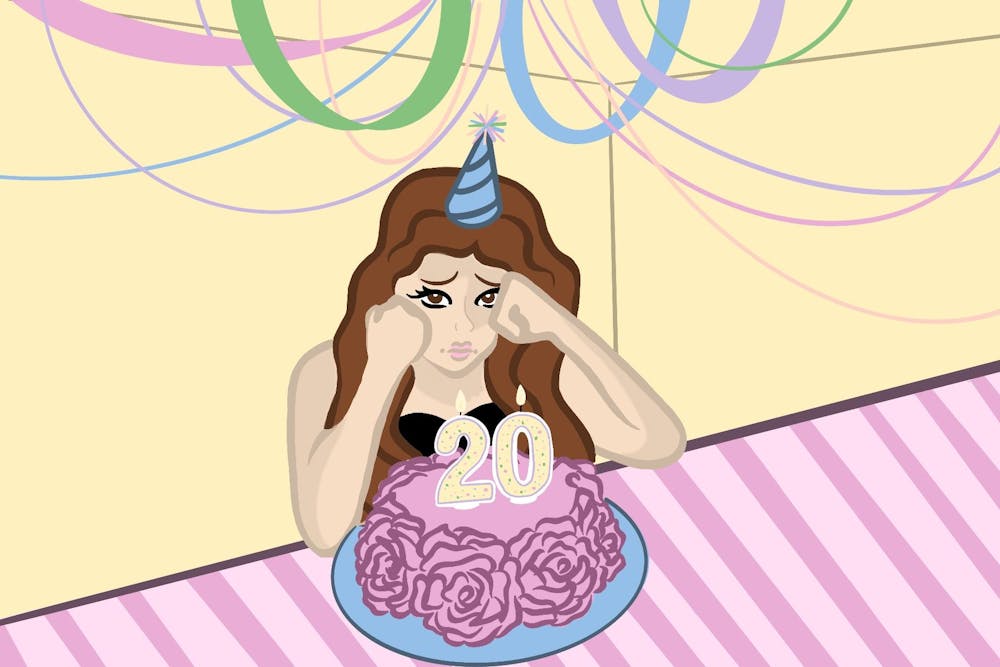
I feel like I’ve been a teenager all my life. When I was a kid, I glamorized the beauty and thrill of being a teen — wearing makeup, staying out late, breaking rules. Being a teenager meant freedom, but within reason. Messing up, yet still having people to lean on. It felt like the perfect in-between. Looking back on it, it really was.
I remember being 15 and inviting all my friends over. We would lie on the floor for hours, exhausted from laughing, music blasting, doing our makeup slowly because we were getting ready to go absolutely nowhere. I even brought all my friends on my first date because I was too scared to go alone. It didn’t feel embarrassing, I was a teenager.
As 18 approached, I felt like it was going to be a turning point — the moment I officially became an adult. But it didn't really feel like anything was changing. I still went home at the end of the day, and I still relied on my parents. I still felt like I had space to mess up without it meaning something about who I was. Ultimately, I still had “teen” at the end of my age, and even though I was technically an adult, I felt the comfort of that trusty suffix cushioning my fall. I wasn’t all that different, really.
Twenty was different, though. Twenty was a whole new decade, a separate set of rules and expectations that I hadn’t agreed to. Suddenly, I needed to be more independent, mature and know how to act professionally. There was no more “teen” at the end of my age to soften it, and I felt like I was being pushed into a new version of myself I wasn’t ready to become.
In the months preceding my 20th birthday, I felt almost a sense of impending doom. I didn’t feel excited when people asked me how I was celebrating “the big 2-0.” Instead, it felt like the number marking my age kept climbing higher, while I stayed just as small inside.
In trying to understand where this fear was coming from, I realized my feelings had a lot to do with the people around me. Everyone I knew seemed to be in completely different places — some getting engaged, some just now in their first relationship and others with internships stacked up and clear professional paths ahead.
Regardless of where they found themselves, all of these people seemed to know exactly what they were doing, and what they wanted out of adulthood. They knew how to tackle this new decade — how to act and how to present themselves. And I started to wonder if, in order to do the same, I was going to have to become someone different.
I was afraid I would be clueless and ditzy forever, frozen in time, while everyone else moved forward — becoming more earnest and sure of themselves.
I can recognize that this sentiment is not uniquely mine — I think a lot of people have a fear of growing up. For me, this fear came from my background in gymnastics, where it felt like my body had an expiration date.
Time was always something I was constantly aware of as a gymnast — something that determined what I could and couldn’t do, how quickly I was improving compared to peers, when I would peak and eventually have to quit. That mindset stayed with me longer than I realized, turning aging into a constant countdown rather than a natural progression of life.
What made the countdown worse, however, was being constantly pitted against my teammates. And while I thought quitting gymnastics would free me from that mindset, I found that I, myself, had simply become my comparative coaches in their absence. Getting older just meant a bigger playing pool, more people to measure myself against and more reasons to be afraid of it.
So now, at 20, it feels like there's more to measure up to than ever. And consequently, I am turning to comparison more than ever. It feels like everyone else seems to have everything figured out, perfectly balancing classes, volunteering, internships and a social life, while I’m just trying to keep my head above water.
In an effort to stop wallowing in this uncertainty and self-doubt, I have recently made a point to consider what the transition to adulthood has given me, rather than just what it’s taken away. And in talking with friends going through the same transition, I’ve been able to reflect on some of the positives of being in this new phase.
I have a kind of freedom now that I once dreamed about. I can go on trips or meet friends for coffee whenever I want, with the independence to make my own schedule. I’m studying at a school I always wanted to attend, building a life that younger me would have been really excited about. I get to study psychology, something that I’ve always dreamed of learning, and each year, I gain a whole new array of valuable life experiences under my belt. Being at this point in my life is such a privilege, and such an incredible, invigorating experience.
Still, comparing myself to others is a terrible feeling, and it's something I am continuing to work on to this day. I have learned that constant comparison obscures reality, making other people seem perfectly put-together, when in reality, they’re probably just as stressed and unsure as I am.
On the other hand, I'm starting to think the discomfort isn't entirely a bad thing — it means I care, that I want more for myself, that I'm still growing. After all, comfort is the enemy of growth, and even if I’m not exactly where I want to be right now, I’m getting there little by little.
Coming back to gymnastics in college, after years of convincing myself I'd missed my moment, showed me that more than anything. It showed me that parts of myself don't just disappear with age. They'll always be a part of what makes me… me.
I don’t think being in your 20s is about having everything figured out. If anything, it’s about figuring it out as you go along. Each year brings new experiences, new knowledge, new versions of myself I get to unpack. I still have a lot to learn about adult life, and I do need to get more intentional about school and internships — but I don't have to lose the parts of myself that feel most natural just to prove I'm growing up. I’m starting to see that growing up doesn’t have to feel like a countdown — it can just be what it is.
Even if I don’t have “teen” at the end of my age anymore, I’m starting to feel excited for this new phase in my life — and every era that follows. So I’ve decided I am going to start glamorizing the era that comes next, whether that’s my roaring 20s or being 30, flirty and thriving.
Read More

The Ozempidemic — is social media telling the full story?
By Dana Douglas | 11 hours agoTo strain the surplus of information about GLP-1 medication circulating on social media, The Cavalier Daily spoke to those on the frontlines of the phenomenon — University medical professionals and a student prescribed GLP-1 — to uncover what this development actually looks like for the future of weight management, diabetes treatment and American healthcare as a whole.

One poke bowl, endless possibilities
By Astrid Cheng | 2 days agoThough this version is my personal favorite, this recipe is meant as a starting point, not a rulebook.
Learning from the land at the University’s Morven Sustainability Lab
By Kendra Mickle | 3 days agoSpread across nearly 3,000 acres of rolling hills, luscious forests and farm lands, the property has become a hub for sustainability education and experiential learning for the University community.


