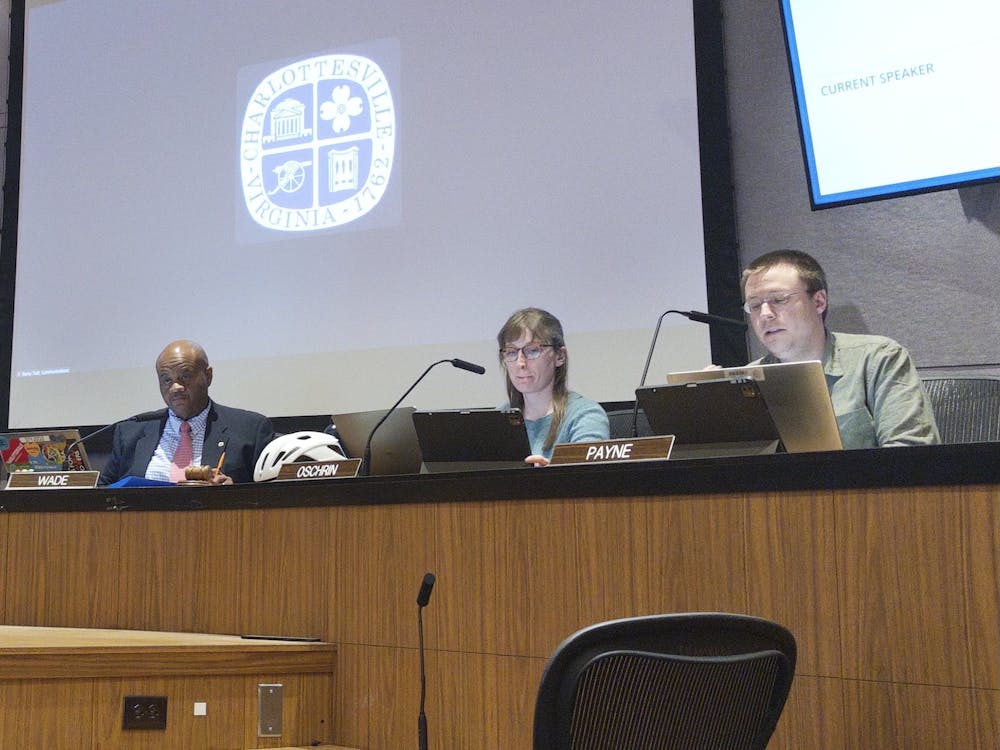
The Charlottesville City Council heard a report from 3TP Ventures — a community planning consultancy firm — and Neighborhood Development Services on possible changes to the City’s Affordable Dwelling Unit Monitoring and Procedures Manual at a regular meeting Monday. The report suggested increasing the fees private student housing developers pay to support affordable housing in the City.
3TP also suggested eliminating the City’s controversial half-mile radius rule, in which private “student housing” projects can be constructed and pay a reduced fee to support affordable housing. Some community members expressed concern, however, with the possibility that 3TP relied on unsound formulas to assess the feasibility of these and other possible changes to City policy.
In its review, 3TP and NDS considered the current system for calculating developer fees to support affordable housing and the merits of the half-mile student housing radius. Under Charlottesville's current Inclusionary Zoning rules, housing development projects in the City with 10 or more units must set aside 10 percent of units at less than 60 percent of the area’s median income, according to Kellie Brown, director of neighborhood development services for the City. When a developer does not wish to include affordable dwelling units as part of their project, or wishes to make less than 10 percent of units affordable, they must pay a fee to the City to make up this difference.
According to Brown, this “in-lieu fee” is currently calculated under a “construction cost” model. The model mandates that developers pay the average cost for developing a unit in Charlottesville for every unbuilt unit needed to satisfy the requirement.
Projects that lease bedrooms on an individual basis and are located within a half-mile radius of Grounds qualify as “student housing” projects, and pay a reduced fee at the rate of a regular, market-rate unit minus that of an affordable unit. This is because private student housing does not traditionally incorporate units for non-students, making an in-lieu fee obligatory. The fees are placed into the City’s Affordable Housing Fund — a grant program that provides funding to nonprofits and developers “for the creation, preservation and rehabilitation of affordable housing” in the City.
In its study, 3TP and NDS considered whether the current in-lieu fee calculations as outlined in the manual are accurate and reviewed the in-lieu fee practices of other jurisdictions to consider alternative options. It further engaged with City staff and “stakeholders” such as neighborhood leaders, the Housing Advisory Committee — which advises the Council on affordable housing policy — and respondents to an online survey to hear community concerns with current in-lieu fee policies.
Chief among the stakeholders’ concerns, according to Brown, was the perception that private student housing is encroaching into “year-round residential areas.” Additionally, she said residents express concern that the lower in-lieu fee for student housing is “incentivizing” the development of affordable housing near neighborhoods vulnerable to displacement and that in-lieu fee policies are a “loophole” allowing developers to avoid building more affordable units. Amanda Klepper, senior planner at 3TP, also explained that one of 3TP’s potential concerns with the “construction cost” model for calculating fee payments is that the model overestimates construction costs, leading to increased fees which could pose a burden for developers.
The report presented to the Council recommended switching to an “Affordability Gap model,” which measures the difference between the value of a market-rate unit and that of an affordable unit and could take into account different affordability levels depending on the subsection of the City in question. This fee would effectively be lower for non-student developers than the current “construction cost” fee. The report also recommended mandating that student housing and non-student housing pay the same in-lieu fee to the City, eliminating the need for a half-mile radius and increasing the amount in fees that student housing projects pay to the City.
The feasibility analysis for potentially altering this fee structure relied on a model that 3TP presented to the City in February to assess the feasibility of a separate tax-abatement policy, as well as to model the potential impacts of construction incentives on various housing projects’ profitability. It indicated that the new fee structure would slightly increase development costs for student housing projects without being likely to severely detract from development feasibility.
Community members expressed concern, however, with the reliability of this model. Rory Stolzenberg, former member of the Charlottesville planning commission and a resident of Water Street, sent an email to the Council and Planning Commission late Sunday evening, in which he challenged its reliability.
According to Stolzenberg, 3TP’s model has numerous “formula-level errors,” including a $20 million error that significantly underestimates the Internal Rate of Return — which assesses property returns over time — of City housing projects. The model does so by mistakenly accounting for a developer’s initial investment twice as part of its profit calculation, according to Stolzenberg. In his email, he argued that the flaws in 3TP’s model render it unreliable as a tool “for policymaking in its present form.”
Jeremy Goldstein, director of analytics for 3TP Ventures who presented the model to the Council in February, asserted that the miscalculation of IRR has no impact on the feasibility analysis for a new fee structure, in response to a question by Council Member Jen Fleisher. Stolzenberg told The Cavalier Daily in a written statement Thursday that he agrees with Goldstein in that the IRR error is “tangential” to the in-lieu fee analysis, which primarily relies on factors like market and affordable rent numbers. He argued, however, that there were numerous other errors — including an instance where a person inputted the market rent for a one bedroom unit at The Pavilion as being $22,559 instead of the correct $2,559 — which would directly impact the analysis.
“There are other issues with the model I unfortunately uncovered, and some of those would affect the in-lieu fee calculation,” Stolzenberg wrote. “That one mistake increases the model's [one bedroom] market rent assumption for student housing by over 20 percent. That's certainly an issue that I'd think would affect rent gap calculations.”
In response to a question by City Manager Sam Sanders, the majority of Council Members said they desired more information on the impact the altered fee structure would have on non-student developers and the mathematics of the model before taking steps to move forward with recommendations immediately. Council Member Michael Payne was the only one in favor of taking steps to move forward.
During the “Community Matters” segment of the meeting — the portion of Council meetings in which up to 16 members of the public can address the Council for three minutes each — other community members expressed concern that 3TP’s recommendations do not fully address the concerns from community members that the City does not adequately require affordable housing units.
Terry Tyree, member of the National Association for the Advancement of Colored People and president of the Charlottesville Community Resilience Center, said the report validates community concerns of displacement and a belief that allowing in-lieu fees instead of requiring affordable housing units in projects “is not working.” Tyree said, however, that she hopes the Council will go further and make affordable units as part of housing projects mandatory.
“We cannot continue to center developer feasibility over community stability,” Tyree said. “Tonight we are asking you to go further — require on-site affordable housing, especially in high impacted areas, strengthen anti-displacement protections … and most importantly, create a process where residents are not an afterthought.”
The next regular, bi-weekly City Council meeting will take place May 4.

Luca Bailey is a third-year College student majoring in politics from Free Union, Va. As a staffer on the news and video desks, he has covered topics ranging from the General Assembly and state elections to local politics and University governance. He is also The Cavalier Daily’s beat writer for the Charlottesville City Council.
Read More

Students, professors weigh in on the importance of letter grades
By Ruby Budetti | 6 hours agoWhen thinking about letter grades for themselves, many University students and faculty said they prefer letter grading throughout all four years of college.
What services does the Student Health Fee provide for students?
By Melody Yuan | 6 hours agoThe University Board of Visitors approved tuition and fees for the 2026-27 academic year in April, and the Student Health fee rose from $1,147 to $1,184 per student.

The ‘AI and Future of Work’ Series — How the University is preparing students for what is next
By Lidia Zur Muhlen | 8 hours agoIn a recent Gallup Inc poll, 79 percent of Americans believe that artificial intelligence will reduce the number of jobs over the next 10 years.