
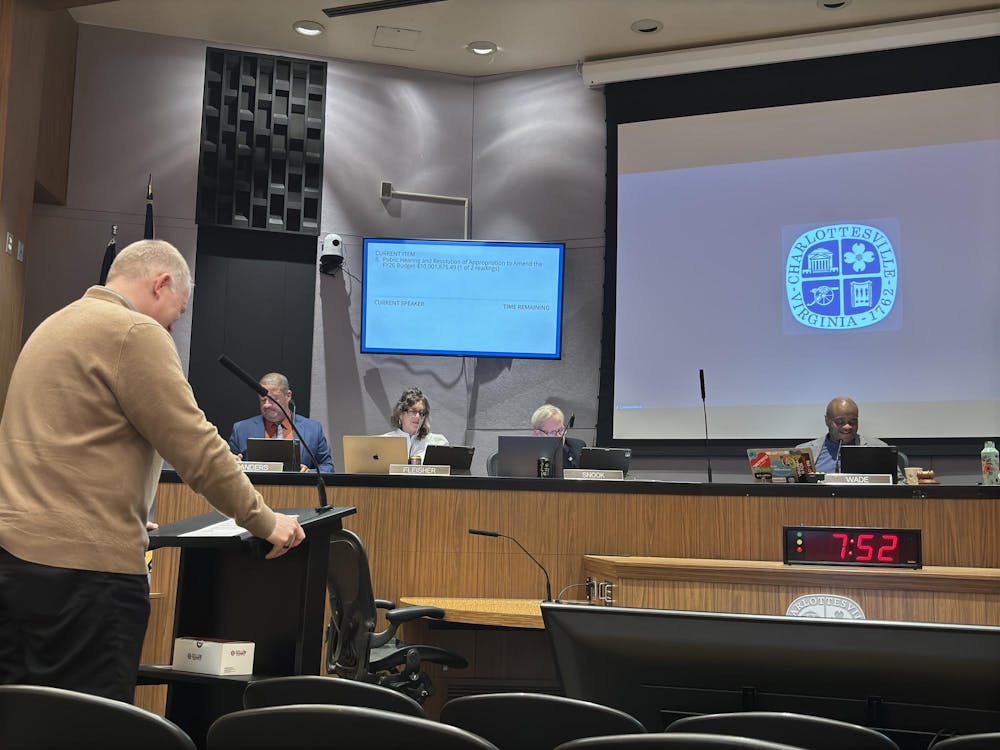
Charlottesville residents and University students voiced their continued concerns with the student housing development project on West Main Street at a City Council meeting Feb. 17. Students and citizens asked the Council to be more proactive in creating affordable housing solutions for marginalized communities and preventing gentrification brought on by student housing. The Council also considered minor reforms to zoning rules and heard a report on tax policy, both of which sparked discussions among councilors on issues related to student housing.
Local organizations, community members and students have long argued that University expansion and an increased student population have contributed to gentrification — the process by which low-income communities are displaced by wealthier individuals moving in and driving up costs — in largely Black neighborhoods within Charlottesville.
One controversial project that came up in the meeting is the proposed development of a multi-story apartment building on West Main Street which is primarily expected to serve University students, according to 29News. The project is proposed by LV Collective — a real-estate developing firm based in Austin, Texas. Residents of Westhaven and 10th & Page have previously argued the new building would decrease accessibility to their neighborhoods and could result in their displacement.
During the Council’s regular “Community Matters” session, councilors heard public comments from 16 speakers. Many were community members and University students who showed up to the meeting to voice their continued concerns with the project on West Main Street.
One speaker, fourth-year Batten student Rachel Mulvaney, argued that allowing such a project to go forward is inconsistent with values the Council outlined in its 2025 vision statement — which states that Charlottesville is a leader in healthy race relations.
“If that is who we are as a city … why, week after week, are there residents standing here asking merely to be heard?” Mulvaney said. “[This project] prioritizes student luxury housing while adjacent neighborhoods worry about blocked access to downtown, blocked sunlight … and erasure [and] it sends a clear message.”
Latricia Giles, executive director of the Charlottesville Public Housing Association of Residents, asked Council members to proactively help community members who could be displaced by projects like the proposed multi-story apartment building by limiting the geographical scope of student housing.
“Right now, too many of our residents … feel like growth is happening to them and not with them,” Giles said. “We know what happens when development [moves] forward without protection for vulnerable communities … if hope is not a strategy, prevention must be the strategy … that means directing student housing to the appropriate areas as we’ve been asking.”
Councilors also reviewed minor changes to the city’s zoning ordinance. Mulvaney said she believes that the minor zoning changes the Council reviewed at the meeting do not adequately ensure the protection of minority communities.
Matt Alfele, Development Planning Manager for Neighborhood Development Service, presented these amendments to councilors for their considerations, explaining that they made minimal changes to the city’s new zoning code, such as addressing missing text or clarifying certain provisions.
Councilor Natalie Oschrin confirmed that NDS’ plan includes a provision that shifts the student housing radius to be more heavily centered on Jefferson Park Avenue and Ivy Road. Councilor Lloyd Snook expressed concern that projects such as the seven-story apartment complex under construction at Jefferson Park Avenue displace students in order for them to be built.
Oschrin responded that a project like VERVE — which will be located at the intersections of Jefferson Park Avenue at Emmet Street and Stadium Road and has 1200 beds — replaced 64 currently-existing living units. She pointed out that the number of beds gained far exceeds the number of living spaces lost for projects like VERVE. According to Oschrin, large projects like the VERVE will continue to be essential in housing the more than 59 percent of students who live off-Grounds.
Four council members voted in favor of these minor amendments to the city’s zoning ordinance, while Councilor Michael Payne voted no. Payne said he felt the amendments did not address the concerns of displaced community members who want stronger, more protective zoning laws.
The Council also held a work session in which experts and city officials presented updates on recent projects for councilors to learn about and consider. Among them was a presentation on the findings of a 10-month long analysis on the pros and cons of implementing a city-wide tax abatement program — which would reward developers for building affordable housing projects by repaying them a portion of their taxes.
Jeremy Goldstein, Director of Analytics for 3TP ventures, presented the report, and he explained two options to councilors that could be implemented. The first, the base model, would repay a portion of taxes paid for improvements made on a property. Another less common option would be a rent gap model — where the city pays any difference between the market value of a property and rent being charged to live there.
Councilors were also introduced to a new tool 3TP developed that allows a user to model development projects’ feasibility depending on proposed policy solutions like tax-abatement. In the current environment, the model predicts that only high-rise apartments — particularly those built for students — are forecasted as potentially having enough profitability to attract developers.
Goldstein explained that someone could alter conditions in 3TP to try and predict the feasibility of a high-rise student housing project, in particular. The model consistently indicates student housing is the only project type reliably expected to earn a substantial profit for developers today.
“There’s no question that there are much higher revenues available [for student housing projects],” Goldstein said. “Especially when you have a captive, high-wage audience like the student housing participants today.”
The Council will reconvene in City Hall March 2 for its bi-weekly Monday meeting.

Luca Bailey is a third-year College student majoring in politics from Free Union, Va. As a staffer on the news and video desks, he has covered topics ranging from the General Assembly and state elections to local politics and University governance. He is also The Cavalier Daily’s beat writer for the Charlottesville City Council.
Read More

The Board will convene Sept. 16-18 — here is a preview of its meeting agendas
By Grace Little | 5 hours agoThe full University Board of Visitors will convene Wednesday through Friday to discuss artificial intelligence strategy, updates regarding the provost and dean searches as well as the buildings, finances and compliance of the University.

At first Council meeting since Free Bridge clearing, residents’ and City officials’ accounts differ
By Luca Bailey | 5 hours agoThe Charlottesville City Council convened for a regular meeting Sept. 8, where residents and City officials presented accounts of the clearing and subsequent early operations at the emergency shelter.

BOV College at Wise Committee discusses Chancellor’s Report, first-year experience
By Solomon Ross-Milligan | YesterdayCollege at Wise Chancellor Donna Henry began the meeting by presenting Board members with a five-year comparison of its fall enrollment statistics.


