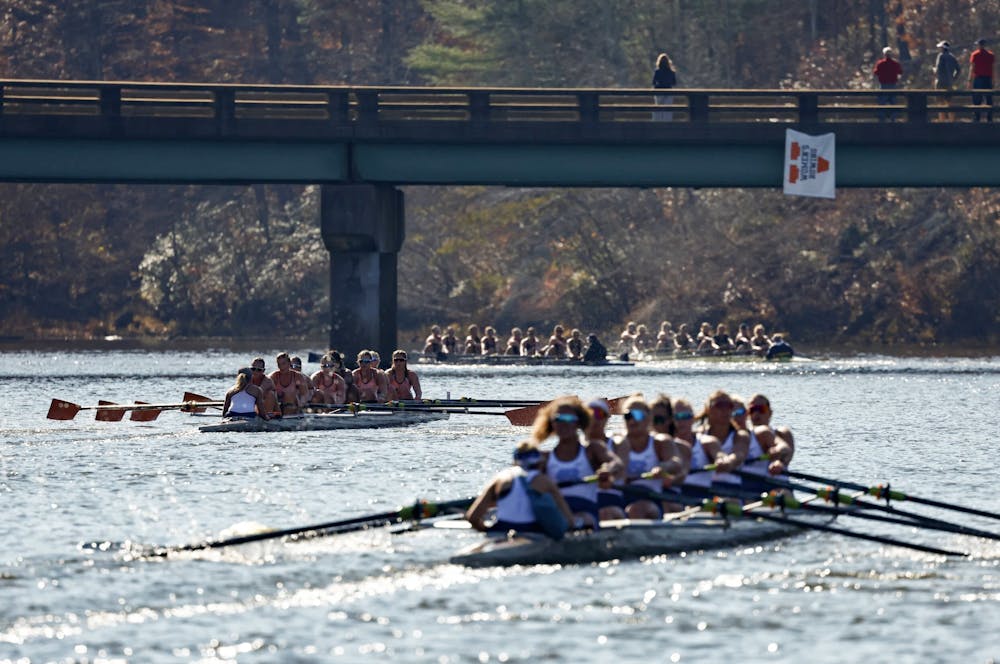
“Imagine you're in a yoga class,” Virginia women’s rowing Coach Wesley Ng tells his crew over the megaphone, his voice cutting through the silence of the morning. “That you're very in-tune with your body.”
It is a strange prompt for a team that, just weeks ago, climbed to No. 6 in the national rankings — the highest ranking any current member of the team has ever seen. In the world of elite collegiate rowing, one might expect results like this to be the product of intense harsh energy where athletes are driven by fear and exertion.
In reality, the Cavaliers hold intentional engagement and a belief that the fastest way to the finish line is not to just pull harder, but to pull smarter. This goal of trying to out-think the water feels tied to the constant mantra repeated by Ng throughout practice — “it's not harder, it's better.”
The team's mornings at the boathouse begin with their land warmup where, as they move from the floor to the ergs, the air is filled with the light atmosphere of a team that enjoys being awake together before the sun — joking and smiling while they stretch their hips. But as soon as the boats hit the water, the conversation instantaneously shifts from social to surgical.
In the launch, Ng watches the blades with precision and from a perspective that spectators will never see. From the launch, he is inches away from the grit, able to see the white knuckles on the oars and the gears turning inside the heads of the athletes as they make minute corrections. It is right on the water that the program's culture is most visible.
Between pieces, Ng pulls his launch alongside his rowers to have a conversation that is a collaborative huddle rather than a lecture — he ribs his athletes about “a very cheeky goose” in their lane over the prior weekend to keep the mood up as the rowers’ heart rates come down. And then comes the pivot to technical instruction.
“Kennedy, how did that feel?” Ng said immediately after a set of pieces.
Junior rower Kennedy Housley, who had already turned to her crew from the stroke seat to discuss how the most recent piece differed from the last, shared with her coaches her feedback. Housley felt there was room for improvement in the slip, when the blade begins to enter the water before efficient power is applied, feedback that the coaches took seriously as they explained the next segment of practice.
“Okay guys … we're going to use the 25 seconds to try to improve the slip,” Ng said. “And in doing so, if the energy comes up and allows us to finish better we shouldn't hold back.”
Ng and his staff are looking for effort, but also looking for confirmation that their crews are translating the logic from their talks on land to the water. They want to see the same “weight room positions” — the specific body angles and core engagement from their land training — manifesting as a synchronized feeling in the shell.
Beside Ng in the launch sits assistant coach Taylor Ruden, a former coxswain who came to the Virginia team from Ohio State and who has a gift for spotting when her athletes make the proper micro-adjustments.
“I like that finish on Ava,” Ruden said quietly in the launch. Seconds later, Ng's megaphone carries the validation to the boat, “Ava, we like your finish.”
Ruden possesses the ability to speak the language that her rowers need her to in any given moment, as junior rower Isabella Furman noted when talking about how Ruden directs her rowers.
“Taylor is really amazing at understanding her boats better than anyone truly I've ever worked with of understanding how to find the correct words to say to someone,” Furman said. “Sometimes [the coaches] will say things and you will see that [the rower] is trying to get it and it won't click, and then Taylor will find a different way to say it and suddenly it's like ‘Oh of course.’”
Virginia women’s rowing blends their intuition with data, relying on the Peach system — a data rig of oarlock sensors that map the mechanics of every stroke. Originally introduced to the first varsity eight in 2024 by former Virginia Coach Kevin Sauer, the program has expanded under Ng to include the second varsity eight and varsity four.
Equipped with monitors on their riggers, rowers can track their stroke efficiency and catch angles in real time. This immediate feedback loop allows them to make technical corrections mid-piece before their coxswain or coach has to remind them. This analysis extends to the land, where the data from the entire boat is overlaid to ensure every individual is synchronized and contributing to the boat's collective efficiency.
Ultimately, this technology serves as a bridge between the subjective feel of a stroke and the objective physics. It identifies wasted energy — such as splashing the water or pulling at inefficient angles — and forces rowers to be active participants in their own technical development. By seeing exactly where their strength is lost, the athletes can instantly adjust to ensure their power drives the boat straight ahead.
The Cavaliers might be able to credit their strong synergy to the fact that each member of the team gets their time with the Peach system, which has to be shared among the boats. One of Furman's favorite things about the team is how each and every athlete has access to the same tools and metrics to advance their skills, meaning that everyone gets the same opportunities and chances to grow.
When the Virginia crew makes its way back into the dock, the rowers have not just spent two hours working — they spent that time getting better. And in a sport where the difference between gold and silver is often less than a second, better is the only thing that matters.
Read More

No. 15 Virginia rebounds with dominant 4-0 senior night win over Syracuse
By Will Reece and Alain Buensuceso | YesterdayThe Cavaliers dictated early play with high pressure, breaking through in the ninth minute as third-year forward Giovana Canali secured her third goal of the season to put Virginia ahead 1-0.

Tallahassee troubles plague Cavaliers through all four quarters in second loss
By Ben McNiff | YesterdayIn a complete reverse of last season’s result, the Cavaliers looked unrecognizable against the Seminoles.

Commonwealth Crash — Virginia men’s soccer loses 2-1 to rival Virginia Tech
By Evan White | YesterdayThe Cavaliers (4-5-1, 2-2 ACC) fought hard, but fell to the Hokies (6-3-1, 3-1-1 ACC) after going down 2-0 in the first half.