Correction: A previous version of this article incorrectly stated that the 20 students and recent alumni received the Fulbright award this spring. They were awarded in Spring of 2025. The article has been updated to reflect this change.
Further, upon publication it was unclear whether the Office of Citizen Scholar Development hosts monthly interest meetings leading up to the application deadline. The Office hosts monthly essay workshop opportunities, but not interest meetings. The article has been updated to reflect this clarification.
The previous version of this article failed to mention the earlier internal University deadline of Aug. 26 at 12 p.m. EST. The previous version of the article also incorrectly titled Steven Gump, associate director of the Office of Citizen Scholar Development. The article has been updated to reflect these changes.
Twenty University students and recent alumni received the Fulbright U.S. Student Program award in Spring 2025 and studied in their respective host country this past academic year, continuing a pattern of success that led the U.S. Department of State to cite the University as a “Top Producer” of scholarship recipients. The grant allows students to pursue either research or teaching positions in a country of their choice, and University students are currently pursuing this opportunity across four different continents and 13 countries.
The Fulbright U.S. Student Program is the flagship international academic exchange sponsored by the U.S., and since its inception in 1946, it has welcomed over 400,000 students. Each year, it sends around 2,000 students to any one of its over 160 partnership countries to study, conduct research or teach in order to foster a stronger international connection and promote cross-cultural dialogue.
The award is available to graduating college seniors, graduate students and young professionals, and the program prides itself on accepting students from all backgrounds through their merit-based selection process. Each applicant must submit basic educational and biographical information which includes transcripts, recommendations and foreign language forms to demonstrate competency for the country they hope to study in. Applicants must also submit a “statement of grant purpose” to propose their research study in 6,000 characters or less, and respond to short answer questions regarding why they are interested in pursuing the Fulbright program.
Recipients of the award receive benefits which include a monthly stipend, health benefits and round-trip airfare, and may be eligible for tuition coverage for their graduate degree program. Additionally, applicants can apply to the English Teaching Assistant awards or Open Study/Research awards. For the latter, applicants can either apply with their own graduate degree proposal or receive their graduate degree in one of the set award opportunities, depending on choice of country. Although grant lengths vary depending on the specific program, recipients typically spend around a year in their country of choice.
The University has consistently demonstrated success within the program, a fact that Andrus Ashoo, director of the Office of Citizen Scholar Development, credits to a number of factors. He said reasons for the University’s success include the quality of the University faculty and breadth of language education as well as the Office’s focus on the fellowship through their monthslong programming.
The advising and events that the Office of Citizen Scholar Development hosts are aimed towards students of all years. According to Ashoo, these events are a great way to learn about the Fulbright program and the application process behind it. The Office hosts its kickoff event, the Fulbright Forum, in February of each year. Then, throughout the semester and into the summer, the Office hosts monthly writing workshops and opportunities for essay review. It also hosts initial advising meetings for any student applying for the Fulbright scholarship, regardless of how far along they are in the application process.
Despite how successful the University is in regards to the Fulbright U.S. Student Award program, Ashoo said he is equally proud of the lesser-discussed benefits of the fellowship programs.
“There's a lot of success with the Fulbright advising program at U.Va. that is never discussed or seen in something as simple as the number of people who receive the Fulbright … many of [the prospective applicants] will clarify their goals [and] be better prepared to apply to graduate schools,” Ashoo said.
Ashoo cited the growth of applicants to the program since he started as director of the Office in 2014, from an average of around 35 applications submitted to nearly 100 per cycle. He said the Office has worked to prioritize the fellowship in a variety of ways, starting with a shift in their philosophy to remove pressure from the parts of the application process a student “can’t control” and manifesting in a monthslong programming of events to spread accurate information about the scholarship.
One student who went through the process is Stella Alexiou, a Fulbright U.S. Student Award recipient and Class of 2025 alumna. She is currently teaching English in Colombia and stressed the importance of beginning the application process early.
“It’s important to know that the application closes in [the early fall], so if you’re thinking about Fulbright you should be thinking about it late junior year into the summer of your senior year,” Alexiou said.
Alexiou said she chose to teach English in Colombia to live abroad and advance her interests in education and Spanish speaking, and that the “comprehensive” nature of the program through its more robust funding and tight network of other Fulbright awardees helped her choose it over other comparable options. She is currently serving in her position at the Universidad Industrial de Santander in Bucaramanga, Colombia.
In her role as an English Teaching Assistant at the university in Colombia, Alexiou splits her time between running English clubs with University students, sitting in on thesis presentations from local students and advising on the quality of the English, and even reviewing professors’ papers. She described her days as busy but fun, and she is able to design her own lesson plans based on the needs of her students.
Alexiou has also become involved in a social project where she teaches local Venezuelan students at a grassroots school. The social projects are a requirement for all Fulbright program participants to involve themselves in an activity of interest within the local community, like food sheltering or journalism. Alexiou further noted she has been able to travel and explore Colombia with friends she has made locally as well as within the Fulbright program.
Class of 2024 alumna Olivia Yang serves in a similar capacity in Taiwan. Instead of university students, though, Yang works in two local elementary schools with fifth and sixth graders. She described her main role in her position as an English teaching assistant and said she plans lessons and helps teach the students English. She specifically noted that she has worked to create a welcoming teaching environment through constant encouragement and reassurance when her students submit assignments.
“I really hope that my presence allows them to realize [that] I am really just a person,” Yang said. “At the end of the day, I am, although speaking a completely different language [and] had such different experiences. I find the same things that they find funny, we like the same things.”
Yang also emphasized how the teaching and cultural exchange goes both ways. She described how she is not only teaching English and learning about Taiwanese culture, but she is also learning Mandarin and teaching the students about U.S. culture.
When it came to the application process for the program, Yang said that forming her narrative into a cohesive story was the hardest part of the process.
“I always knew that teaching, mentorship, education was something I was interested in … but figuring out how to craft that into a cohesive and eloquent one page essay … was a bit difficult for me,” Yang said.
Alexiou and Yang agreed that the University’s resources, especially those within the Office of Citizen Scholar Development, were critical to their application’s success. They also said supportive professors and broader University resources, as well as the Fulbright student community also played a huge part in helping them during the process.
Caroline Carter, a PhD candidate in Mediterranean Art and Archaeology and IKY-Fulbright Scholar, took the open study/research route. IKY refers to her position as a Fulbright Scholar who is also supported by the Greek State Scholarships Foundation. Carter currently lives in Athens, studying caves as places of worship in Greece from 750 BC to 300 BC. She emphasized her research as working towards understanding the historic relationship between humans and the natural environment.
Carter said she separates her day-to-day research into three categories — library research, local museum visits and fieldwork in caves. She said Fulbright stipend funding makes a lot of her fieldwork research possible as it subsidizes miscellaneous costs such as rental cars. She said the Fulbright program has also allowed her to build relationships with Greek institutions and scholars to get a firsthand view into Greek archaeology.
The application process for Carter was spread out among multiple years, as she said she knew for years prior to her application that she wanted to pursue the Fulbright U.S. Student Program award. Still, she said it was not an easy process, and she relied on many different people at the University from her PhD advisor to Ashoo and Steven Gump, associate director of the Office of Citizen Scholar Development, to help her complete the application.
“You can't just get a Fulbright by applying overnight. You need so much help. And U.Va. was really helpful to make sure that I put my best self forward,” Carter said.
The need for collaboration to complete the application process is something that Alexiou, Yang and Carter all said the University was able to provide, and Ashoo said it is something he hopes to continue and expand on in the future. Ashoo also noted the reflective nature of the application, and posited that many more students at the University should consider pursuing the Fulbright U.S. Student Program award to learn more about themselves as individuals.
“I can’t guarantee that you will receive the Fulbright if you commit to this process, but I can guarantee that you will grow, often in some ways that you will not expect, and often in ways that help clarify your next steps, regardless of whether they’re related,” Ashoo said. “So why wouldn’t you [apply]?”
Applications for the Fulbright U.S. Student Award open in March or April of each spring. For the 2027-28 cycle, there is an internal deadline for the University of Aug. 26 at 12 p.m. EST, and the national deadline is October 6 at 5 p.m. EST.
Solomon Ross-Milligan is a staff writer on the news desk from Charlottesville. He is a second-year College student.
Read More

How does the Honor Committee manage its endowment?
By Isabela Delgado | 12 hours agoThe Honor Committee manages an endowment upwards of $200,000, and for its 2026-27 academic term, it has budgeted $204,500 — just over its available endowment.
Provost search committee seeks Faculty Senate’s Executive Council input on qualities for next provost
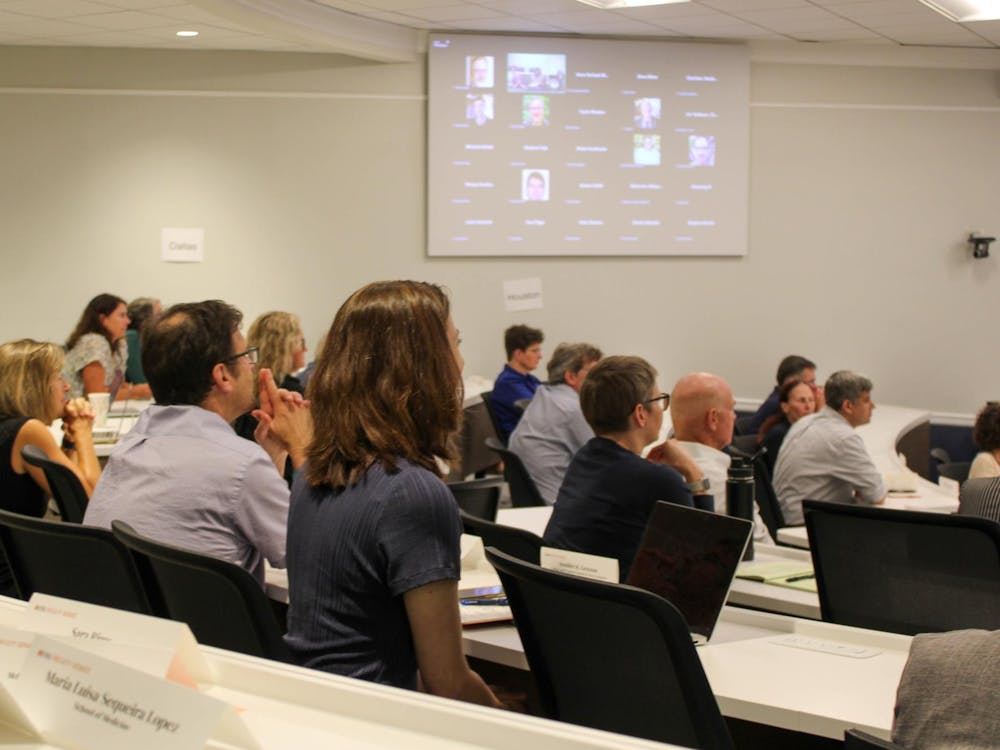
By Jaylynn Perez and Cassidy Hazel | YesterdayBrie Gertler, interim executive vice president and provost, also provided updates on the University’s developing approach to artificial intelligence.

U.Va.’s Larry Sabato weighs in on midterms, issues warnings for Democrats ahead of 2028
By Luca Bailey | YesterdaySabato shared his insights into how the country’s 2026 midterm elections are unfolding heading into the final weeks of the campaign.