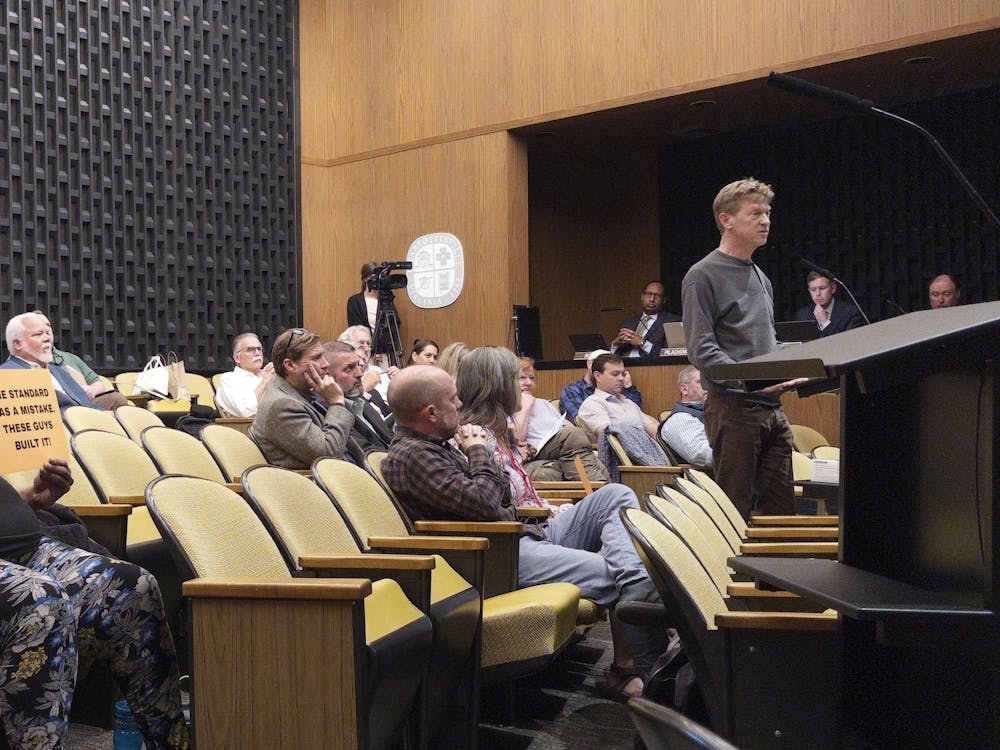
In a 3-2 vote May 4, the Charlottesville City Council reversed a December ruling by the City's Board of Architectural Review, granting “The Mark at Charlottesville” a necessary Certificate of Appropriateness for construction. The decision paves the way for LCD Acquisitions, LLC — the private developer of The Mark based in Athens, Ga. — to continue with plans to develop the seven-story student housing project in the historically Black neighborhood of Fifeville.
The Mark is a proposed, private apartment complex which would be built at 202, 204, 208 and 214 7th Street, SW as well as 613 Delevan Street in Fifeville. The project will primarily be marketed towards University students, and is among a growing number of private student housing options that developers are seeking to build under the City’s new zoning code. This surge in “luxury student housing” has prompted concern among local residents that projects like The Mark will gentrify nearby neighborhoods — attracting wealthier residents, thus raising the cost of living and forcing working locals to move — and block sunlight.
According to the zoning code, the Mark would be located in a Residential Mixed-Use Five district, where development projects can be up to seven stories tall and have an unlimited number of beds “by right” — not requiring the Council’s approval. The Council got to weigh in on the issue, however, after the BAR voted 6-1 in December to deny LCD a Certificate of Appropriateness, leaving LCD to appeal to the Council.
A Certificate of Appropriateness is required for construction of the development as 204 and 208 7th Street are Individually Protected Properties home to two historic cottages. Members of the BAR, which considers “preservation and design,” took issue with the height, mass and scale of The Mark in relation to the historic cottages — which will remain on the property, undergo renovations and be incorporated into the design of the apartment complex.
Mayor Juandiego Wade, Vice Mayor Natalie Oschrin and Council Member Lloyd Snook voted to grant LCD the Certificate of Appropriateness. Council Member Michael Payne and Council Member Jen Fleischer voted against the motion.
During the “Community Matters” portion of the meeting — in which up to 16 members of the public can address the Council for three minutes each — City residents and students expressed outrage with the project. Speakers urged the Council to support the BAR’s previous decision, pointing to The Mark’s potential to gentrify Fifeville. Many expressed concern that the project would stand out on account of its size, “looming over” the rest of the community.
Fifeville resident Paul Reeder argued that development of The Mark would permanently alter the character of the neighborhood, turning Fifeville into a “suburb of U.Va.”
“This development dumps 770 students and their 234 cars into a mammoth seven-story tower … in a local neighborhood,” Reeder said. “This will overwhelm Fifeville visually, culturally and numerically … we want development that contributes to Fifeville and builds it up, not something that tears Fifeville down … I call on you to back the BAR.”
Fifeville resident John Mason pointed out that the potential displacement has a racial dynamic, saying that The Mark would further contribute to the declining presence of Black residents in the City. According to Mason, the number of Black residents in Charlottesville dropped from 22 percent of the population in 2000 to 15 percent of the City’s population in 2020 — a decline of roughly 3,000 Black residents.
“The apartment building will be a driver of gentrification of Fifeville and the displacement of many of its residents, especially African-American citizens,” Mason said. “There is no sign that this slow-motion ethnic cleansing of Charlottesville will come to an end. This is a crisis and you have the opportunity to slow it.”
Further, some residents urged Council Members to consider stated goals in the City’s Charlottesville Comprehensive Plan — a “guide” adopted in 2021 that outlines the City’s general priorities for policy making — in weighing its decision May 4. The plan affirms that neighborhoods which have experienced displacement, as well as others at risk, “will be supported and protected.” Other residents argued that the Council should further compel the University to house more students on Grounds, or to voluntarily give funds to the City in order to ensure the University better pays “its fair share.”
For the December ruling, BAR members consulted Charlottesville’s Architectural Design Control Districts Design Guidelines in making their decision. The guidelines recommend that new projects not “overpower the traditional scale” of buildings nearby — in this case, the cottages. This effectively suggested projects on the Fifeville lot be no more than four stories in height or 64 feet in width.
According to Jeff Werner, Charlottesville’s historic preservation and design planner, The Mark will be seven stories tall, 219 feet wide and take up more than 80 percent of the project site. As part of the Council’s hearing process May 4, Werner delivered a presentation in which he strongly recommended upholding the December ruling on these grounds.
“I stand behind the BAR in its decision,” Werner said. “I think that their decision is substantiated by the guidelines as they were interpreted.”
Attorneys Steve Blaine and Valerie Wagner Long — LCD’s legal counsel — argued in their appeal that the BAR overstepped its bounds by considering the entire building’s compatibility with the neighborhood as opposed to the small portions of The Mark which would encroach on 204 and 208 7th street, plus renovations to the cottages.
By contrast, Werner explained that, since the BAR considers the merits of proposal designs — which is highly subjective, context-dependent work — even a small intrusion on an Individually Protected Property from a development project means the entire project must be subject to its review.
“We looked at a coherent project,” Werner said. “I would hope that you wouldn’t ask the BAR to look at something [on one side] and then the rest of the sides … [were] plastic and vinyl siding … It doesn’t make sense to look at a sliver of a project. That’s not good design.”
Regardless, Long said that between June and December, LCD made certain design adjustments to the broader apartment complex in an attempt to address the BAR’s concerns. These changes involved scaling back much of the wall just behind the two historic cottages, enunciating The Mark’s U-like shape and creating a courtyard for the buildings. LCD also modified the height of the brick facade to be the same height as the cottages — also made of brick — for a more “sympathetic” look. Long added that LCD “voluntarily” chose to remove some of the uppermost sections of the building in order to address neighborhood concerns about its height.
Blaine and Long also highlighted LCD’s plans to rehabilitate the two uninhabited cottages — in “extreme disrepair” according to Blaine — at a cost of roughly $2 million. Blaine said that the historic cottages, which cannot feasibly be renovated as standalone projects, will therefore benefit significantly from The Mark’s development.
“[LCD] can [rehabilitate them] because they can spread those costs,” Blaine said. “There’s no way that this would be a viable investment without [LCD’s] projects.”
In their own remarks to the Council Monday, BAR Chair James Zehmer and Vice Chair David Timmerman said they “applauded and supported” LCD’s attempts to salvage the historic buildings, but they said that the City’s ADC guidelines clearly indicated The Mark would be out of place in relation to the historic cottages.
“The simple truth is that a 180-unit, 770-bed, seven-story building is not compatible with two, one-room deep, two-story buildings,” Zehmer said. “We were unable to find this large structure appropriate in the context of the smaller buildings.”
According to Timmerman, the BAR felt as though it had received mixed signals from the City government. Members of the BAR desired to preserve the historic buildings, and the new zoning code adopted in 2023 generally allows for seven-story development in that section of Fifeville. The guidelines which the BAR must consult in its decision-making were, by contrast, developed in 2011. Ignoring its own guidelines, Timmerman said, would render the BAR useless.
“Please take a moment to process the paradox we were presented with here,” Timmerman said. “Does the BAR simply ignore the guidelines set in place to protect our city’s historic fabric — setting a poor precedent moving forward — or do we work to uphold the guidelines but do so at the … cost [of] losing the [historic cottages]?”
In a statement sent to The Cavalier Daily after the vote, Payne said he did not believe The Mark would be visually compatible with the historic cottages and the neighborhood of Fifeville. Payne also said the conversations highlighted a broader question of whether it is morally defensible to allow development by right, with no opportunity for community input, in the oldest historically Black sections of the City.
“In the very same neighborhoods [where] urban renewal occurred … City government has made the decision [that] 'We know best. We're going to impose on your neighborhoods the changes we deem appropriate, without collaboration or meaningful feedback.’ I do not believe this is morally right,” Payne wrote.
The Council will reconvene for its next biweekly meeting May 18.

Luca Bailey is a third-year College student majoring in politics from Free Union, Va. As a staffer on the news and video desks, he has covered topics ranging from the General Assembly and state elections to local politics and University governance. He is also The Cavalier Daily’s beat writer for the Charlottesville City Council.
Read More

Tao Tan discusses financial future of U.Va., rising college tuition trend nationwide
By Lily Kostro | 7 hours agoTan explained how tuition costs will shape the future of academic institutions such as the University.

U.Va. Health cuts scribe hours as AI documentation tools expand across Health System
By Vrinda Vashisht | 7 hours agoScribes in the undergraduate medical scribe program said in interviews with The Cavalier Daily that a new emergency department schedule that began Sept. 15 has reduced or eliminated certain scribe shifts and has decreased scribe availability to clinicians in the Emergency Department.

How does the Honor Committee manage its endowment?
By Isabela Delgado | YesterdayThe Honor Committee manages an endowment upwards of $200,000, and for its 2026-27 academic term, it has budgeted $204,500 — just over its available endowment.