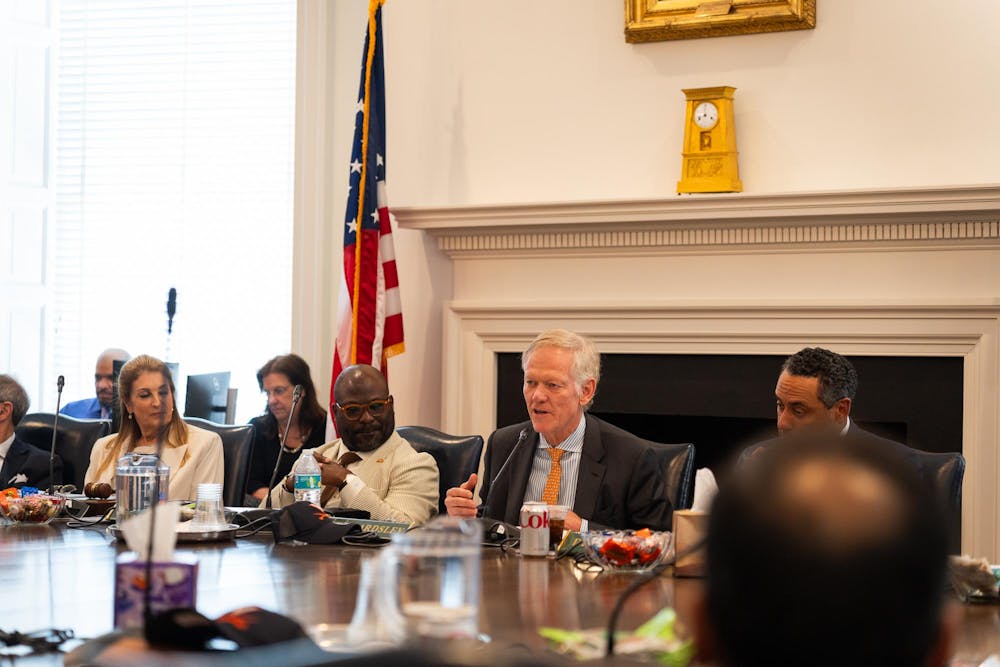
The University’s full Board of Visitors convened Thursday for a meeting that brought together student leaders, faculty and administrators to reflect on the 2025-26 academic year. The Board also named Jackson Sleadd, Class of 2027 President and third-year College student, and Jeri Seidman, outgoing Faculty Senate chair and professor of Commerce, as the incoming student and faculty representatives to the University’s Board for the 2026-27 academic year.
The meeting included a presentation from University President Scott Beardsley outlining the University’s progress in fulfilling its current mission, an update on researching funding gaps and federal delays and remarks from both student and faculty leadership regarding institutional trust and shared governance over the past year.
Fourth-year College student Gregory Perryman currently serves as the student representative to the Board, and Engineering Prof. James Lambert currently serves as the faculty representative to the Board.
The student representative communicates student perspectives and concerns to the Board, while the faculty representative conveys faculty priorities and academic issues. Both representative positions are non-voting and hold one-year terms. Sleadd and Seidman will begin their terms at the start of the 2026-27 academic year.
Beardsley reflected on his first 100 days in the role, during which he led “Grounds for Discussion” — an initiative centered on listening and creating structured and informal dialogue with various stakeholders across the University community.
Through his “Grounds for Discussion” initiative, Beardsley said he held more than 100 meetings across schools and the University’s health system and visited a wide range of spaces, from student dining halls to the Faculty Senate to state government offices in Richmond. He framed these conversations as part of a broader effort to understand both the University’s strengths and challenges while restoring a sense of stability following the leadership transition.
Beardsley outlined the University’s core mission as educating future leaders, creating knowledge, providing clinical care and serving the public. He emphasized that becoming the nation’s leading public university is the central goal for the University, noting that achieving it requires clearly defining what that means through measurable and objective standards. He pointed to the University’s record admissions demand — with an applicant pool of 82,118 — to emphasize the University’s national interest. He also highlighted strong national U.S. News rankings across multiple graduation programs, noting that the School of Law was ranked the fourth best Law school nationwide while the Darden School of Business retained its spot at No. 11.
“Each element of those parts of the mission are important, and they give us a sense of purpose,” Beardsley said. “I think we can be recognized as the best public university in this country … Part of my job as president is to lead the community, helping find what [it means] to be the best public university and that's some work that we’ll have to go delve into.”
Beardsley also highlighted the University’s expansion of patient care, noting that U.Va. Health now sees approximately 1.8 million patients annually. He said that U.Va. Health generates 60 percent of the University’s overall revenue. He acknowledged constraints, particularly in infrastructure, noting that capacity limitations have led to situations where patients must be turned away due to a lack of available beds.
Beardsley also discussed the University’s financial position, including significant investments made through the Strategic Investment Fund and capital spending over the past decade. He provided updates regarding several initiatives in the University’s 2030 “Great and Good” plan. The 2030 plan is a detailed list of four goals and 10 initiatives that the University hopes to achieve and make progress toward by 2030 aimed at establishing the University as the nation’s leading public institution.
As part of the 2030 plan, the Emmet-Ivy Corridor — which is located at the intersection of Emmet Street and Ivy Road — is currently still under development and set to be completed by 2027. The Ivy Corridor project will expand the number of academic buildings and upperclassmen housing options. The Virginia Guesthouse — a hotel and conference center located in the Ivy Corridor — officially opened April 6. The Manning Institute of Biotechnology — which is located in the Fontaine Research Park — remains under development but is set to be completed by 2027. The Institute aims to transform biomedical discovery and treatment, focusing on the University’s development in cancer, neuroscience and immunology research.
In a research presentation, Lori McMahon, vice president for research and professor of neuroscience, outlined the current state of the University’s research enterprise. She explained that sponsored research — which are research projects externally funded through grants and contracts from federal, state or private organizations — represents a major component of the University’s research activity. Approximately 81 percent of that funding originates from federal sources, either directly or through collaborations. According to McMahon, the National Institute of Health accounts for the majority of these federal dollars.
McMahon noted that research funding is currently slightly behind the 2024-25 academic year, in part due to delays associated with the federal shutdown and slower grant review processes across agencies such as the NIH, National Science Foundation and the Department of Defense. She also pointed to the impact of several large one-time awards received the previous year, which has made current comparisons appear lower. The University received two $20 million awards from the U.S. Environmental Protection Agency and a $20 million award from the Office of Defense in 2025.
McMahon emphasized that research activity remains critical to both producing knowledge and education, noting that student access to research opportunities is a key component of the University’s academic mission. At the same time, she highlighted increasing federal compliance requirements — which have risen significantly in recent years without corresponding increases in federal reimbursement, placing additional financial pressure on universities.
“Research is done to create new knowledge, and that's across all disciplines … We often talk about education and research as separate pillars, but to me, you cannot separate education from research,” McMahon said. “It’s important to give [students] research opportunities that enhance critical thinking skills and enhance problem solving skills.”
McMahon also discussed efforts to expand the University’s research profile through interdisciplinary hubs focused on areas such as artificial intelligence, quantum computing, hypersonics and nuclear energy. She noted ongoing investments in early-stage research, industry partnership and efforts to improve infrastructure for clinical trials.
In his remarks to the Board, Clay Dickerson, outgoing Student Council president and fourth-year College student, reflected on his term and discussed how students experienced the leadership transition following former President Jim Ryan’s resignation last June. The Board also underwent leadership changes in recent months, including Gov. Abigail Spanberger’s (D) Jan. 17 appointment of 10 new members to fill the vacancies after the resignation of five members — including former Rector Rachel Sheridan and former Vice Rector Porter Wilkinson. Dickerson characterized the academic year as “wild,” emphasizing that students underwent the same leadership transition as University officials but experienced it in a more unique way.
Dickerson said many students viewed Ryan as a “superhero” and struggled to adjust to his sudden absence from leadership. He emphasized that students responded with resilience and maintained a strong sense of community.
“Looking back on all the events that have happened to our University, to our student body, I can't help but feel hope. I can't help but feel pride in the ways in which the students conducted themselves, the ways in which our University community banded together,” Dickerson said.
Dickerson described what he called the University’s “magic” as a defining force that persisted even during one of the most difficult periods the University has faced. He connected this idea to everyday student experiences — from academic work to extracurricular involvement — and argued that this sense of shared identity is what sustains the University during periods of instability. Dickerson further urged the Board to prioritize preserving that sense of community, emphasizing that the University’s “magic” is reinforced through “open, transparent and consistent” dialogue between students, administrators and Board members.
He also said that the University functions as a microcosm of broader society where individuals at all levels — students, administrators and leadership — hold meaningful influence within the University community. He argued that recognizing this shared responsibility is key to fostering a more collaborative and responsive institutional environment.
Drawing on his own experience as Student Council president, Dickerson described representing students who lack the time or access to participate directly in governance, and emphasized that advocacy on their behalf is a core responsibility of student leadership. He extended this idea to the Board, noting that its decisions affect many individuals who are not in the room.
Dickerson continued by addressing tensions between Student Council and the Board earlier in the year — including Student Council’s vote of no confidence following Ryan’s resignation — but noted that these relationships have begun to improve. He emphasized that trust is being rebuilt through continued dialogue and engagement, and that maintaining open lines of communication will be essential moving forward.
“The bridges are being rebuilt. This University is fragile, but we won't break and we will continue to grow stronger. And that is why this University is so magical … [Student Council] passed a no confidence in the Board of Visitors, and confidence is growing, the relationship is strengthening,” Dickerson said.
Perryman also spoke to the full Board Thursday and noted national trends affecting higher education. He pointed to a significant decline in public trust in universities among Americans over the past decade, along with growing concerns about political polarization and academic freedom. Perryman argued that these trends place greater responsibility on the University to demonstrate its value through transparency and service to its community.
Perryman emphasized that the University must remain focused on its core mission of advancing knowledge, providing education and serving the public while also ensuring that it remains accessible to students from diverse backgrounds. More specifically, he highlighted the importance of supporting international students and maintaining a commitment to inclusivity. He stressed that the University should not expect to be insulated from political pressures, but should instead respond by reaffirming its commitment to truth, open dialogue and public accountability.
Regarding student voices, Perryman noted that the Board’s effectiveness depends on its willingness to listen to students and incorporate their perspectives. He said that trust is a necessary condition for institutional success and argued that the University cannot achieve its goals without maintaining strong relationships with its stakeholders.
“This Board's success is predicated on the consent and collaboration of students and other stakeholders. U.Va. cannot be the number one public university without the trust, passion and criticism of its students,” Perryman said. “Our success will be determined by the depth of our commitment … as a public, accessible, inclusive and equitable institution for students of all backgrounds.”
As part of its agenda, the Board passed a commending resolution recognizing Perryman for his service as the 44th student representative to the Board. Board member Rudene Haynes noted that Perryman served during a particularly challenging period with multiple presidential transitions — including Ryan’s resignation, Jennifer Wagner Davis, executive vice president and chief operating officer, as acting president, the interim presidency of Paul Mahoney and the appointment of Beardsley.
Haynes also emphasized Perryman’s consistent outreach to students and his role as a resource for the Board, highlighting his participation in the selection process for the University’s 10th president and his service as the student representative to the Board alongside four University presidents, three rectors and 30 Board members.
Addressing the Board, Seidman said that faculty have experienced a “profound sense of loss” and declining trust in University decision-makers following Ryan’s resignation. She said that despite these challenges, she is hopeful for a renewed partnership with University leadership moving forward.
Seidman described shared governance as a “regular and meaningful occasion for consequential input." She used this definition to emphasize that faculty should have opportunities to engage with the Board and University administration.
Seidman called for collaboration between the Board, faculty and the broader University community to implement the University’s mission going forward. She emphasized that rebuilding trust depends on meaningful engagement and expressed her willingness to work with the University leadership to achieve the University’s mission.
“The faculty remain committed to partnership with the Board and with the administration to work together to create a vision of how U.Va. continues to live out our mission over the next decade,” Seidman said. “I hope that through regular and meaningful occasion for consequential input, trust and partnership between the Board and the faculty can be rebuilt as we develop this vision together.”
The Board also passed a memorial resolution honoring Philip Bourne, founding dean of the School of Data Science, who passed March 8 from mesothelioma. Bourne was recognized as a pioneering figure in data science whose career spanned more than four decades — including early work as a physical chemist and the completion of his doctorate at Flinders University in South Australia in 1979. Over the course of his career, he authored more than 400 papers and was among the most highly cited researchers in his field.
Bourne was credited with shaping the School of Data Science into a collaborative and interdisciplinary institution, emphasizing partnerships across disciplines and with community organizations. The resolution named him founding dean emeritus of the School of Data Science and recognized both his professional accomplishments and his personal qualities as “a visionary leader, an inspiring colleague and a true friend.”
The Board unanimously elected Rudene Haynes to serve as an additional member of the Board’s Executive Committee — a group of Board leaders authorized to act on behalf of the full Board between formal meetings. The Board also approved the appointment of Lydia Johnson to the University Health System Board — the governing body responsible for providing oversight and strategic direction for U.Va. Health.
The full Board will reconvene during the regularly scheduled June Board meetings.

Jaylynn Perez is a third-year College student from Chesapeake, Va., majoring in Government and minoring in Public Policy and Leadership in the Batten School. She currently serves as news senior associate editor and video staffer. She frequently covers topics such as student self-governance organizations, University governance and local politics.
Read More

After Supreme Court upholds birthright citizenship, students express relief and disappointment
By Jaylynn Perez and Luca Bailey | 3 hours agoStudents at the University are expressing a range of emotions, with two who spoke to The Cavalier Daily signaling relief at the Court’s decision, and one expressing opposition.
Welcome back, Hoos — here’s what you missed this summer on Grounds
By Grace Little | 3 hours agoLooking to late August, classes will commence Tuesday, and various University groups will reconvene after adjusted summer schedules.

U.Va. School of Medicine names two new department chairs, explains selection process
By Michael Racz | 4 days agoIn an interview with The Cavalier Daily, Colin Derdeyn, interim dean of the School of Medicine, explained the selection process of the two chairs and the new chairs’ plans for their departments.