Editor's note: The images embedded throughout this article were photographed by Sam Keller.
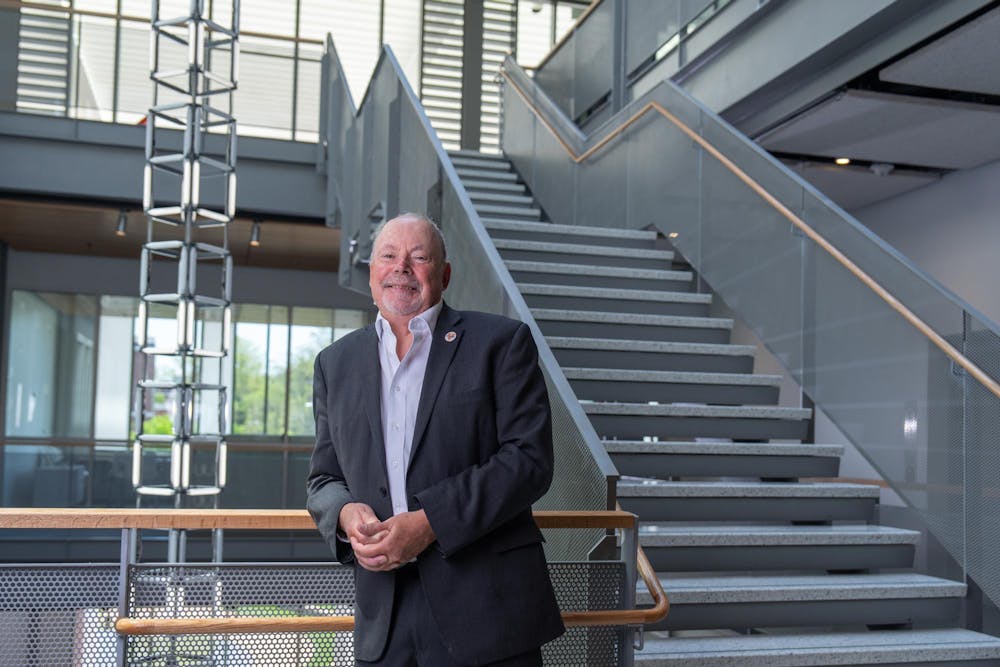
Philip Bourne, founding dean of the School of Data Science, passed away March 8 after a battle with cancer. According to his close friends, colleagues and family members, he will be remembered for his commitment to the communities which he was involved in and for going above and beyond in everything he did, from his scientific discoveries to his care for the people around him.
Bourne’s array of accomplishments include co-directing the Protein Data Bank during his time as a professor and associate vice chancellor of innovation and industrial alliances at the University of California, San Diego to advance drug discovery, spearheading the Big Data to Knowledge initiative at the National Institutes of Health and authoring over 400 papers and five books. Beyond those achievements, he is credited for his establishment of the SDS — a “school without walls” — and what many described as his exemplary character.
Ian Solomon, dean of the Frank Batten School of Leadership and Public Policy, was a close friend of Bourne’s. In an interview with The Cavalier Daily, he emphasized Bourne’s humble, yet devoted, esteem and the way Bourne connected so impactfully with those around him.
“Here’s someone who’s … made some of the really profound discoveries of the 20th and 21st century, who’s worked with some of the most eminent scientists and scholars and discoverers … and yet is also so normal,” Solomon said. “That ability to both operate at the highest levels of the academy in science and yet also talk to just about anybody … It’s a sort of role model for citizenship, for scholarship [and] for leadership that I really admire.”
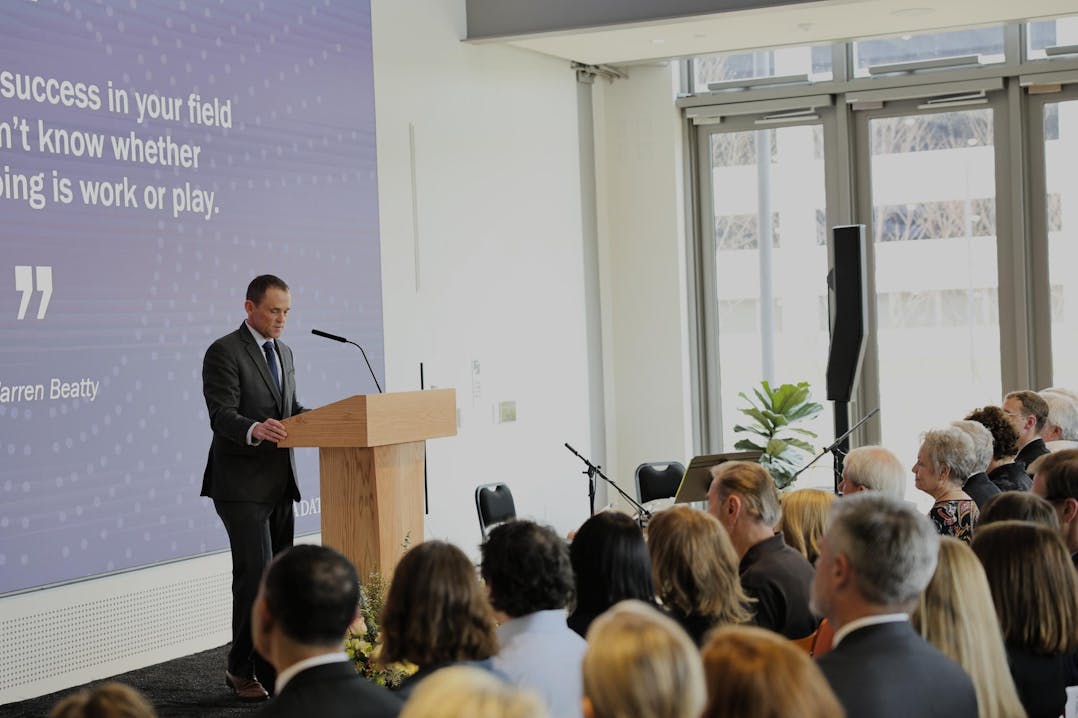
Jim Ryan, former University president and Law professor, spoke at the memorial held for Bourne Friday. In his speech, Ryan explained how Bourne first floated the idea of turning the Data Science Institute into the University’s 12th school early in Ryan’s presidency. Originally, Ryan turned down the idea — he said that the establishment of a new school would both be costly and could potentially silo data science, which Ryan said was a subject he believed should be incorporated into all studies at the University.
However, Ryan emphasized what he called Bourne’s ability to be a visionary. Bourne developed plans for the future — including for the field of data science, hence the need for a school, rather than just an institute — far before others could understand them.
“Phil would explain something to me that I couldn’t quite see immediately, but we would continue talking … until I could see what was already clear to him,” Ryan said at the memorial. “Then I [would] do what he suggested, which I believe gave him satisfaction, not because he won, but because he loved when others finally saw what he did.”
The SDS, which opened in 2019 and had its first full cohort of Bachelor of Science students in the fall of 2024, offers an undergraduate B.S., an undergraduate minor and three graduate programs. Bourne is honored for not just establishing the school, but for creating an environment in which, according to several of Friday’s speakers, individuals work collaboratively and creatively.
SDS Interim Dean Jeffrey Blume — who stepped into his role March 9 — also spoke during Friday’s memorial and cited the innovative nature of the SDS and its students, professors and administrative members.
“As founding dean of the School of Data Science, Phil built something extraordinary here — not just an institution, but a place defined by people, curiosity and a sense of possibility,” Blume said at the memorial.
Several of Friday’s speakers also underscored Bourne's love of working to advance all initiatives on Grounds and his ability to integrate the SDS within the broader University community. Solomon said in an interview with The Cavalier Daily that Bourne took the subject of data science and found a way for it to contribute to the greater good of humanity.
“You can imagine sometimes, ‘Oh data science, that’s all about algorithms and high-level math and machine learning,’” Solomon said. “Dean Bourne showed you very quickly, ‘No, it’s about our humanity and … how are we improving lives and improving medicine and improving public services?’”
Kemi Jona, University vice provost for online education and digital innovation, began working with Bourne in 2023 to amplify the SDS’s online master’s program. In an interview with The Cavalier Daily, Jona said this program is one of the fastest growing online programs at the University, and the two worked to increase enrollment and improve overall operations.
Jona recalled Bourne’s curiosity and care for all things happening on Grounds, even throughout his battle with cancer.
“I don’t think there was a minute that he took his foot off the gas in terms of work,” Jona said. “[Bourne] was always wanting to talk about new ideas, or things that were happening on Grounds, even … 48 hours before he passed.”
Despite Bourne’s continual commitment to the University, his friends and family members spoke to his outside passions. Speakers said Bourne had an extraordinary love for those around him and for his hobbies — namely, motorcycling and spending time with his family.
Bourne’s son, Scott Bourne, reflected Friday on the unwavering love he received from his father, and how that same love shone through to the University and to his friends.
“When [my sister and I] did get [my dad’s] attention, he was always the most devoted father — impossibly funny, ever-optimistic and encouraging to my sister and I,” Scott Bourne said at the memorial. “He wasn’t just Phil Bourne the dean, he was Phil Bourne the Cub Scout leader, the Go Kart builder, the field trip organizer, the computer fixer, the career advisor, the driving instructor.”
Scott Bourne’s positive sentiments were carried amongst multiple speakers Friday — that Bourne had an outstanding love for everything he did, and he never changed the way he loved. Whether it was the scientific work he devoted himself to, the University which he aimed to innovate or the kids which he raised, remembrances of Bourne highlighted the personality which he stood true to.
“Phil was always himself — an irresistible combination of deep intelligence, empathy, optimism, energy, endless curiosity and good humor,” Ryan said at the memorial. “He took his work seriously, and he knew it was important, but he had no trace of self-importance. Whenever you mentioned his name around Grounds, the reaction was always the same — ‘I just love Phil Bourne.’”
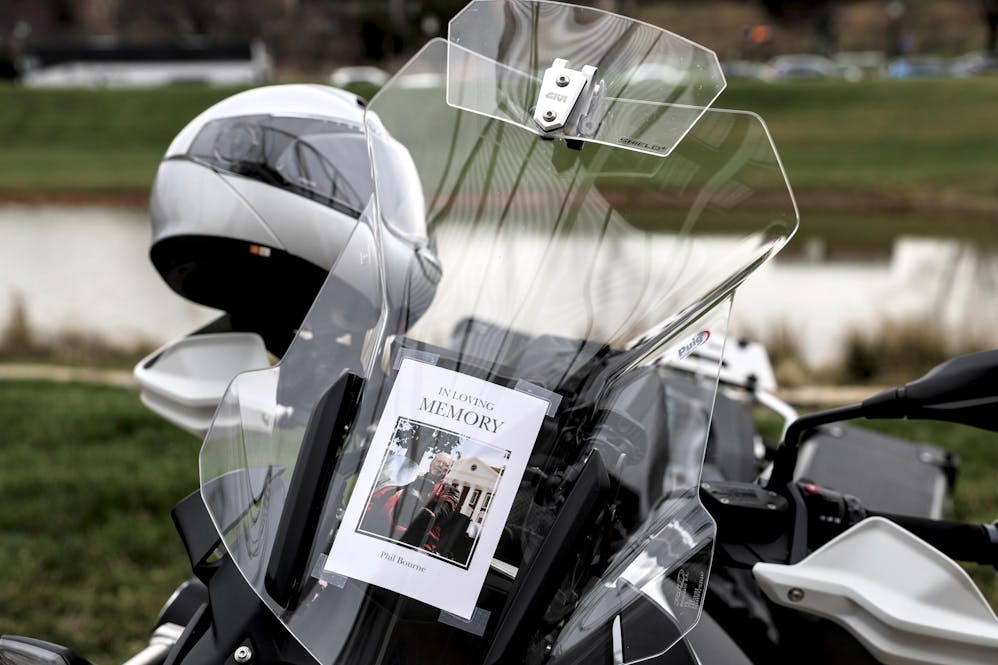
Also on the list of Bourne’s many commitments stood his love for motorcycling. Hell’s Administrators was a motorcycle gang which included Bourne, Solomon and for some time, John Unsworth, former dean of the University libraries and English professor.
The name, Hell’s Administrators, is both satirical and stemmed from the “rebellious” nature of deans riding around on motorcycles, according to an interview between U.Va. Today and Bourne in August 2025.
On weekends with nice weather, Hell’s Administrators rode around the greater Charlottesville area, and Bourne and Solomon took a trip through the Rocky Mountains during the summer of 2025. Solomon said their rides were unique because rather than communicating through earpieces as they rode, Hell’s Administrators would ride in silence and save their valuable conversations for mealtimes.
“We’d stop and have lunch [and] the way he would treat the people at the restaurant … There was just an ease and a right and a decency about him,” Solomon said.
A group of Bourne’s friends — including Solomon and Unsworth as well as motorcyclists Bourne rode with throughout his life — went for a ride around Charlottesville before the memorial Friday and finished their ride in front of the SDS.
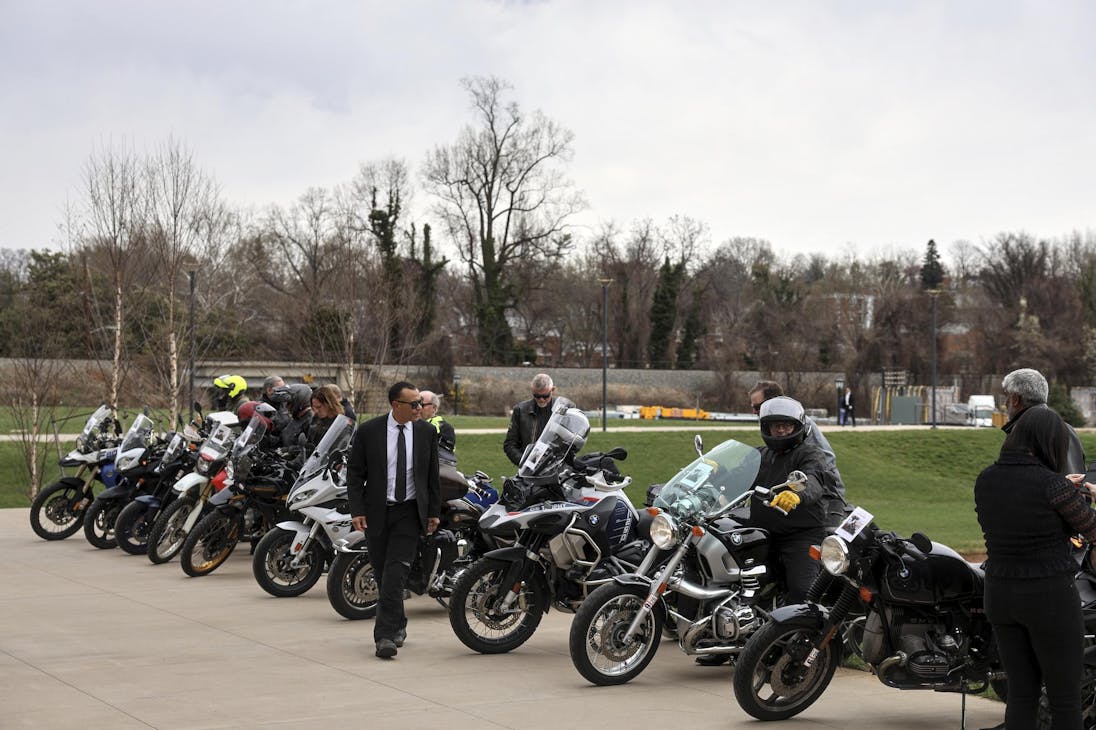
Unsworth, who spoke Friday on behalf of the Hell’s Administrators, read aloud a section of Bourne’s blog from a solo motorcycle trip he took in 2023.
“The first part of the day has its own unique characteristics. It’s cooler, the air is fresh, there’s a sense of adventure for what will unfold today,” Bourne wrote in his blog. “The backroads of America tell a wonderful story. Each day, fate has its say.”
In this blog entry, Bourne went on to write about a friend he made at breakfast and emphasized the “sites along the way” of his trip were memorable, but what was most important were the people he came across.
Unsworth echoed this part of Bourne’s writing in his speech — he, just like Solomon and others Bourne interacted with, said there was a special way in which Bourne addressed individuals he met, no matter their background.
“Phil was more about satisfying his curiosity than he was about ticking off accomplishments. And he was especially curious about people,” Unsworth said at the memorial. “He was gathering data about humanity, but he was also learning stories from strangers about their experience.”
For many, Bourne was a mentor, dear colleague and adventurous partner, and all of Friday’s speakers agreed that the legacy he leaves behind on the University is beyond profound. Ryan pointed to Bourne’s leadership as outstanding.
“He’ll … leave a legacy of being an amazing leader, and that means not simply having a compelling vision, which he did,” Ryan said. “It means being able to get things done, which he was able to do, but it also, in his case, meant he was unbelievably kind and empathetic to everyone he met.”
Lauren Seeliger is a news editor of the 137th term and enjoys covering U.Va. Health and University governance. Lauren is a fourth-year Behavioral Neuroscience student from Fairfield, Connecticut.
Read More

From the Archives: Fraternity life
By Maisy Callahan and Emily Conway | 13 hours agoMore fraternities decide to partner with the Historic Renovation Corporation, a University-affiliated agency that provides tax credits for the restoration of historic buildings.

Center for Politics hosts Tom Perriello to discuss AI, congressional responsibilities
By Melody Yuan | YesterdayAt the event, titled “The Deep Divide Between How the People and the Powerful Are Thinking About AI,” Perriello also referenced his Sept. 22 article “To Wary Working People, AI Preemption Is the New Nafta” in The New Republic during his discussion.

U.Va. Health’s telehealth program approaches 1 million visits
By Vrinda Vashisht | YesterdayThe program arose from the challenge of U.Va. Health physicians traveling to communities across Virginia to treat patients who could not easily reach Charlottesville.