In an interview with The Cavalier Daily in March, University President Scott Beardsley said he aims to be a “global president” of the University. Beardsley has spent much of his career abroad — he worked in management consulting in Belgium for over two decades — and he said a central focus of his tenure at the Darden School of Business included expanding international experiences for students.
“I plan to be a global president for U.Va., meaning that I will fly the U.Va. flag across the world,” Beardsley wrote in a statement to The Cavalier Daily. “I firmly believe that traveling and studying in different cultures will help students become stronger leaders and public servants.”
To further probe Beardsley’s vision for his global-focused presidency, The Cavalier Daily received Beardsley’s written responses to questions on why the University’s international connections matter and his plans for future global initiatives.
Beardsley affirms the University will aim to retain international students and faculty
Historically and in the present, international students and faculty have contributed vastly to the talent pool and academic environment of the University. The University received a record 10,035 applications from international students for the entering Class of 2030, which is a 30 percent increase from international applicants for the Class of 2029. The University accepted 971 of these applicants hailing from 83 countries, and these students are entering during a time when international student numbers are dropping nationwide. Seventeen percent fewer new international students enrolled in United States institutions for the fall of 2025 compared to the fall of 2024, according to an Open Doors survey of 825 U.S.-based higher learning institutions.
When asked how the University will retain these international students and faculty amidst a national trend of lower enrollment rates for international students, Beardsley affirmed that the University is fortunate that many international students, faculty and staff choose to study in Charlottesville. He wrote that these community members bring global perspectives to the community, and the University is committed to fostering a “strong home” for international students and faculty.
Beardsley provided some statistics to demonstrate that numbers have remained consistent despite national trends of declining international enrollment. According to Beardsley, as of fall 2025, the University had a total of 921 enrolled international undergraduate students and 1,600 enrolled international graduate students, which are values consistent with enrollment totals over the past several years. Beardsley also wrote that many University programs — including the International Students and Scholars Program team — serve as support systems for international students.
“Our [ISSP] team does tremendous work to help international students and faculty feel welcome and valued at U.Va. — from the Global Greeters who welcome students at Dulles International to the year-round social and cultural programming at our Lorna Sundberg International Center,” Beardsley wrote. “Our international students and faculty have a great deal to contribute to the University community, and it’s important that we continue offering opportunities for our community to engage with international peers.”
Looking more broadly at nationwide trends, according to Common Application data, undergraduate applications by international students to U.S. institutions fell by 9 percent nationwide for the Class of 2030. The trend of declining applications has been attributed to geopolitical concerns and visa uncertainty — F-1 visa approvals for students were down 19 percent in August of 2025 compared to approvals from the same time in the year prior, according to The Washington Post.
In terms of international faculty, for the 2024-25 academic year, the University employed 1,801 tenured and tenure-track faculty members and 1,422 general faculty members. In total, 2,983 individuals were U.S. citizens, and 210 individuals were non-U.S. citizens.
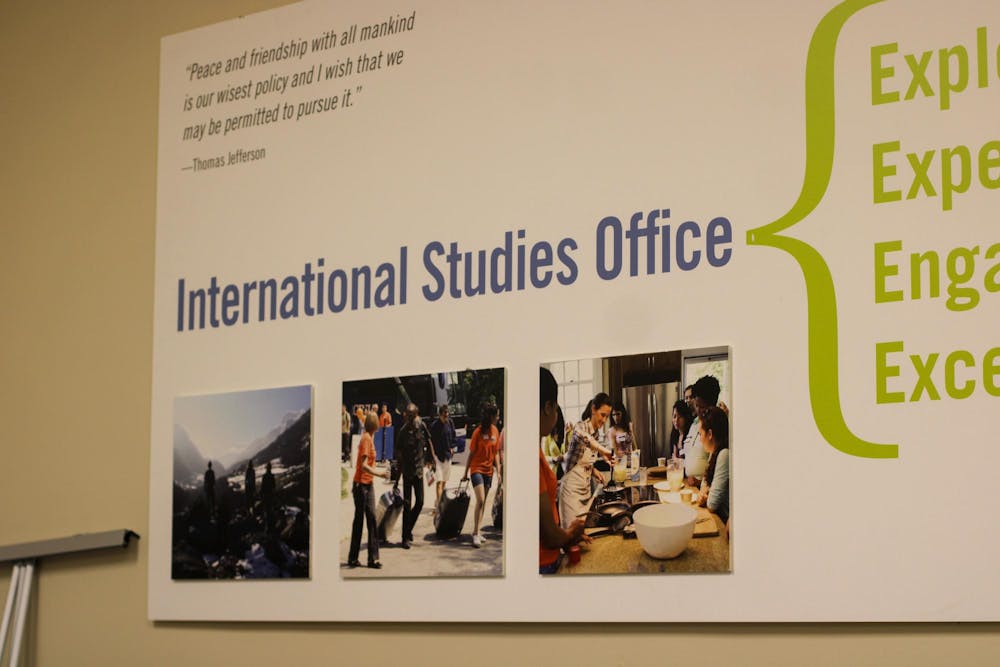
As an example of the University’s work to support international students during this time, Beardsley wrote that the Citizen Leaders Fellowship — a collaboration between the International Studies Office and the Contemplative Sciences Center — brings together international students, transfer students and athletes to design and implement projects to improve the University’s student experience. Project examples include establishing a clothing closet to provide for international students and others in need, producing podcasts and photography works documenting student life and expanding access to culturally meaningful food.
Beardsley addressed the shifting immigration landscape — he wrote that ISSP is focused on communicating updates with the University’s international community. The Trump administration rescinded a 2021 policy Jan. 20, 2025 that granted special protection from immigration enforcement on college campuses. Incidents involving student arrests by Immigrations and Customs Enforcement have been reported at college campuses nationwide.
According to Beardsley, ISSP added an FAQ to its homepage to meet a need for information amidst constantly evolving developments. Regarding further services to address the changing policy environment, ISSP has also collaborated with Student Legal Services to offer a “Living Legally and Locally” webinar.
“These and other initiatives and events scheduled throughout the academic year provide support to our international community and keep them informed,” Beardsley wrote.
Beardsley lays out immediate plans for the University’s global future
Focusing on the short-term, Beardlsey wrote that he is prioritizing expanding global learning experiences for undergraduate students. According to Beardsley, University leaders have asked Stephen Mull, vice provost for Global Affairs, to convene a working group charged with developing a plan to advance a “Global Guarantee.” According to Beardsley, the initiative is “an institutional commitment to ensuring that every undergraduate has access to at least one education abroad experience before graduation,” including financially underprivileged students.
Beardsley wrote that Mull and the ISO are also meeting the current moment by managing both the University’s international programs alongside assistance for international students during “a challenging time for global education.” Beardsley wrote that his listening tour — “Grounds for Conversation” — to all schools and major units of the University will also inform planning efforts.
“[I] hope to hear directly from [various University groups] about what would be most helpful to their efforts, including their efforts in global education,” Beardsley wrote.
Additionally, Beardsley acknowledged the University’s current international locations of interaction, including India, Italy, Spain, China and current projects to expand into Southern Africa based at the University of the Western Cape in Cape Town, South Africa. In the 2024-25 academic year, University students studied abroad in 90 countries.
“I look forward to opportunities in the future to visit our study abroad locations and engage with our alumni and friends around the globe,” Beardsley wrote. “At U.Va., we also welcome faculty, staff, students and guests from around the world.”
Beardsley’s global focus at Darden shapes his focus as University president
At Darden, Beardsley expressed a firm belief that business today is global. According to Beardsley, this global shift applies to all 12 schools across the University, especially considering technology’s role in connecting people across the world. He wrote that faculty ideas will inform his leadership for furthering global initiatives by discipline of study.
“I am excited to learn more about how faculty in disciplines across U.Va. are thinking about how research in their fields reaches and impacts global audiences and consider how to prepare students for future global collaboration across disciplines,” Beardsley wrote. “Students of any major can study abroad, so there’s a lot to gain from any student of any field of study choosing to expand their knowledge and experience with a study abroad program.”
The University offers study and intern abroad programs in a wide range of disciplines, including engineering, architecture, foreign language, business and a variety of STEM subjects. According to the ISO Annual Report for the 2024-25 academic year, 3,444 University students participated in an education abroad experience, and 2,097 of those students were undergraduates. 2,097 is about 12 percent of the University’s enrolled 17,901 undergraduates for fall 2024.
At Darden, the Center for Global Initiatives includes “academic degree programs and extracurriculars” that are “infused with global content to help all students develop a global mindset.” In terms of Beardsley’s involvement in these programs and initiatives, Beardsley wrote that he expanded global education as part of the MBA program, and during his tenure as dean, student participation more than doubled in study abroad programs.
Beardsley noted one initiative in particular that excited him, which was the Darden Worldwide Scholarship Program facilitated by a financial commitment from the Batten family — the family that founded the Frank Batten School of Leadership and Public Policy. The program enables every student in the full-time MBA program to participate in a week-long global immersion course.
“I was lucky to lead students on a few of those [international Darden] courses, in Europe and Africa, which were always tremendously fulfilling and enriching opportunities,” Beardsley wrote. “Darden connects with more than 80 countries each year through courses, client projects, exchange programs, residencies and other means.”
Beardsley breaks down abroad representation by region
In assessing which University programs are doing well, Beardsley wrote that the most popular regions where University students choose to study abroad include Spain, the United Kingdom, Italy, France and programs with multiple Europe destinations. Beardsley listed multiple European destinations — Italy, Spain and Germany — as popular choices for graduate and professional students.
In terms of areas with room for growth, Beardsley wrote that the University aims to deepen its impact in South America and Africa. To expand its programming into these areas, Beardsley mentioned that the Center for Global Health Equity is set to expand two of its programs in Ghana and Kenya this summer, and the University opened its office in Cape Town, South Africa this spring.
“We’re pleased to see such high student interest in pursuing an enriching educational opportunity abroad,” Beardsley wrote. “Our goal is to provide accessible, affordable options for global engagement during a student’s time at U.Va.”

Grace Little is a news editor for the 137th term. She is a third-year student from Dallas majoring in neuroscience and the interdisciplinary major in public policy, politics and media studies. She enjoys writing about the shifting landscape of higher education, and you can reach her at g.little@cavalierdaily.com.
Read More

At rare three-way meeting, City, County and University officials discuss regional coordination
By Luca Bailey | 4 hours agoThe meeting also gave City, County and University officials an opportunity to discuss areas of mutual concern.

Federal judge upholds Virginia law allowing immigrant students to receive in-state tuition
By Jaylynn Perez and Ruby Budetti | 4 hours agoSenior U.S. District Judge Robert Payne of the U.S. District Court of the Eastern District of Virginia ruled Oct. 5 that Virginia can continue allowing immigrant students to receive in-state tuition at public colleges and universities.

The Faculty Senate discusses international student visa policies, parking challenges
By Jaylynn Perez | YesterdayAdditionally, the Faculty Senate heard from Brie Gertler, interim executive vice president and provost, who gave updates on the ongoing dean searches as well as resources for faculty members with concerns regarding online harassment and academic freedom.