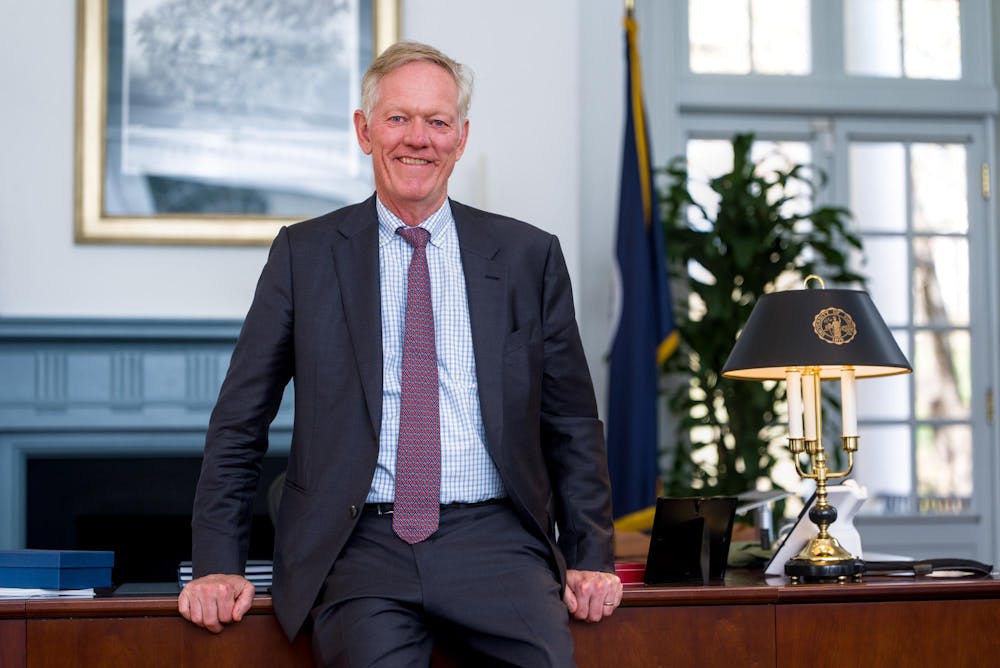
University President Scott Beardsley did not know as a college student that he would become president of the University — he said he “never envisioned” it, but then again, he said he never envisioned marrying a French woman or moving to Belgium, either.
Beardsley said his path to his presidential role is winding — he was born in Maine, grew up in Alaska and worked in management consulting in Belgium for 24 years for McKinsey & Company before becoming dean of the Darden School of Business in 2015. He was then appointed as the 10th president of the University by the Board of Visitors Dec. 19.
Although many university presidents spend their careers rising through the ranks of academia until their appointment as president, Beardsley said that no president has a “typical” background — in fact, he wrote a book on nontraditional leaders in higher education. The book, titled “Higher Calling: The Rise of Nontraditional Leaders in Academia,” details how the population of “traditional,” tenure-track presidents and higher education leaders is rapidly becoming diversified with individuals from alternative career backgrounds.
According to Beardsley, his career background affords him the ability to understand complex organizations and develop a sturdy financial strategy — he said the University is a 12-school, “complicated” organization with 55,000 faculty, staff and students and a $6.5 billion budget. Additionally, he said his work as dean and in consulting gave him experience in fundraising by articulating the impact of particular projects.
“I'm very comfortable dealing with complex organizations,” Beardsley said. “How do you make [organizations] work better? That’s what I did my whole career.”
Speaking to challenges faced coming into his role at Darden, Beardsley said he encountered the hurdle of learning the culture of the institution, especially after spending over two decades in Belgium. According to Beardsley, he came in as an outsider, and he had to then learn the University’s values, mission and norms. To assimilate and succeed in his role as dean and as president, Beardsley said he relies on a strong team with a diverse skillset.
“My approach … [was] to build a team with people that had a lot of experience at U.Va.,” Beardsley said. “Your ability to be successful depends upon your ability to build a great team … Just like in a new role like president … the combination of the skill sets that everyone brings to the table is built to solve the problems at hand, rather than [doing] it all by yourself.”
Regarding his transition into his presidential role, Beardsley said his approach involved listening to, asking questions of and meeting with many University community members, including members of the new and old Board — after Gov. Abigail Spanberger (D) assumed office, she filled 10 of the 17 Board seats with new members.
Coming into his role, Beardsley faced skepticism from various constituencies — the Faculty Senate had expressed disapproval of the rushed search process leading to his appointment, as had Student Council and the American Association of University Professors. Most recently, 191 faculty members signed a letter Feb. 19 asking the Board to restart a new presidential search and for Beardsley to reconsider his decision to accept the role.
Beardsley described this approach for beginning his role as a “diagnostic” — part of this diagnostic involved learning factual information, and the other part involved meeting with community members and leaders.
“I [didn't] come into the role of thinking I [knew] all the answers … Some of the stakeholders I already knew … [But] on the other hand, there were a bunch of [people] I did not know,” Beardsley said. “For example, I had a lot of outreach meetings to go learn and listen from the legislators, meeting with [Spanberger] as well.”
Aside from his interactions with local and state leaders, Beardsley spoke on the University’s relationship with the Commonwealth as a whole. As the Commonwealth’s flagship university, Beardsley said that although perception varies, Virginia residents recognize the University’s importance to the Commonwealth. Regarding the University’s state-wide impact, Beardsley said that the University provides a public service hospital with 1.1 million patient visits per year, and according to a recent economic impact study, the University brings about $12 billion worth of impact per year to the Commonwealth.
Regarding potential negative perception from residents, Beardsley said that the selectivity of the University can foster the idea that the University is “elitist.” For its most recent regular decision cycle, the University offered admission to an average of 7.2 percent of applicants from its in-state and out-of-state applicant pools.
In the same vein of the University’s relationship with the Commonwealth, Beardsley said he has met with state legislators, including the state representative for Charlottesville and members of Spanberger’s administration. He said his approach to these meetings was to convey his interest in collaboration for mutual benefit.
“My main plan was to introduce myself — I care, I want their input [and] any advice that they have,” Beardsley said. “How can we [at the University] be helpful? How can we work together to make the Commonwealth better?”
Although he said has not met with the federal government, Beardsley spoke on the University’s reliance on the federal government for research funding. Following World War II, the federal government shifted to largely supporting research through higher education institutions. According to Beardsley, it is normal for a government to want to fund research to advance their own country — this practice of federally-funded research occurs elsewhere beyond the U.S.
However, considering whether the proportion of funding from the government is ideal — a large portion of research funding for the University comes from the federal government — Beardsley said the University does have to work as a “partner” in its research initiatives when government dollars are attached. Beardsley noted that federal agencies can have shifting priorities over time, and interests are currently concentrated around artificial intelligence.
The University entered into a settlement agreement with the U.S. Department of Justice Oct. 22, agreeing to follow federal civil rights law and release quarterly compliance reports. The first report came out to the public Jan. 29 and detailed the dissolution of diversity, equity and inclusion offices and programming, the removal of diversity language from communications and revisions to admissions policies.
For a multitude of reasons, Beardsley said he is not sure whether the University is “too reliant” on the federal government. Level of reliance aside, Beardsley said the University does require the support of the federal government for student loan guarantees and federal funding for research, so it must be a “good” partner.
“We are dependent on the federal government, not just for the research dollars, but … [for] student [loans] … That means that you have to comply with federal guidelines to be considered an entity that they're willing to do business with,” Beardsley said. “There's a series of requirements that universities have to meet in order to be considered a good partner in the federal government.”
Continuing on the subject of the federal government, many congressional members have recently taken issue with higher education for being “too liberal” and producing Democratic belief systems. According to Beardsley, universities should be a place where students can explore topics from a diversity of perspectives. Beardsley said universities allow students to form their own conclusions on a personal belief system through their own research.
“Each student has to decide for themselves if they're willing to allow their opinion to be given to them. I would hope the answer to that is no,” Beardsley said. “If the University becomes a total indoctrination machine … what would be the implication of that? … The implication would be that you're not getting a full education of the alternative points of view.”
Speaking on viewpoint diversity, Beardsley said the value of free speech is immense. According to Beardsley, its value lies in an individual’s ability to explore the truth without fear of punishment.
“I’ve worked in many environments where there’s [no] free speech. You’re not able to say what you’re thinking. It’s very easy to take it for granted that we have this ability to say what we think,” Beardsley said. “Free speech is not free, so some people forget that speaking freely does not mean you’re free … from criticism [from] other people who don’t agree with you.”
Beardsley said that many people “need” to understand that with free speech comes great responsibility — a person who speaks freely is not protected from what a dissenter may think.
Beardsley spoke on the value of a University degree looking forward. As tuition costs have surged nationwide and a strong labor market offers a promising paycheck without the requisite of a college degree, researchers have taken a closer look at the return-on-investment of various college degrees.
When asked about the value of a degree from the University, Beardsley said the most value lies in the personal investment students make in themselves by attending the University. According to Beardsley, a University education offers skills and a good education, and the value difference between receiving and not receiving this education is “very large.”
“[With a college education], you've opened up a lot of alternatives and options for yourself to achieve your full potential and to continue to learn how to learn,” Beardsley said. “You're just at the beginning of your learning journey.”
Beardsley acknowledged, however, that the cost to receive such an education is very high. Beardsley said he was able to receive an education through need-based aid, and he said it was “painful” to pay the loans back. Accordingly, Beardsley said it is the University’s responsibility to raise as much money as possible to make it an affordable experience.
“That promise of education is why I'm excited to be president, because you have the privilege to potentially change people's lives for the better and give them a new trajectory in life,” Beardsley said. “I also believe that we need great leaders for the future, so if we can educate the next generation of leaders that have a strong moral compass, critical thinking and ability to interact with different stakeholders … then we have done a great service to society.”

Grace Little is a news editor for the 137th term. She is a third-year student from Dallas majoring in neuroscience and the interdisciplinary major in public policy, politics and media studies. She enjoys writing about the shifting landscape of higher education, and you can reach her at g.little@cavalierdaily.com.
Read More

Tao Tan discusses financial future of U.Va., rising college tuition trend nationwide
By Lily Kostro | 2 hours agoTan explained how tuition costs will shape the future of academic institutions such as the University.

U.Va. Health cuts scribe hours as AI documentation tools expand across Health System
By Vrinda Vashisht | 2 hours agoScribes in the undergraduate medical scribe program said in interviews with The Cavalier Daily that a new emergency department schedule that began Sept. 15 has reduced or eliminated certain scribe shifts and has decreased scribe availability to clinicians in the Emergency Department.

How does the Honor Committee manage its endowment?
By Isabela Delgado | YesterdayThe Honor Committee manages an endowment upwards of $200,000, and for its 2026-27 academic term, it has budgeted $204,500 — just over its available endowment.