
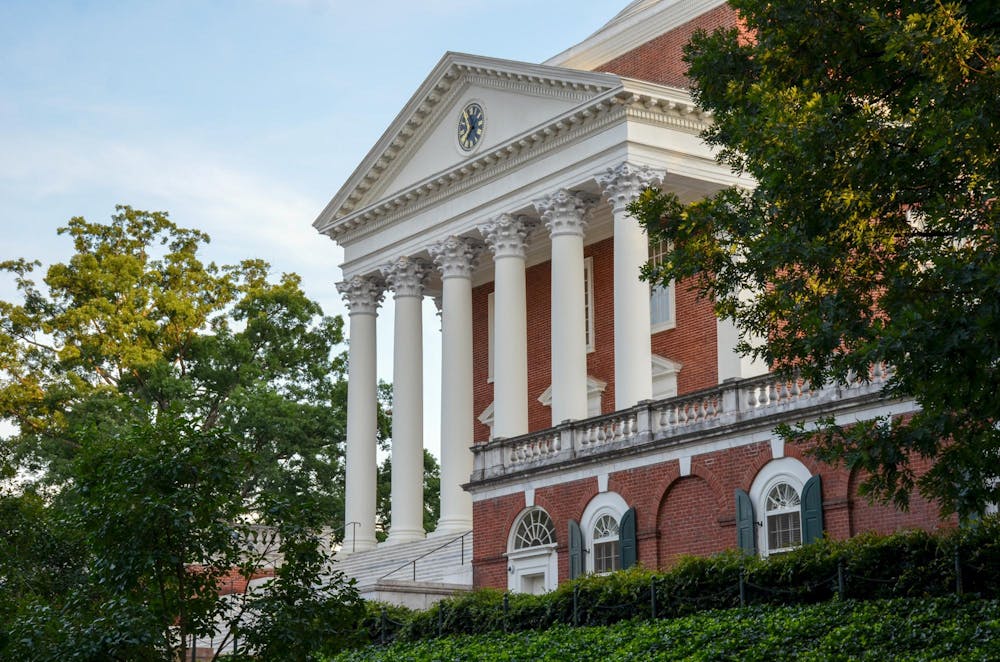
In a letter addressed to the Board of Visitors, University President Scott Beardsley and the University community Thursday, 191 “concerned faculty” requested the Board restart its search for a University president and pause the search for University executive vice president and provost. Thursday’s letter follows a letter signed by 201 faculty in January requesting the revocation of Beardsley’s presidency.
The faculty characterized the seven-month search for Beardsley — which occurred over the summer and through the fall — as “hasty.” The Board appointed Beardsley Dec. 19, just three weeks prior to when Gov. Abigail Spanberger (D) took office, requested five Board members to resign and subsequently appointed 10 new Board members.
Throughout the search for Beardsley, University stakeholders — including faculty — released an abundance of statements expressing disapproval that the Board was operating with vacancies. Statements from faculty also noted feelings that the search was secretive and did not consider input from the University community.
Thursday’s letter echoed many of the sentiments from statements released throughout the search process. The faculty specifically raised questions regarding what they called an irregular process undertaken by the previous Board which appointed Beardsley.
“Did [the Board] constrict the pool of willing applicants? If so, what confidence can we have that the best candidate was chosen?” the faculty wrote. “If not, how did Mr. Beardsley end up the top candidate? What role did Isaacson Miller play in propping up a process that became all but a sham by the end?”
Isaacson, Miller was the external search firm hired by the Board in August to assist in the search for Beardsley, and the cited faculty concern stems from Beardsley’s prior relationship with chair of Isaacson, Miller, John Isaacson.
Prior to Spanberger’s appointments to the Board Jan. 17, the Board was not lawfully constituted — it consisted of 12 members and did not meet Virginia law requiring at least nine members to be Virginia residents and at least nine to be University alumni.
The faculty wrote Thursday that they are pleased with the reconstitution of the Board — the 10 appointments brought the Board in accordance with Virginia Law — but they emphasized that the new Board should not leave questions about Beardsley’s appointment process unanswered.
“We are delighted that we have a newly reconstituted and fully staffed Board of Visitors,” the faculty wrote. “But it is important to realize that the replenishment of the Board is not the end of our difficulties — it only prepares the way for the repairs that now must be done.”
The 191 faculty members also wrote that the Board should pause the search for the University EVP and provost — a search which began when former EVP and provost Ian Baucom announced his resignation in January 2025. Currently, the search is ongoing with the expectation of the position to be filled in March.
The faculty also wrote that Beardsley’s employment contract is a “poison pill contract.” If Beardsley’s employment were to be terminated without cause, he is entitled to receive payments equal to his salary for 12 months as well as paid sabbatical leave for up to 12 months — Beardsley’s base salary for 2026 is $1.3 million.
“It is unusual, perhaps unprecedented, for such a contract to be used in appointing a president by the University’s governing Board, the more so because we are a public institution,” the faculty wrote. “By making it prohibitively expensive to dismiss Beardsley, the contract effectively undercuts the Board’s and by extension the governor’s, the legislature’s and the taxpayers’ right and obligation to oversee the operations of the University.”
To conclude their statement, the faculty addressed Beardsley directly, and requested that he reconsider his position as president, given that he assumed office under “dark times” at the University.
“The outgoing Board made clear its disdain for process, history, tradition and the University’s best interests,” the faculty wrote. “You have benefited directly from that decision and the way it was reached. But even now you may reject their agenda and agree to reset the process in the best interest of the University and in consultation with the new Board and the University community.”
Lauren Seeliger is a news editor of the 137th term and enjoys covering U.Va. Health and University governance. Lauren is a fourth-year Behavioral Neuroscience student from Fairfield, Connecticut.
Read More
Board of Visitors discusses the implementation of AI in research and academics
By Jaylynn Perez | 6 hours agoThe Board also received an orientation on changes to NCAA athletics, completed its annual Atlantic Coast Conference certification, heard a report from Aaron Bloomfield, Faculty Senate chair and engineering professor, and discussed the University’s ongoing searches for a provost and several deans.

Audit, Compliance and Risk Committee discusses risk management, internal auditing across University
By Charlotte Gabriel | 22 hours agoThe meeting commenced with opening remarks and a meeting overview by Owen Griffin, Committee chair, Commerce Class of 1994 and Darden Class of 1999 alumnus. The Committee also welcomed Steven Weber, new director of Health System Audits.

Finance Committee reviews UVIMCO investment performance, approves Darden housing rates
By Avantika Jadhav | 22 hours agoThe Committee also approved updates to the University’s six-year institutional plans and state funding requests and heard an audit report of the Strategic Investment Fund.


