
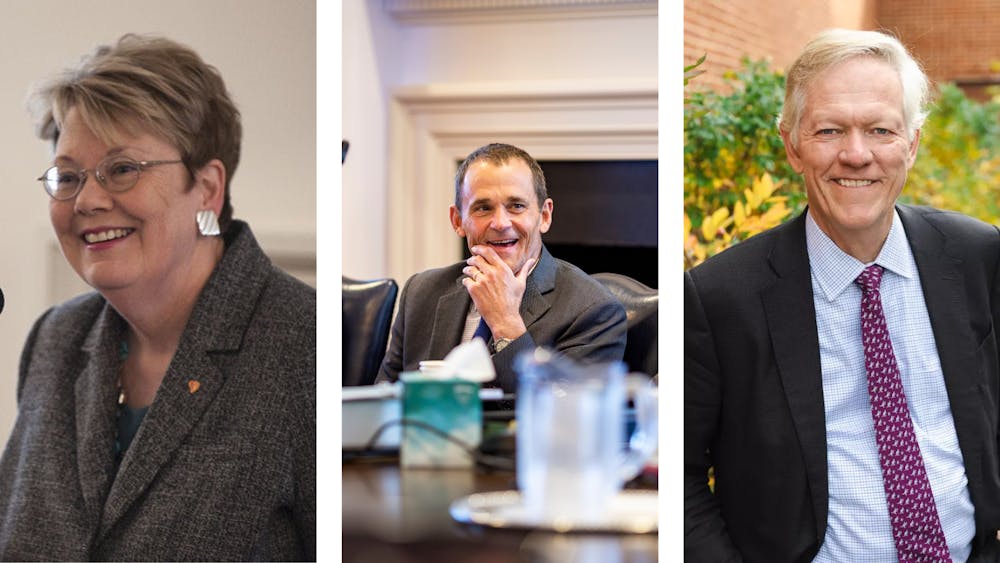
The University’s search for its 10th president lasted roughly five months, beginning over the summer and ending with the appointment of Scott Beardsley, current dean of the Darden School of Business, Friday. Isaacson, Miller — the executive search firm that assisted in the search process — said in a letter to the Faculty Senate Nov. 21 that the progress followed that of a classic presidential search.
The recent search spanned an equivalent timeframe as the search for the University’s eighth president but finished roughly two months sooner than the search for the University’s ninth president. Additionally, the recent search continued despite calls to pause the selection process until Gov.-elect Abigail Spanberger is inaugurated Jan. 17.
To recount the University’s search for its 10th president, here is a closer look at the timeline.
The phases of the search — a four-stage process
Former University President Jim Ryan announced his resignation as the University’s ninth president June 27 following pressure from the Justice Department. The search committee for the University’s 10th president was established July 25 and included 10 Board members, as well as University administrators, faculty and alumni. At the Aug. 4 Board of Visitors meeting, Paul Mahoney was appointed as the University's interim president.
The search for the 10th president followed a multi-phase process, beginning with the establishment of a search committee and the hiring of Isaacson, Miller — an external search firm — in August. The search committee then defined the presidential profile by soliciting input from students, faculty and alumni through surveys and listening sessions. In the discovery phase, candidates were recruited and thoroughly evaluated through their application and interviews.
In the final phase of the search, finalists were chosen by the search committee. The Board then reviewed the candidates and voted to appoint Beardsley.
The search committee’s meetings — August to December
The search committee held five documented meetings between August and December as part of the 10th presidential search. Discussions about candidates were conducted in closed session to preserve confidentiality and comply with standard presidential search practices. Details of the search committee’s meetings were drawn from the official meeting minutes and University statements.
Shortly after the Board appointed Mahoney Aug. 4, the search committee convened Aug. 22. Members established the search committee’s role, reviewed confidentiality expectations and received an overview of the search process. The meeting minutes included the University’s priorities and plans for community engagement through surveys and listening sessions.
During the committee’s next documented meeting Sept. 22, members reviewed feedback collected from initial listening sessions and survey responses. Members identified recurring themes, including prioritizing academic leadership, the student experience and institutional transparency. Candidate evaluation criteria was adjusted to reflect community input.
Isaacson, Miller provided an update on recruitment efforts at the search committee’s Oct. 7 meeting. The search firm presented an initial report of potential candidates in closed session to ensure confidentiality. Additionally, the search committee discussed a new presidential profiling system to organize each candidate’s experience, leadership style and alignment with the University’s priorities.
The search committee then conducted interviews over the week of Nov. 17 to Nov. 21 with the first-round of selected candidates to evaluate leadership experience and compatibility. Search committee members continued reviewing presidential candidates at the committee’s Dec. 11 meeting.
Special Board meetings were scheduled for Dec. 19 and Jan. 6, and according to Board Rector Rachel Sheridan, the search committee planned to conduct additional interviews with presidential candidates over the two weeks leading to the Dec. 19 meeting. At that meeting, Beardsley was ultimately presented to the Board and appointed unanimously out of four finalist candidates.
Calls to halt the search, and counters from the search firm
The search for the 10th president continued amid broader debates over University governance. Gov.-elect Spanberger wrote a letter to the Board Nov. 12 requesting to delay the selection of finalists or appointment of a president. She requested the Board wait until she fills five vacant seats on the Board after she assumes office Jan. 17, expressing her concerns over the current Board’s composition.
The Faculty Senate also passed a resolution Nov. 14 calling for the presidential search to pause. Similar to Spanberger’s request, the Senate asked for the search to wait until the vacancies on the Board are filled.
In response to these requests, John Isaacson, chair of Isaacson, Miller wrote a letter to the Faculty Senate Nov. 21, describing the process of the search for the University’s 10th president as progressing at a typical pace for a presidential search.
Isaacson also noted that, while following standard search structures, the search for the 10th president exceeded typical levels of community engagement. The firm pointed to the size of the committee — which included over 20 members — and the number of listening sessions and survey responses as distinguishing features of the process.
“The Special Committee, by design, includes students, faculty, staff, alumni, current trustees and former trustees from prior administrations,” Isaacson wrote. “It is considerably larger than most presidential search committees. Over the last few decades, we have only seen one or two that are larger.”
According to another statement released Nov. 21 by the search committee, no finalists had been selected and the search for the next president would continue according to established procedures. Reflecting on the work completed over the search, the committee emphasized the integrity behind their efforts, even amid debates and calls from stakeholders.
“As a committee, we want to state unequivocally: this search has been conducted with rigor, fairness and integrity thus far. We would not lend our names or our service to a process that failed to meet those standards,” the search committee wrote in a statement.
Nine of the University’s 14 academic deans wrote a letter to the Board following these counters Dec. 2 requesting a pause in the selection process. They highlighted a lack of institutional trust regarding the legitimacy of a presidential appointment.
The most recent call to stop the search came from the Faculty Senate Dec. 12, who passed a resolution expressing discontent with the timeline of the presidential search process. This resolution called for finalist candidates to request a pause in the process.
A comparative analysis — Beardsley’s search versus those of Ryan and Sullivan
Isaacson, Miller included an examination of the search timelines of former University Presidents Teresa Sullivan and Jim Ryan in their letter to the Faculty Senate Nov. 21. They indicated that the progression of the search was consistent with prior searches in terms of the number of search committee meetings held per month.
Similar to the search for Beardsley, the University hired Isaacson, Miller to aid the process of selecting a ninth president following Sullivan’s announcement Jan. 2017 that she would step down from her position as University president. The search for her successor spanned between Feb. 3, 2017 and Sept. 15, 2017 — approximately seven months.
The process for the ninth presidential search involved the participation of a search committee through initial candidate screening and multiple rounds of interviews. This search led to the approval of Ryan as the University’s ninth president Sept. 15, 2017. Ryan officially began his tenure Aug. 1, 2018 — nearly a year later — following the conclusion of Sullivan’s term July 31, 2018. The ninth presidential search committee met approximately 10 times over the course of the search. In comparison, the search committee for Beardsley met five times within five months.
Following the announced retirement of former University President John T. Casteen Aug. 11, 2009, the eighth presidential search was conducted. The University hired a Dallas-based executive search firm — R. William Funk & Associates. The search spanned approximately five months, and the Board appointed Sullivan Jan. 11, 2010 as the University’s eighth president.
The appointment of Beardsley as the University’s 10th president ultimately concluded faster than the search for Ryan, but spanned approximately the same timeframe as the search for Sullivan.
Looking ahead
There is one further special meeting of the Board scheduled for Jan. 6. However, the purpose of this meeting remains unclear. Beardsley is set to begin his tenure Jan. 1.

Jaylynn Perez is a third-year College student from Chesapeake, Va., majoring in Government and minoring in Public Policy and Leadership in the Batten School. She currently serves as news senior associate editor and video staffer. She frequently covers topics such as student self-governance organizations, University governance and local politics.
Read More

English department considers AI’s place in the classroom
By Lily Kostro | 2 days agoFor the University’s English department, some professors have chosen assignments that utilize AI in writing, while others take the approach of completely eliminating students’ access to generative AI in their writing process.

The Cavalier Daily joins amicus brief supporting student press at University of Alabama
By Jaylynn Perez | 2 days agoThe Cavalier Daily joined 39 other collegiate news organizations and 15 student editors from across the country in signing an amicus brief Sept. 2.

Student Council considers creating an ad hoc committee to review UBE proceedings
By Lucia Gambacini | 3 days agoConsideration of the bill was postponed until the next general body meeting.


