Few musicians have left a cultural footprint as enduring and globally recognized as Michael Jackson. As a result, any cinematic portrayal of his life faces the challenge of striking a delicate balance between homage and honest storytelling. “Michael,” a heavily anticipated biopic depicting the life of the King of Pop from his childhood stardom to solo rise, promised the former — revealing detailed reenactments of the singer’s most famous performances, outfits and songs in trailers and early press releases. Following the film’s Friday release, it is apparent that while it shines in the homage, it ultimately falters in its storytelling, struggling to compile a cohesive narrative that delves deeper into the star’s life.
Opening in Gary, Ind., the film follows a young Michael Jackson played by Juliano Valdi through his childhood marked by grueling music rehearsals and physical abuse at the hands of his father, Joe — portrayed by Emmy Award-winning actor Colman Domingo. As he and his brothers hone their musical talents, they slowly rise to fame, eventually signing with various record companies and moving to Encino, Calif. After this move, an adult Michael, now portrayed by Jaafar Jackson — the real-life nephew of the star — faces inner turmoil alongside a rise to stardom as he attempts to separate his career from The Jackson 5, the Motown-era sibling group that established him as a star. The film culminates in Michael Jackson’s final separation from the group, highlighting the release of his album, “Bad,” and his first solo concert tour of the same name.
The film is directed by Antoine Fuqua, whose work in popular action and thriller movies establishes him as a stand-out director through films like 2013’s “Olympus Has Fallen” and 2014’s “The Equalizer.” While the biographical nature of “Michael” is a stark turn from those genres, Fuqua also has experience directing music videos for acclaimed artists like Prince and Stevie Wonder. This expertise proves to be an overall strength for the film as it heavily features Michael’s music videos and concerts.
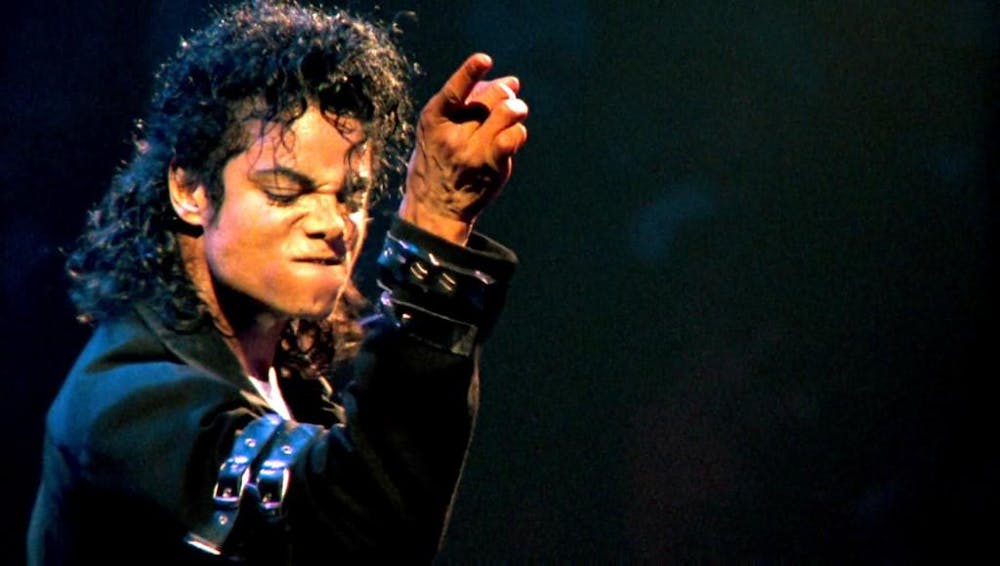
The film’s strongest moments surface in its reenactments of Michael Jackson’s most iconic performances, in which the attention to music and visual accuracy is most apparent. From choreography designed by brothers Rich and Tone Talauega to mimic Michael’s actual dancing during his performance at the 25th anniversary of Motown Records — “Motown 25: Yesterday, Today, Forever” — to faithful costuming in a reenactment of the “Thriller” music video, these sequences demonstrate a commitment to capturing the spectacle that defined his public-facing life. In these scenes, Fuqua’s background in music video direction becomes evident via dynamic camerawork that emphasizes both Michael’s presence as a performer and the scope of his popularity, often framed through sweeping yet stark shots of energetic crowds.
Another notable technical strength lies in the film’s sound design, overseen by Academy Award-winning music supervisor John Warhurst, who previously worked on prominent music films, including 2018’s “Bohemian Rhapsody.” The film blends actors Valdi and Jackson’s vocals over Michael’s original tracks to preserve a sense of authenticity, whether in quiet solo shots of Jackson scatting in the studio or in resonant vocals during performance sequences. These choices result in an enchanting soundtrack in which each moment pays tribute to the singer's musical prowess. As such, this soundtrack leaves the film chock full of recognizable sounds and beloved music that make the film feel akin to a live concert setting. However, while this emphasis on musical accuracy is effective, it comes at the expense of the film's narrative development.
Important plot transitions in the film — including the Jacksons' reasoning behind their move to California, Michael’s relationship with producer Quincy Jones or his private settlement with PepsiCo — are either glossed over or largely go unexplained for the sake of succinctness. As a result, limited time is spent observing or exploring the emotional impact of these changes. The pacing leaves the narrative feeling fragmented, with significant moments serving more as narrative checkpoints than opportunities for deeper analysis into Michael’s life.
Furthermore, while Domingo and Jackson effectively convey the tension in the complex father-son dynamic of Joe and Michael Jackson, the film’s dialogue offers little to their relationship beyond this central conflict. As a result, the film leaves their relationship feeling one-dimensional, remaining narrowly hyper-focused on Joe’s exploitative nature, especially in the film's latter half. This limitation extends to Michael’s relationship with the rest of his family — particularly his siblings — as well. For example, although the film repeatedly emphasizes his siblings’ importance to Michael, there are few meaningful interactions to substantiate that claim. When such moments do occur, they are underdeveloped and brief, lacking the depth needed to make the relationship truly resonate.
This lack of emotional resonance is further reflected in the film’s use of CGI throughout to depict Michael’s pet chimpanzee — Bubbles — and other animals. While the decision to use CGI allows Fuqua to circumvent the ethical and logistical challenges of using real animals, its execution is uneven. The rendering of Bubbles, along with digitally enhanced crowds in concert sequences, feels heavily artificial due to inconsistent texturing, uneven lighting and rigid facial features. This creates a sense of uncanniness which detracts from the film’s otherwise realistic details. Additionally, the use of CGI to modify Jackson’s face to better match his uncle’s also falls flat in some scenes, drawing attention away from Jackson’s strikingly realistic portrayal of Michael’s mannerisms and instead onto the film’s editing.
A further limitation of “Michael” lies in its reluctance to engage with the more controversial aspects of his private life. While the film focuses heavily on his public-facing persona and artistic achievements, it rarely delves into the scrutiny and controversies surrounding his private life, notably omitting two years of his life between The Jackson 5’s “Victory Tour” and the film’s ending on stage at the “Bad” tour. This omission results in a portrayal of Michael Jackson that feels selective, choosing to celebrate his legacy rather than examine his life. Although this decision falls in line with the film’s emphasis on homage, it further reminds of its shortcomings in portraying a well-rounded narrative look into the star’s life.
Regardless of these faults, “Michael” ultimately functions as a biopic that celebrates the career and influence of Michael Jackson, offering visually and musically stunning reenactments of some of his most iconic moments. While its more ambitious storytelling elements are less consistent, the film still delivers a compelling tribute that appeals to fans of the singer, even if those seeking a deeper exploration of his life may find it less thrilling.
Read More

An essential guide to the Charlottesville music scene
By CC West | 2 days agoWhether someone is a composer, a dedicated listener or looking to grow their music knowledge, here are some ways to find new harmonies throughout a student's years on Grounds.

Bebe Stockwell’s sunny disposition shined at The Southern
By CC West | 2 days agoFor the third show of her first headlined tour, Bebe Stockwell graced The Southern Café and Music Hall Saturday with her upbeat attitude and optimistic lyricism.

‘Final Friday’ at the Fralin brings an opportunity for hands-on engagement with the arts
By Amelia Lucien | 2 days agoThe majority of Final Friday events also include free food and student-led tours of the museum via the Fralin Student Docent program.