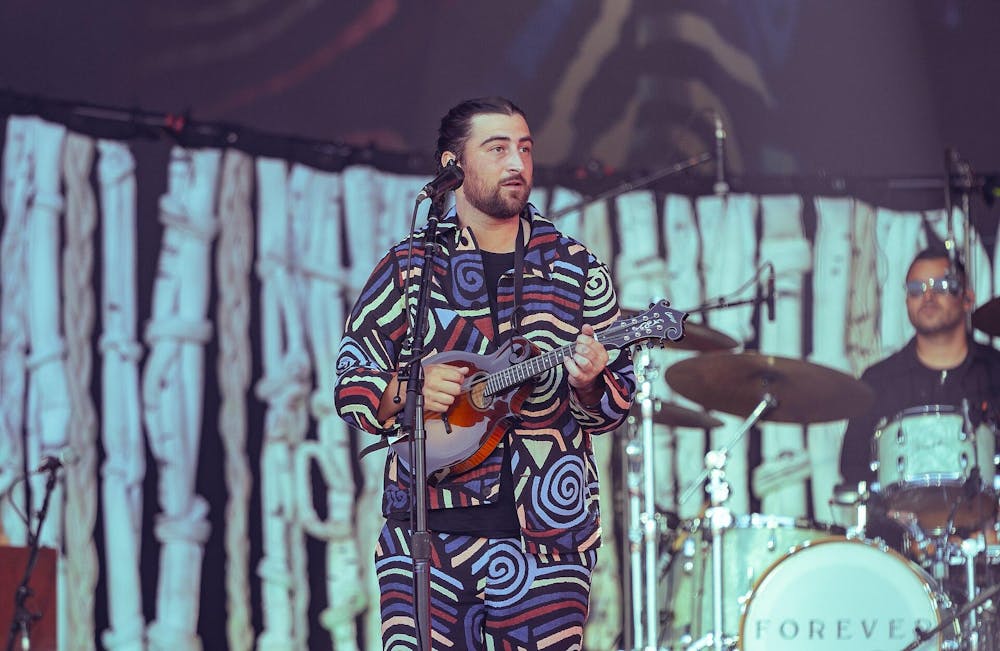
Folk-pop singer-songwriter Noah Kahan released his latest project Friday after two years with the album, “The Great Divide.” Kahan is known for his viral tracks that deeply resonate with audiences for their authenticity and lyricism. This personal work — a story of masterful songwriting and vulnerability — contains 17 tracks with a total runtime of one hour and 17 minutes.
Kahan garnered a massive commercial breakthrough in 2022 with his third album, “Stick Season.” The viral titular track earned over 1.7 billion streams on Spotify, leading to the album peaking at number two on the Billboard 200 chart. This popularity led Kahan to release two extended album versions: “Stick Season (We’ll All Be Here Forever)” and “Stick Season (Forever)” in 2023 and 2024, respectively.
Kahan’s latest project captures an emotional journey into the past. Like his previous works, Kahan explores themes of parental relationships and mental health. However, “The Great Divide” is unique as it deals with Kahan’s insecurities especially after returning to his quiet and stifling hometown of Strafford, Vt. Now, Kahan writes with the added pressures of fame and celebrity, something unexplored on previous projects.
The album kicks off with “End of August,” a melancholic piano-based track that examines the foreboding feeling that arrives once summer ends. Kahan sorrowfully sings of emotional numbness with the line “Oh, everythin' you see out hеre will die / Oh, it's a matter of time.” As the track crescendos to its bridge, Kahan foreshadows the devastating and emotional journey during the album. At the end of the song, he whispers “05072 / A long shadow,” the zipcode of his hometown and a nod to the influence of his past on his songwriting and the album’s themes.
The next track, “Doors,” explores Kahan’s struggles with self-doubt. With an upbeat guitar backing, he sings, “Have you ever stared directly at the sun? / Have you ever shared some closeness, so exposed / To have it spit back by someone?” The middle of the song ends with a layered chorus that transitions into a vibrant violin to liven up the song in the midst of vulnerable lyrics. Kahan shares deeply personal thoughts about himself and his relationship with others on this song, creating an intimate atmosphere of authentic songwriting.
One of the most sensitive tracks on the album is “Paid Time Off,” an acoustic song about using a toxic relationship to fill an emotional void. The utterly devastating chorus sings, “And your love is like an open flame, I'm a runnin' car, and you're a closed garage / Someonе once told us there's a world out thеre, but we don't care enough to drive that far.” This tune reflects themes of previous songs such as “The Great Divide,” a later track on the album, which deals with the guilt of holding on to past nostalgia.
This track transitions into the album’s first single, “The Great Divide,” in which a bright electric guitar juxtaposes the heavy lyrics. Tied for the longest song on the record, Kahan grapples with religious trauma through the chorus “I hope you're scarеd of only ordinary shit / Like murderers and ghosts and cancer on your skin / And not your soul and what He might do with it.” Through this reverential emphasis on “He,” Kahan speaks to his grievances about a godly presence affecting those around him. Kahan also mentions the album’s overarching theme of the pressures of fame with the lyric “But the world is scared of hesitating things / Yeah, they only shoot the birds who cannot sing.” These lines reflect the harsh pressures of the music industry, especially on those who are struggling, painting a picture of Kahan’s innermost thoughts and apprehension about his sudden rise to fame.
As the album progresses, the song “Haircut” continues these themes with soft laments about Kahan’s self hatred. The song in particular is lyrically strong, with cheeky lines like “You grew your hair out long, now you think you're Jesus Christ” and “We were fine without you, baby, long after you're gone / Spare us all the pity, love, save it for the microphone.” “Haircut,” is written in a second person perspective, as if writing directly to himself with a reflective, retrospective tone towards his life and career. This artistic choice helps to communicate to audiences about Kahan’s fears that even after becoming successful, he cannot run from his past.
The second half of the album is defined by the second single “Porch Light.” The repeated lyrics in the refrain, “But it's cold, and it's cold, and it's cold, and it's cold, and it’s cold / And I don't know, I'm alone, I'm alone, I'm alone, I'm alone,” help to build up to a catchy and soulful chorus written through the perspective of Kahan’s mother, Lauri Berkenkamp. In the song, Kahan sings as her to himself, in a second person perspective similar to “Haircut.” The lyric “I hope you tell me that you're winding down / That you lost thе taste to face the crowd / That whatеver made you famous made you sick” hints that Kahan’s family is worried about how his fame is negatively affecting him.
With slower and wordier tracks “Headed North” and “We Go Way Back,” the latter part of the record is melodically weaker than the former. The songwriting on these pieces is just as strong as the rest of the track by building a compelling story and fitting thematically. Yet, with how strong the earlier tracks are, they can easily be overlooked. However, these simpler songs are needed to pace the album, especially with heavier instrumentals in faster songs like “Deny Deny Deny” and “Dashboard.”
To end off the record, the tracks “All Them Horses” and “Dan” provide chilling commentaries on isolation and death. In “All Them Horses,” the chorus “I've crossed the county line, I cannot go back / I'm always on my own” provides a visual metaphor of Kahan’s personal yet isolating journey to stardom. The final track, “Dan,” is similarly lonesome, and possibly named after Kahan’s childhood best friend. “Dan” provides an existential conclusion to the album, with Kahan singing “Where do we go when we die? / I wouldn't mind right here, I wouldn't mind at all.”
“The Great Divide,” with masterful melodies and powerful motifs, supplies a compelling companion to Kahan’s previous albums, a testament to his lyrical and emotional prowess. After just one listen, audiences are privy to Kahan’s innermost dialogues, producing a truly intimate experience.
Read More

Big Red makes Charlottesville’s day on his ‘Day Made’ tour
By Bridget Baile | 19 hours agoFor the chronically online, Big Red’s “Day Made” tour lived up to its name.

On Repeat: 2010s indie rock songs to listen to on NFL Sundays
By Darya Bartol | YesterdayFootball-filled Sundays can cause a rollercoaster of emotions even in the most stoic of fans. These 2010s indie rock hits represent this emotional turbulence whether celebrating with friends or mourning in solitude.

Sasha Fishman’s ‘Lemniscata’ puts water in motion at Ruffin Gallery
By Preet Manukonda | 2 days agoThe fountain-like installation and accompanying pieces explore the circulation of water through both human-made and natural environments.