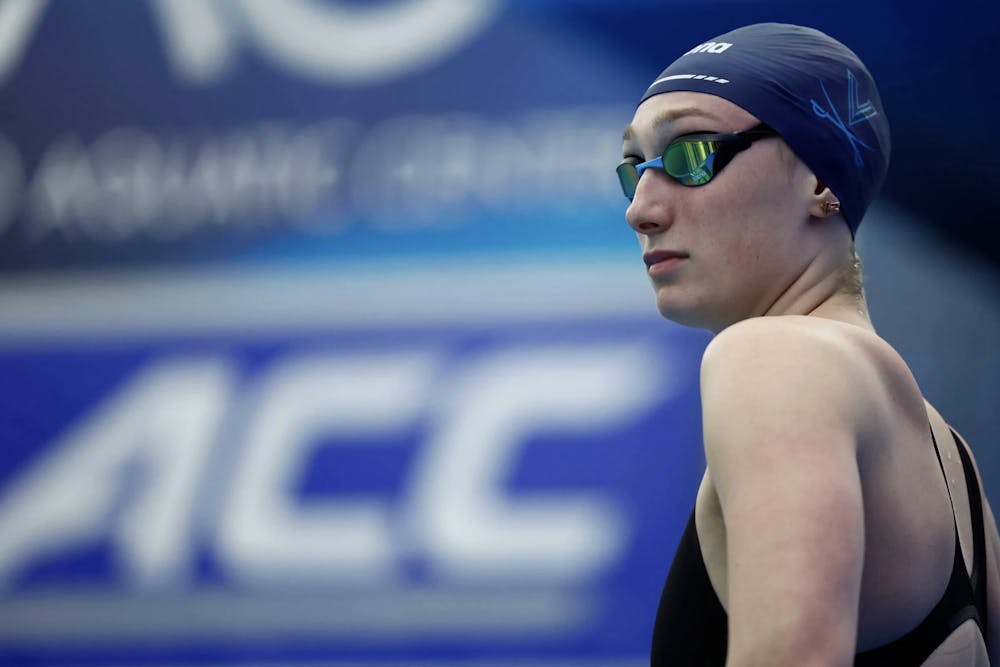
As Virginia women’s swimming enters their final preparations for the 2026 ACC Swimming and Diving Championships, they do so not just as a team, but as a juggernaut with a track record of pure, unadulterated dominance.
The Cavaliers have captured six consecutive team titles since 2020, cultivating a reputation for overwhelming relay victories and record-breaking performances. They hold the ACC record in every single individual and relay event, and own the NCAA records in all five relays.
With the Cavalier Invitational complete and no other ACC women's programs competing before the championship, the regular season is officially in the rearview mirror. Virginia heads to Georgia Tech this week having averaged 1,508 points across their past six conference championship victories, margins so dominant that runner-up teams often finish hundreds of points behind.
The ACC Championships operate under strict constraints — chief among them being that only 18 swimmers can travel. For most programs, filling those 18 spots with scoring athletes is an aspiration, yet the Cavaliers routinely have more than 18 who are deserving.
In fact, Virginia currently owns 83 top-24 swims across the 13 individual events on offer at the conference championships — averaging over six scorers per event. Of these 83 swims, they have 24 current swimmers within individual scoring range in at least one event, meaning six student-athletes who are fast enough to score points at the conference level will be left in Charlottesville.
Nowhere is this issue of depth more evident than in the 200-yard freestyle. The Cavaliers claim nine of the top 24 conference times, with sophomore superstar Anna Moesch leading the pack at No. 1 nationally with 1:40.25. Freshman Madi Mintenko sits in the No. 2 spot with a 1:41.70 — that ranks her at No. 6 in the NCAA this season.
The 200-yard butterfly presents a nearly identical scenario — eight Virginia swimmers are ranked in the top 24, led by Curzan's conference-best 1:51.35. The distance events offer no respite for opposing teams either, as the Cavaliers have five swimmers in the top nine of the 500-yard freestyle, led by senior Aimee Canny's No. 1 time of 4:34.26.
The program’s domination of ACC rankings was only exacerbated by Virginia’s final regular-season tune-up at the Cavalier Invitational last weekend. Historically a last-chance meet for bubble swimmers to earn places on the ACC roster, a large portion of the team used it to drop NCAA-worthy times in events they rarely ever swim.
The headline came from the ever-versatile Canny. In her first-ever attempt at the 400-yard individual medley — apparently bored of the many events she is already elite in — produced a 4:03.36, a time that catapulted her to No. 4 in the conference and No. 6 in the entire NCAA.
But Canny was not alone — junior Tess Howley posted a blistering 1:52.53 in the 200-yard butterfly, breaking the Aquatic and Fitness Center pool record for another No. 6 time in the NCAA. Freshman and Italian Olympian Sara Curtis ripped a 51.03 in the 100-yard butterfly prelims, then came back at night to clock a 50.68 in finals, a mark that now sits No. 4 in the ACC and No. 5 in the NCAA this season.
With this embarrassment of riches, one might expect Coach Todd DeSorbo to be buried in spreadsheets — but the former accountant-turned-coach insists his strategy relies far less on data than one might think.
“I always say, if I knew I was going to be a coach, I would have majored in psychology instead of accounting,” DeSorbo said. “Numbers and data are great, but confidence is everything.”
This philosophy may seem counterintuitive for a program chasing a seventh-consecutive conference championship and sixth-consecutive national championship. He lets swimmers take the wheel on their event lineups, allowing them to swim what excites them the most.
"At the end of the day, if you're looking at a top three finish in any one of a number of events, then just pick the one that you're really excited about,” DeSorbo said. “Because the events that you're most excited for are going to be the ones that you're gonna do best at, so you know [we just] kind of let them pick.”
Letting his swimmers take the wheel on lineup decisions reflects DeSorbo’s belief that confidence and joy matter more than any points projection or team score calculation.
“Sure, we give them some guidance … but at the end of the day, you know, a happy swimmer is a fast swimmer and we want them to be happy,” DeSorbo said. “We want them to have fun, and just swim events that [they’re] excited to swim and that [they] want to swim … if it makes sense from a team perspective then we certainly agree with it 100 [percent].”
That freedom is a luxury, but it also creates a paradox of choice for athletes like Olympians Canny and Curzan.
Canny, the Cavaliers’ Swiss Army knife, presents a complex conundrum. The South African ranks within the top 16 across a staggering number of events. She leads the conference in the 500-yard freestyle and sits within A-final range in the 200-yard breaststroke, 200-yard freestyle, 200-yard individual medley, 400-yard individual medley, 100-yard breaststroke, 1650-yard freestyle, 200-yard butterfly as well as No. 15 in the 100-yard freestyle — that is nine potential scoring events for an athlete limited to three individual races.
Meanwhile, Curzan currently ranks No. 1 in the ACC in three events — the 100- and 200-yard backstroke and the 200-yard butterfly — with her backstroke times of 49.12 and 1:47.89 also leading the nation. She also sits at No. 2 in the 100-yard butterfly, and within A-final range in the 50-, 100- and 200-yard freestyle.
Each choice precludes another, and with many of these events being ones swam in the five relays on offer, Curzan and the coaching staff have a lot to consider this postseason.
Individual events aside, Virginia sits No. 1 in the conference rankings in three of the four relays they have contested this season — the 200-yard and 400-yard medley relays, and the 200-yard freestyle relay.
Even in the one relay where the Cavaliers are not slotted first — the 400-yard freestyle relay — they are a microscopic three-hundredths behind first-place Stanford, 3:07.62 to 3:07.59. Virginia heads into 2026 on a six-year win streak in that event, so the Cavaliers will no doubt field their best to reclaim the top spot come race day.
But it is the 800-yard freestyle relay where Virginia's legacy looms largest. The Cavaliers have not lost this event at the ACC Championships since 2007 — a 19-year winning streak that predates the current roster, coaching staff and most of the program's recent dominance. But with four swimmers ranked in the top eight of the 200-yard freestyle, that streak appears safe, despite not having contested the event yet this season.
The ACC Championships also serve as a practice run for the NCAA Championships. With both championships being hosted at Georgia Tech's McAuley Aquatic Center, the conference meet offers Virginia valuable familiarity heading into the national championship. DeSorbo considers this coming week a dress rehearsal as they continue their season-long pursuit of a historic sixth-straight NCAA team title.
“I think [having the meets at the same venue creates] a positive effect,” DeSorbo said in an interview with The Cavalier Daily. “Uncertainty creates anxiety, and when you go to a new pool or a new hotel or a new breakfast … you don't know what to expect, and it might take you a few days to get into a groove. This is like, we've just been here. We know everything.”
The venue aside, the conference field includes No. 2 Stanford, No. 5 California, No. 7 Louisville and No. 8 NC State — programs that will go on to provide stiff competition at NCAAs. But as Virginia heads to Atlanta, it is primarily navigating the limits of its own excellence.
Read More

No. 12 Virginia women’s soccer draws Georgetown in back-and-forth stalemate
By Sofie Keppler | 11 hours agoIn a back-and-forth battle defined by defensive physicality and backline saves, the Hoyas and the Cavaliers were both held scoreless after 90 minutes of action.

No. 5 Virginia field hockey's lead slips away in 61-second Ohio State comeback
By Eleanor Lynch | YesterdayAfter spending most of the game dominating the flow of play, the Cavaliers were ultimately left chasing an equalizer that never came in the fourth quarter. The loss marked Virginia's first of the season and brought an abrupt end to what had been an impressive opening stretch for the Cavaliers.

Volleyball finds itself on a roll after taking VCU down in straight sets
By Cierra Lyles | YesterdayTaking the court against their host, the Cavaliers (3-1, 0-0 ACC) annihilated the Rams (1-3, 0-0 A-10) in straight sets, 25-13, 25-17, 25-22.