
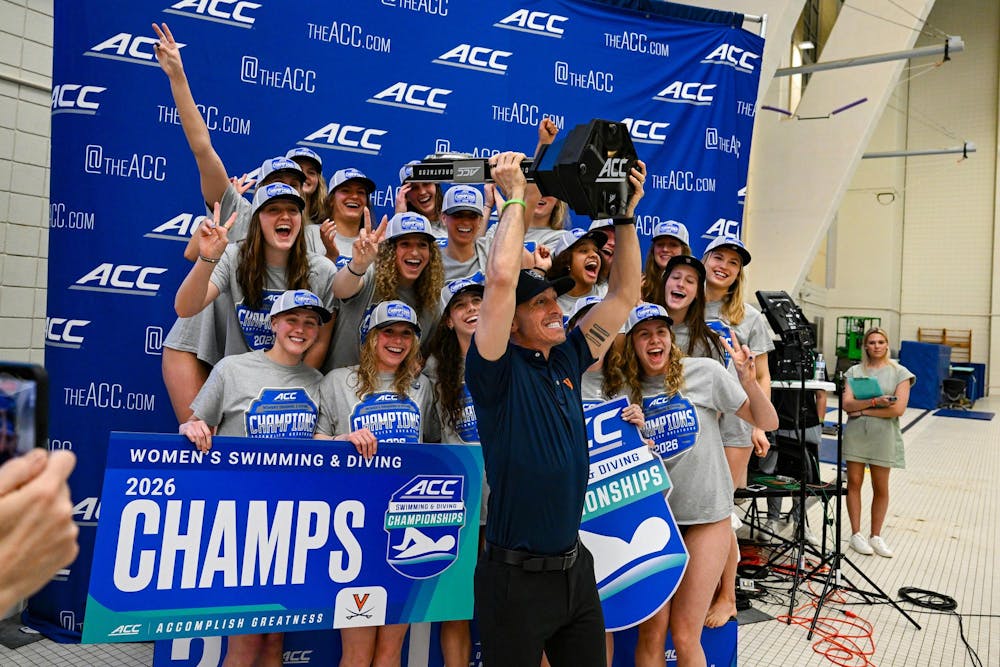
In their first championship meet of the post-Walsh era, the Virginia women refused to slow down.
The Cavaliers spent the week in Atlanta, Ga. at the McAuley Aquatic Center and left no doubt, racking up 1410.5 points to blow past Stanford and Cal for their seventh straight conference crown. Virginia accomplished all of this without a single diving point, still sitting in last place on night three after medaling in two relays, making the 371.5-point margin of victory all the more staggering.
With the inevitable dominance of the Walsh sisters gone, the question entering the season was not whether Virginia would be competitive — few doubted it would be — but whether it could sustain the kind of unadulterated dominance that has defined the 2020s of Todd Desorbo’s tenure as head coach.
That question was answered with an emphatic and resounding ‘yes’ over five nights of mind-boggling Cavalier achievements. Virginia claimed 11 event titles, broke two NCAA records and saw three swimmers — junior Claire Curzan and sophomores Anna Moesch and Katie Grimes — each win two individual events.
Virginia’s intentions became clear from the opening night of the swimming events, when the Cavaliers put up the second-fastest 800-yard freestyle relay in history, despite only returning one swimmer from their NCAA-record setting relay at last year’s ACC Championships.
The quartet of senior Aimee Canny, freshman Madi Mintenko, junior Cavan Gormsen and Moesch combined for a 6:45.34 that shattered the Georgia Tech pool record. The time also surpassed the legendary 2017 Stanford relay of Katie Ledecky, Simone Manuel, Lia Neal and Ella Eastin in the all-time rankings — only the Cavaliers' own NCAA-record 6:44.13, set with both Walsh sisters, Canny and Curzan, remains faster.
The sole blemish of the meet was a shock silver in the 200-yard medley relay, where Louisville, powered by 22-year-old freshman Anastasia Gorbenko’s breaststroke split, edged Virginia by a mere two-tenths, 1:32.26 to 1:32.46 — the Cavaliers have been as fast as 1:31.91 this season.
Despite winning a gold and a silver, the Cavaliers entered day four in last place, after earning no points from the two days of diving competition prior. But that did not last long — the Cavaliers fired back with a 200-yard freestyle relay victory in a pool record of 1:23.75. Three of the four swimmers split sub-21 seconds to combine for the second-fastest performance ever, second only to Virginia’s NCAA record of 1:23.63 by a mere tenth of a second.
Wednesday also saw the beginning of the individual event slate for the Cavaliers. The schedule opened with the 500-yard freestyle, where Virginia swept the event going 1-2-3-4-6. U.S. Olympian Grimes grabbed the win in 4:33.78 over Canny, with Gormsen just behind to complete a sub-4:35 Virginia podium.
On the final night of competition Saturday, Grimes picked up her second ACC title in the mile, clocking 15:45.20 to win by over five seconds. Gormsen added another third-place trophy to her collection to solidify a strong distance showing in Atlanta.
But if there was a breakout performance of the championships, it belonged to Moesch. The sophomore had posted ever-sharper times all season, but her 200-yard freestyle Thursday has solidified her spot in the top echelon of all-time ACC swimmers.
Moesch broke the elusive 1:40 barrier in the 200-yard freestyle, becoming only the fourth woman ever to do so and joining legends Missy Franklin, Gretchen Walsh and Mallory Comerford in one of the most exclusive clubs in the sport. Her time of 1:39.72 lowered the pool record by more than a full second, with teammate Mintenko finishing second in 1:41.52 to give the Cavaliers a 1-2-4-6 finish.
Franklin’s mythic record of 1:39.10 — untouchable even by Gretchen Walsh — is considered one of the toughest remaining NCAA records for Virginia to break, and Moesch seems poised to achieve this come March.
Then, on the final night of competition, Moesch delivered once again. She stormed home in the 100-yard freestyle to hold off Stanford Olympic champion Torri Huske by eight-hundredths of a second, posting 45.71 to become the third fastest all-time performer in the event behind Gretchen and Stanford alumna Simone Manuel. Freshman Italian Olympian Sara Curtis added a bronze in 46.03, rounding out an event podium entirely composed of top-10 performers in event history.
But the most valuable performer of the meet — and honored as such — was Curzan. In the 100-yard backstroke, Curzan dominated, winning in a time of 48.38 that gave her the second-fastest time in event history, behind only Walsh’s NCAA record of 48.10. Junior Tess Howley and sophomore Charlotte Wilson went 1-2 in the consolation final, underscoring the program’s backstroke depth.
Curzan returned on the final night of competition to blast a 1:46.09 in the 200-yard backstroke, shattering her own NCAA record by seven-tenths of a second and leading a 1-5-7 showing for the Cavaliers thanks to Howley and Wilson.
Curzan also placed second in the 100-yard butterfly behind Huske, the 2024 Paris Olympic champion in the 100-meter butterfly. Virginia also claimed fifth in the final with a strong swim from Curtis, and senior captain Carly Novelline won the consolation final for the Cavaliers.
Canny, the South African Olympian who has become a critical piece of the Cavalier machine, may have had some of the most impressive results despite not coming away as an individual champion. She finished second in the 200-yard breaststroke to Stanford NCAA champion Lucy Bell, dropping a massive 3.6 seconds from her previous personal best to clock 2:02.97, vaulting her into the NCAA all-time rankings and leading a 2-7 finish for Virginia.
The ever-versatile senior then stepped up for the 400-yard freestyle relay, splitting a 47.01 en-route to the Cavaliers breaking their own NCAA record.
Canny also helped carry the 400-yard medley relay to victory, with a whopping 56.38 breaststroke split. Her contributions on the 800-yard freestyle relay, as well as a second-place finish in the 500-yard freestyle and third-place finish in the 400-yard individual medley, are perfect examples of the depth that Virginia showcased.
Although the Cavaliers’ showing in the 500-yard freestyle was by far the most dominant, in the 400-yard individual medley, the Cavaliers placed 2-3-4-5. The 200-yard butterfly saw the Cavaliers finish 2-5 while the 100-yard breaststroke yielded a 4-7 showing.
Freshman Sophia Umstead took fifth in the 200-yard individual medley with a huge personal best after a seventh-place swim in the 200-yard breaststroke, and sophomore Leah Hayes placed seventh. Curtis won the 50 freestyle in a career-best 21.09, with Moesch taking bronze in 21.22.
The final night encapsulated everything you need to know about this new-era Virginia team — Grimes dominated the mile, Curzan broke her own NCAA record in the 200-yard backstroke and Moesch held off an Olympic Champion to win the 100-yard freestyle.
Then, Curzan, Moesch, Canny and Curtis came together in the 400-yard freestyle relay, closing out the championships by obliterating Virginia’s previous NCAA record of 3:05.84 with a 3:05.30 — the old mark swum by Virginia legends Maxine Parker, Kate Douglass and Gretchen and Alex Walsh.
Curzan led off in a lifetime best of 46.00, pushing her to No. 7 in the all-time performers list, and Moesch split 45.81 on the second leg. Canny, coming off the 200-yard breaststroke, contributed a 47.01 and Curtis brought it home in a 46.48. By winning this title, the Cavaliers proved that their dominance transcends any one generation of swimmers.
Virginia will return to the same McAuley Aquatic Center in mid-March as the overwhelming favorite for a historic sixth-straight NCAA title, and with the results the Cavaliers have already produced at Georgia Tech, that outcome is beginning to feel more and more like a foregone conclusion.
Read More

No. 11 Virginia field hockey dispatches JMU in home opener shutout
By Adair Reid | 2 hours agoVirginia field hockey handed James Madison a 7-0 defeat in its home opener Sunday, landing its first shutout of the season in a match where the Cavaliers (4-1, 0-0 ACC) maintained the possession game and showcased their offensive potential.

Virginia puts its best foot forward at season-opening home meet
By Mariam Tafwed | 15 hours agoBeyond Virginia, the meet hosted a bevy of teams, featuring Howard, Johns Hopkins, Norfolk State’s men, North Carolina, Wake Forest’s women and William & Mary. No stranger to Panorama’s charming hills and grassy course, the Cavaliers showed off their preseason preparation with a gritty and vigorous season-opener.
No. 3 Wake Forest hands No. 10 Virginia its first loss despite resilient push late
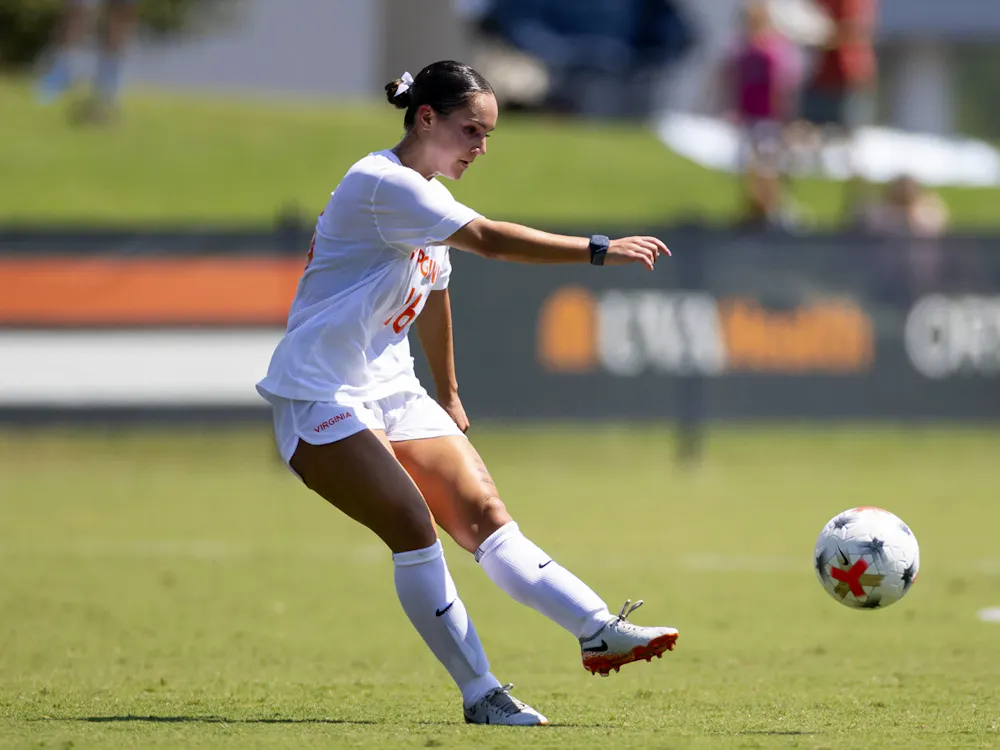
By Sofie Keppler | 16 hours agoThat single goal in the 37th minute from sophomore forward Kylie Maxwell off of a beautiful feed from graduate forward Henley Tippins, who drew multiple Virginia defenders, was enough to give No. 10 Virginia (4-1-2, 0-1-0 ACC) its first loss of 2026, 1-0.


