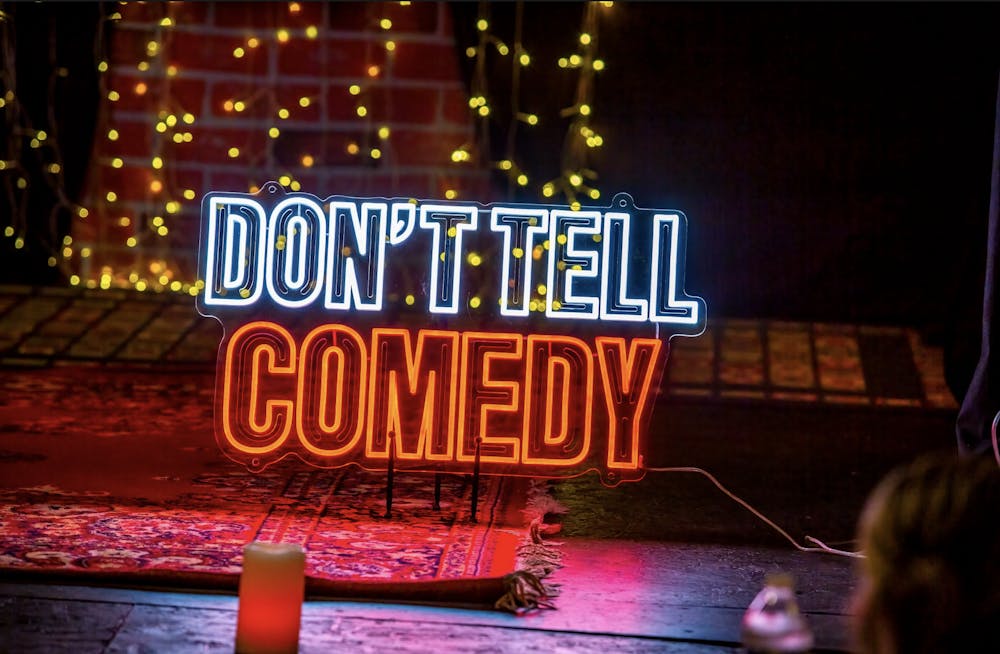
Founded in 2017 in Los Angeles, Don’t Tell Comedy has since expanded to over 200 cities around the country. Recently, they found a new home in Charlottesville and have put on several events around Albemarle County. Local comedian Chris Alan brought this chapter to Charlottesville in 2024 after establishing a comedy open-mic presence in the City and performing at Don’t Tell shows in Northern Virginia, Richmond and Washington, D.C..
Don’t Tell breaks the mold on how a comedy show works. When the company announces a show, they keep most of the information hidden until the day of the event. Upon purchase of their tickets, all that attendees know about the event is the date, time and reassurance that the comedians are up to the standard of one of the country’s most innovative platforms for up-and-coming comedians. This makes the experience of every show slightly different.
Alan said that Don’t Tell has spurred the growth of the comedy scene in Charlottesville and that with the arrival of Don’t Tell, the talented, creative comedians here have the opportunity to perform through a nationally-renowned company.
“Don’t Tell brought us a whole different audience … It’s really helped us legitimize the scene,” Alan said. “I've been here for quite a while, almost over 10 years, and there's a lot of talented people here. The comedy scene is growing, and with the scene growing, it really encourages people to keep going.”
Charlottesville is an ideal location for a chapter of Don’t Tell to take root. It has an active arts scene and talented comedians throughout the community, but lacks the infrastructure for comedians to truly emerge on a larger scale, according to John Rademacher, a Charlottesville-based comedian who has performed at several Don’t Tell shows.
“We're a smaller scene,” Rademacher said. “We don't have as many mics as, say, Richmond, D.C., like any bigger city would. We don't usually get as much stage time.”
Don’t Tell takes much of the burden off of the comedians themselves by finding a venue, providing all necessary resources and connecting young, aspiring comedians with an engaged audience usually ranging between 50 and 150 people. These shows are less like open-mic nights than they are professional gigs, where comedians are expected to come with their own, tested material that, most of all, needs to make people laugh.
Gunnar Cain, local comedian and co-producer of Don’t Tell Charlottesville, said that Don’t Tell is particularly important for young comedians.
“For these Don't Tell shows, these are professional shows,” Cain said. “So making sure that these shows are professionally run, they're paid great and they're in really great venues. And they're typically always sold out, so putting a young comic in front of 50 to 150 people is a big deal.”
However, this elevated requirement for comic material does not discourage more amateur comedians from working with Don’t Tell. Rather, it enables them to polish and test their work at open mics and similar events to strengthen their best routine. Then, once the comics land on a consistently funny, entertaining set, they are eligible for bigger shows with Don’t Tell.
That is where the company steps in, breaking the mold for traditional comedy shows and making use of local venues in a city that lacks a true comedy club. Many of these venues are unconventional, uncharted spots for comedy shows such as breweries, restaurants and local businesses.
Social media and digital media, too, have been crucial in the promotion and expansion of the Don’t Tell brand. The company has 5.2 million followers across Instagram, TikTok and YouTube, expanding the audience for comedians far beyond those attending the live shows. Class of 2025 alumnus Vance Elliott performed stand-up with Don’t Tell and has since accrued more than 290 thousand followers on Instagram alone.
As Don’t Tell has grown into a widely recognized way for comedians to build a following, the company has only attracted bigger names and greater renown. Recently, Deadline revealed their list of “20 Stand-Ups To Keep An Eye On in 2026,” half of whom have performed sets with Don’t Tell. Rademacher, who has been active in the Charlottesville comedy scene for about eight years, said that there is great potential for virality and subsequent growth through Don’t Tell shows.
“The videos they post are like 10-minute clips on YouTube,” Rademacher said. “And if that [video] goes viral, then that can really help your career. It’s a lot easier to get booked on other shows and actually go on tour if your video hits the algorithm just right.”
Ultimately, Don’t Tell provides a sense of community and connection between the comedians and their audience, united by a shared love of laughter. As a member of the local community and someone who has been active in the comedy scene for years, Alan said he appreciates the opportunity to produce shows in and around Charlottesville.
“People really like the idea of crowding into a place where we shouldn't be after hours, or in a back room, or just somewhere where comedy typically wouldn't take place,” Alan said. “It creates a fun buzz, and people really enjoy it. It's a lot of fun, and I'm glad to be able to do it in Charlottesville.”
Don’t Tell is hosting their next show Saturday at 8 p.m. While the exact location will only be revealed to ticketholders on the day of the event, the show will take place indoors at an art gallery. More information about the show is available on their website.
Read More
Michael Longfellow and Isabella Fazio close out Wahoo Welcome with a hilarious night
By Carter Horner | 14 hours agoThe show brought together the best of the local University comedy scene with national talent, creating a unique experience for the arts at the University.

beabadoobee shines on her electrifying album ‘Pylon’
By Kelsey McIntyre | YesterdayEven though beabadoobee began writing rock music as a teenager, this is certainly her most adventurous project in terms of genre.

Lizzy McAlpine soars to new heights on ‘Angel’
By Alena Touve | YesterdayLizzy McAlpine’s “Angel” is a triumph of sonic experimentation and lyrical ability, channeling both folk and musical theater into one harmonious product.