
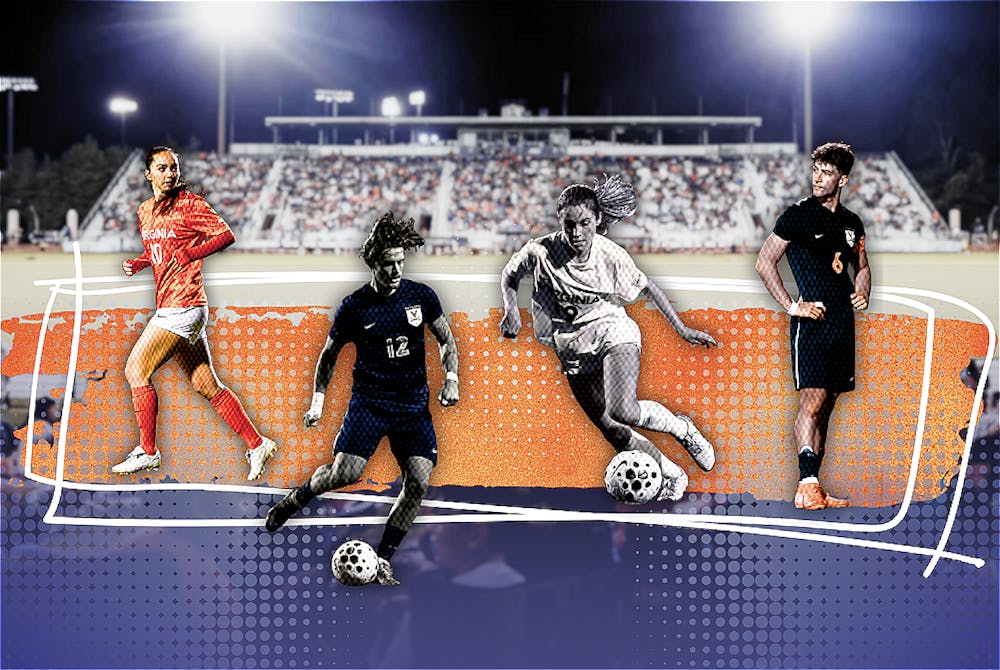
Both season-ending matches followed the same formula
David Sewall, Staff Writer, Women’s Soccer: Despite a narrow 3-2 loss to No. 1 Stanford in the ACC semifinals, Virginia still entered the NCAA tournament in a strong position, earning a No. 1 seed and the expectation of an extended postseason run. The Cavaliers validated that seeding early, posting decisive wins over High Point and Penn State in the first two rounds. Those victories set up a Sweet 16 matchup against No. 4 seed Washington at Klöckner Stadium.
In front of a roaring home crowd, Virginia largely dictated the tempo and generated plenty of scoring opportunities against Washington, yet ultimately exited the tournament in frustrating fashion — falling on penalties after a tightly contested match. The Cavaliers and Huskies played to a 1-1 draw through regulation and overtime before Washington prevailed on a boot from senior midfielder Lucy Newlin in the fifth round of penalty kicks.
By nearly every statistical measure, Virginia controlled the match. The Cavaliers outshot the Huskies 29-6, conceding only two shot attempts after halftime and allowing virtually no sustained Washington pressure. From the 80th minute onward, Virginia also played with a one-player advantage following a Washington red card. Still, the decisive second goal never materialized, and the Cavaliers saw their season slip away by the smallest of margins.
Mofeoluwa Akande, Staff Writer, Men’s Soccer: Coming off an unfortunate showing in a gritty ACC championship 1-0 loss to SMU, the NCAA championship tournament presented a clean slate for Virginia to right their wrongs. The quest back to Cary, N.C., started with the Cavaliers hosting a first-round bye, obtaining a favorable No. 2 overall seed. Their second-round date was a rematch with a familiar foe, UNC Greensboro, where the first matchup ended in a 1-1 deadlock.
After bearing witness to a demoralizing loss from the women’s squad moments before game time, the men played with purpose to restore the life that was sucked out of Klöckner Stadium. The game was a back-and-forth affair, as both teams traded a series of blows. A 1-1 score progressed to 2-2, entering overtime after an 80th minute life-saving penalty by standout freshman forward Nicholas Simmonds.
Both teams went the distance with no breakthroughs in overtime to show for. Ultimately, there were only so many hits Virginia could take before they finally fell through in a crushing 4-3 penalty shootout. In the waning moment of defeat, midfielder Marcos Dos Santos sailed Virginia’s hopes of advancing across the goalpost.
The men's and women's finales were separated by one measly goal in regulation and penalties. It was a night of déjà vu in Klöckner Stadium. A night of opportunity for Virginia turned into a night to forget.
Both seasons held championship aspirations that fell short
DS: The preseason No. 15 Virginia women’s soccer team opened the year with the profile of a solid ACC contender, but exceeded expectations quickly, catapulting its way into the national spotlight. Unbeaten through its first 12 matches, Virginia navigated a demanding non-conference slate with composure while collecting marquee wins over opponents Penn State and Duke. Those early results propelled the Cavaliers to No. 1 in the national polls and reframed expectations outside of the program — from simply being a competitor near the top of the ACC, to becoming a challenger for both conference and national titles.
As ACC play intensified, Virginia’s form became less consistent. Losses to Stanford and Florida State, paired with draws against California and Louisville, halted the team’s early momentum and contributed to a slide to No. 7 in the national rankings. Even so, the Cavaliers remained firmly positioned among the nation’s elite teams. Graduate midfielder Lia Godfrey and senior forward Maggie Cagle continued to anchor a productive attack, while junior goalkeeper Victoria Safradin provided stability in net with timely saves and presence.
Taken together, Virginia’s body of work reflected a season in which championship aspirations were sustained deep into the campaign, although results in both tournaments ultimately prevented those ambitions from being fully recognized.
MA: Also beginning the preseason ranked in the teens, then-No. 17 Virginia men’s soccer was challenged early on by a competitive schedule, which featured a flurry of nationally ranked teams. After dropping a testy road match to George Mason, the Cavaliers finished out the regular season on a 12-match unbeaten streak of their own, notching notable wins over then-ranked No. 1 Wake Forest, No. 2 NC State, No. 6 Louisville and a draw with No. 9 Virginia Tech.
After emerging out of ACC play with zero blemishes, Virginia was able to clinch its first outright regular season title since 2001 following a 1-0 win at SMU in the ACC closer. The hot streak continued into the ACC tournament as the now No. 4 seeded team notched wins over North Carolina and California, catapulting the Cavaliers into the ACC final.
Coming into the final with momentum, Coach George Gelnovatch won his third ACC coach of the year award and Virginia continued to receive stellar play from both sides of the ball. Simmonds and Dos Santos continued their formidable offensive attack, complemented by the stout defense of graduate defender Sebstian Pop and goalkeeper Casper Mols.
The ACC final started the string of unfortunate events with the 1-0 loss to SMU. Their first loss in over two months found the Cavaliers in unfamiliar losing territory — territory that they did not manage to escape, falling short to UNC Greensboro to end their brief NCAA tournament run.
Both programs navigated the regular season with dominant streaks that propelled them from promising ACC programs into legitimate title contenders. However, the pressure of the postseason proved to be the ultimate equaliser, as both the men and women saw their championship hopes derailed by unexpected late-season stumbles.
Both teams benefited from an abundance of star power from start to finish
DS: For Virginia women’s soccer, high-end individual talent complimented the program’s usual emphasis on collective play. While the Cavaliers are known for a cohesive, possession-oriented style, several players produced seasons that stood out even within that broader structure. Dec. 2, the United Soccer Coaches recognized five Virginia players with All-Region honors — a reflection of how the roster’s quality extended across every line of the field. Godfrey was a First Team selection, graduate defender Laney Rouse and Safradin earned Second Team selections, Cagle a Third Team honoree, while senior defender Kiki Maki was a Fourth Team selection.
Godfrey’s season, in particular, underscored her status as one of the premier midfielders in the country. A semifinalist for the MAC Hermann Trophy, she finished the year with 11 goals and four assists while earning All-Region honors for the fourth time in her career. She was also named ACC Midfielder of the Year and secured a spot on the All-ACC First Team. Her ability to dictate play in the final third and generate offensive opportunities consistently tilted matches in Virginia’s favor.
Rouse, Safradin and Cagle also each earned All-ACC Second Team selections. Rouse helped anchor the Cavaliers’ back line. Behind her, Safradin finished second in the ACC in goals-against average, at .71, and second in save percentage, at .833. Cagle also tallied 11 goals on the year and a team-leading six assists. Taken together, this collection of individual standouts gave Virginia star power that not only produced awards and statistics, but also helped keep the Cavaliers in the national title conversation.
MA: For the men, a combination of promising freshmen, seasoned returnees and exciting transfers all contributed to its most successful season since 2019’s ACC Championship and College Cup appearance runs.
The promise was highlighted by electric play all season from All-South Region honoree Simmonds, who gave Virginia its second ACC Freshmen of the Year award in two years. As a lethal threat to opposing defenses, Simmonds led all Power Four freshmen in goals scored at 10. Whether it was clutch goals like his equalizer against Virginia Tech or pure dominance like his brace against Wake Forest and hat trick against Clemson, the MAC Hermann semifinalist always had a nose for the ball. Joining him on the All-ACC freshman list was freshman defender Zachary Ehrenpreis, whose consistent play was crucial to the team's defensive stability.
Senior captains midfielder Umberto Pelà and defender Nick Dang both made All-ACC Second-Team honors as well as All-South Region honors, bringing the much-needed seasoned experience to the squad. Pelà’s four goals and six assists tallied out to be second on the team with total points. Although injuries sidelined Dang for certain stints within the season, his technical play came through when available, imposing his will and putting a halt to opposing possessions.
Excitement was never lacking with the defensive stands led by transfer graduates Mols and Pop. Earning All-ACC Second and Third Team respectively were much deserved for the pair of transfers who orchestrated crucial saves and stops, preserving plenty of games.
Both squads were bolstered by elite individual talent that garnered national recognition. This wealth of star power defined a year where individual excellence — whether that was prolific scorers or steadfast goalkeepers — consistently fueled Virginia’s collective success. While both seasons ended in heartbreak, the emergence of young studs like Simmonds and Safradin offers a promise for a deeper run come 2026.
Read More

Taking stock as Virginia men’s soccer finally leaves Charlottesville
By Michael Liebermann , Mofeoluwa Akande and Noah Cinel | 9 hours agoAfter a lengthy homestand to kick off the season, Virginia men's soccer finds itself in a shaky position with a 3-3-1 record. Three writers assess where the team is now and what is of note in the future.

No. 9 Virginia field hockey slips in defensive slog against No. 8 Duke
By Adair Reid | 10 hours agoThe absence in the cage would match the Cavaliers’ zero sum score — Virginia lost to the Blue Devils (5-1, 1-0, ACC) 0-1 in Durham, in a match decided by a single penalty corner.

No. 13 women’s soccer gets back to winning ways against Miami
By Peter Kratz | 17 hours agoThe Cavaliers (5-1-2, 1-1-0 ACC) were dominant in a 3-0 defeat over the Hurricanes (6-2-1, 1-1-0 ACC).


