As the lights dim, the curtains fall and actors step onto the stage ready to immerse their audiences in hours of storytelling, one aspect of theatre magic is often lost among the spectacle of the performances — the costumes. While audiences experience the final result onstage, the research, construction and creative decision-making behind each costume occurs mainly out of sight. For groups like First Year Players, this behind-the-scenes nature of costuming does not diminish the care and intention invested in their costume design.
FYP — the oldest theatre organization on Grounds — is different from other performance groups in that only first-year students and transfer students are cast in their semesterly productions, helping underclassmen break into the theatre space at the University. The restriction on casting does not limit FYP’s capabilities, as students of all ages are employed behind the scenes on different technical jobs, from directing to stage managing to costuming.
Lillianne McMinn, FYP’s spring costume head and third-year College student, first learned to sew during the COVID-19 pandemic. Now, she teaches new crew members basic skills when creating FYP’s costumes, such as sewing patches onto a jacket or resizing clothing. She also utilizes velcro for shirts and zippers to help quick costume changes go smoothly. McMinn said that tricks like these help to maintain the spectacle of the costumes onstage without sacrificing their practicality.
“[Costumes for theatre] don’t have to look super good, as long as they look good from an audience perspective. We’ve put a lot of people on a stage with a dress that doesn’t zip … Theatre magic is hiding all of that. That is the objective,” McMinn said.
Third-year College student Layne Parker helped lead the costuming for FYP’s fall semester production of “Anastasia” — a musical set in 1920s Russia about a lost princess turned orphan trying to find her identity after her family’s execution in the Bolshevik Revolution.
According to Parker, “Anastasia” is a period piece, meaning historically accurate costuming was important to build immersion. Parker said that the production was one of the largest and most impressive showcases of costuming that FYP has put together.
Specifically, Parker said that for plays set in specific historical eras, such as “Anastasia” or this semester’s “Tuck Everlasting,” historical research and context are necessary for accurate costuming. Katie Chambers, costume head for the production of “Anastasia” and third-year College student, found that the Imperial Russian outfits of the Romanov family — the dynastic clan at the center of the musical — were not in touch with the fashions of the time, but were instead worn as a show of strength and wealth, which was mimicked in costuming. Chambers examined both the family's history and the costumes used in the Broadway production of the show in order to design costumes with historical and cultural accuracy for FYP.
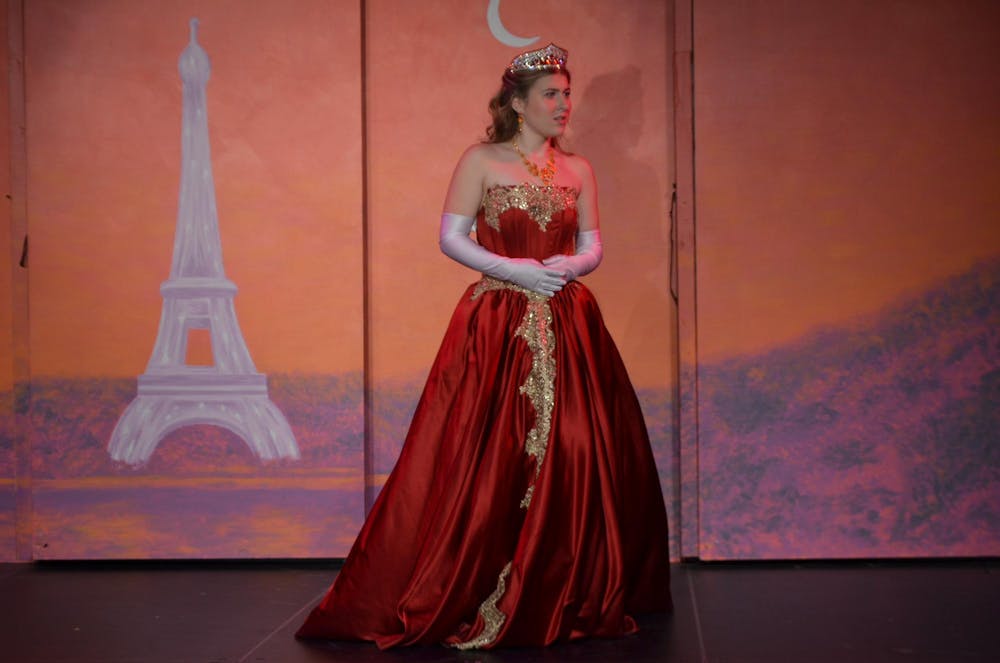
Anastasia’s iconic red dress featured golden embellishments and beautiful accessories, added by the FYP costuming team, to fit the early 20th century time period. The statement dress was originally first-year College student Caroline Brewer's prom dress that the crew sewed intricate golden appliques onto and accessorized with long white gloves, jewelry and a tiara.
Anastasia’s other dress was inspired by the film's royal blue gown with a straight waist. The crew altered that dress — which came from the organization’s storage collection — as well, sewing pearl linings and adding diamonds down the center. Costuming opted for a pearl necklace to pair with the navy blue dress and added a silver tiara and white gloves to complete the look.
“I’ve learned from costuming a show that the accents or the accessories are the biggest part of it,” Parker said. “[The red dress] wouldn’t have been anything without the jewelry and the tiara, or the gloves that she's wearing. You have to have the accessories, otherwise she’s just wearing a dress.”
According to Parker, in order to craft such elaborate costumes, the organization obtains costumes from a variety of sources — including personal closets, thrift-shops, Amazon and archival outfits from the group’s storage shed.
The FYP costume heads often imbue their outfits with color symbolism as well, helping the audiences pick up on themes or messages without explicitly stating them. In FYP’s Fall 2024 production of “Guys and Dolls,” the costume team gave one of the primary characters, Adelaide, the signature color pink, which they dressed her in throughout the play. By the end of the play, Adelaide had come to terms with her relationship with a man who treated her poorly, finally realizing her independence and self-worth. To signify her newfound empowerment, the costume heads dressed her in blue for her final scenes, using the color to suggest a victory over the patriarchal system that she overcame.
For “Anastasia,” Parker focused on complimenting color palettes for the lead couple — as the pair began interacting more, the colors of their costumes increasingly complemented each other. Additionally, because “Tuck Everlasting” deals with immortality and being stuck in time, the costume heads plan to dress the characters in more muted colors, utilizing greens and browns.
“In theory, what you want is for every single [part of the production] to enhance your concept. In my head, it’s like making an argument for an essay … All of the tech elements need to support that same theme,” Parker said. “I think costumes for me are the easiest thing for the ensemble to see how [the theme] is coming to life and how that intersects with the characters or intersects with the text specifically.”
Using a combination of scrappy resourcefulness, careful research and attention to detail, the crew at FYP creates innovative and aesthetically pleasing costumes each semester for audiences to enjoy. “Tuck Everlasting” will run this spring from April 16-19 at the Student Activities Building. Tickets are released closer to the show and will be available for purchase on FYP’s website.
Read More

Hoo’s Watching: Anatomy of a teen TV show
By Caroline Lee | 8 hours ago“Crew Girl” is not reinventing the wheel, nor is it particularly interested in doing so.
‘Verity’ falls short on its psychologically thrilling promise
By Julia Prevost | 18 hours ago“Verity” is entertaining in moments, particularly when its dialogue becomes so outrageous that disbelief gives way to amusement.

Virginia Film Festival unveils full lineup for 39th rendition
By Matthew Wang | 3 days agoThe Festival’s 39th rendition, which will run for five days from Oct. 21 to Oct. 25, will feature a myriad of films from Virginia and across the world, as well as live discussions and panels with celebrated filmmakers and industry professionals.