The transition from a dynasty to a startup is rarely seamless. For freshman squash player Charlotte Pastel, it felt like an invitation.
To understand Pastel's composure, one must first understand the winning machine she left behind. At Greenwich Academy, Pastel's high school in Connecticut, squash is a legacy where trophies are an inheritance and winning is the baseline. Pastel is a product of a program with an intense culture that functions like a legendary manufacturing plant for champions — because they are.
“In high school our team was always expected to win, just because they historically have had such a strong program,” Pastel said. “But there's something so special about being a part of a growing [program] … They built such a great program here so quickly already, so to see where that can go in the future is something super exciting to be a part of.”
That draw led her to a Virginia program that is essentially a startup in the landscape of elite collegiate squash. After starting as a club team in 2001, the Cavaliers only achieved varsity status in 2017. With no decade-long streaks to protect in Charlottesville, the program has a blank slate to fill how they see fit.
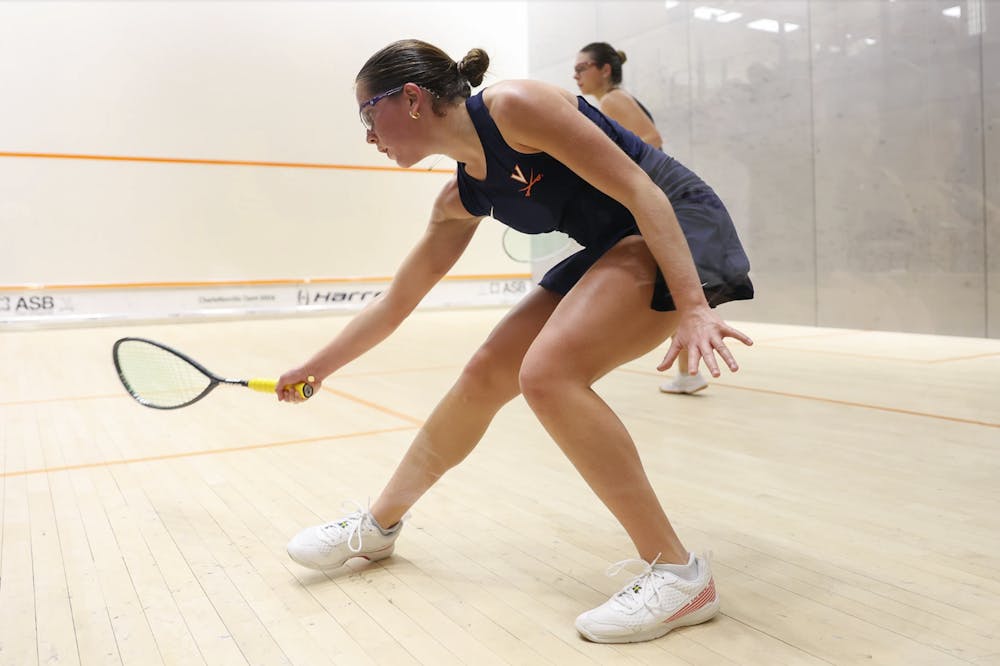
After arriving at Virginia, Pastel was immediately thrust into the No. 1 position in her first collegiate match against Denison and essentially refused to leave. She brought the Greenwich standard to the McArthur Squash Center but left the anxiety of expectations at the door.
In a sport that can feel like a lonely struggle between two people in the box, Pastel has pursued collective growth, finishing her debut season with a 14-6 record — the most wins on the team. These impressive metrics are not the only part of Pastel that stands out.
Pastel's true value to the Cavaliers is her refusal to let her position isolate her. She credits her captains — Minnis and senior Nina Hashmi — for fostering a culture where the team focuses on putting their best foot forward without the fear of failing when they do so.
“Something so awesome about our group … [is that] our main values are each other at the end of the day,” Pastel said. “We put everything out there during our matches, but no one's holding it over anyone's head, no matter what the result is. And you know [that] when you step out on that court, all your teammates expect from you is that you're going to put your 100 percent into it.”
This willingness to taunt failure with effort is what allowed Pastel to step out of the collegiate bubble and into the professional space this past February. Competing as a wild card in the Steel City Open in Pittsburgh, Pa., Pastel entered a world where the physics of the game literally change.
In professional squash, the tin — the metal strip at the bottom of the front wall — is lowered by two inches from the 19-inch collegiate norm. It is a subtle shift that redefines the match — shots fly lower, the pace quickens and the margin for error shrinks dramatically.
Yet despite this fundamental change, Pastel thrived. With her father there to coach her, she stunned the gallery by upsetting a professionally ranked No. 59 in the world, Cindy Merlo, to reach the second round. The following day, she faced Sabrina Sobhy, the world No. 11.
“She absolutely destroyed me,” Pastel said. “It was a great experience to go out there and see that I could hang with people within the 60s and 50s rankings … the second match definitely showed me if this is what you want to do, it's not going to be easy at all. So definitely a very productive experience.”
Competing with the big leagues is not the only way that Pastel fuels herself for success. In fact, when the season ends, she focuses on recharging her energy through activities that allow her to explore her interests off the court.
Pastel said that many of these other sides of her, including the one that is a dedicated surfer, are more calm and fluid than the version in the box — but she is the first to dismiss any notions of transferable skills between that hobby and her squash success. In fact, she argued the opposite.
“I'm definitely a very, very competitive person, but really just with athletic stuff,” Pastel said. “I would say outside of that, I definitely am more on the chill side. But … when I step on the squash court I'm pretty intense.”
The two worlds do not bleed into each other, creating an intentional barrier between Pastel's personal life and the pressurized environment of elite competition. She understands that if the sport becomes too engrossing, development stalls and the box begins to feel like a cage.
“Taking good breaks just to clear your head and have a fresh slate mentally is super important,” Pastel said. “I've definitely learned that as I've gotten older, too — how crucial that is to juice your development as an athlete, to really take your breaks and have other passions. Because if it's too all-consuming, I think that at the end of the day, that's just not good for anyone.”
This well-roundedness is both her hobby and her strategy. Pastel is constantly cultivating her “fresh slate,” with some of her favorite ways to do so being playing Spikeball on the beach, doing exercise like running and hot yoga or tucking away with a good book.
This perspective is a product of her parents, who both speak the language of elite athletics. Her father was a tennis player at Davidson, while her mother swam at Cornell. Even with their competitive backgrounds, Pastel feels lucky to never have felt pressure from her parents to achieve a certain level of success.
“The most helpful part about having [my dad] help me throughout my squash journey and everything is the mental aspect of it,” Pastel said. “He just gets it and gets what the competition's like.”
Knowing that she has that support acts as a psychological armor that allows Pastel to step onto the court not to defend a legacy, but to explore her own ceiling.
She understands a truth that often takes players years to grasp — the only way to dominate the box is to remember how big the world is outside of it. It is this philosophy that Pastel is weaving into the fabric of Virginia squash. Under the guidance of her veteran teammates, Pastel aims to foster a culture where the result on the scoreboard is secondary to the effort left on the hardwood, a culture where newcomers feel “in the mix” from day one, like she did.
“My teammates are the greatest group of friends, the best supporters, and they really push me each and every day in practice,” Pastel said. “Immediately when I got here we started doing pretty intense preseason training, and I think that really started as a great base for our team.”
As Pastel resets in anticipation of her sophomore season, the expectations will only grow. She will see a shift from being a talented freshman hailing from a squash dynasty to becoming the face of a rising power in Charlottesville.
Virginia squash is young, hungry and building something from the ground up. In Charlotte Pastel, the Cavaliers have found their primary architect. She is proof that you do not need a program legacy to dominate as long as you have the composure to build something yourself.
“My priority is our team 100 percent during the season,” Pastel said. “I chose U.Va. because I visited and I could see how awesome the culture was … I'm so grateful for what we have at U.Va., and I think there's something so special about our building program.”
Read More

With a stunning upset of No. 6 Stanford, Virginia’s midfield is making a case for hope
By Noah Cinel | 2 hours agoIf Lambe and company continue to control the middle of the park, and the Cavaliers can finally finish what they start, this season could still take a very different shape.

The Cavaliers battle through ITA All-American Championships
By Anderson Kim | 21 hours agoA week full of tough matches against the best in the country saw two Cavaliers earn their place at the NCAA Championships in Athens, Georgia.

A shifted ACC and a rising Virginia rowing looks to close the gap in its 2026-27 season
By Eleanor Lynch | YesterdayWith the ACC as strong as it has ever been, the Cavaliers will have to keep their standards high to achieve success.