
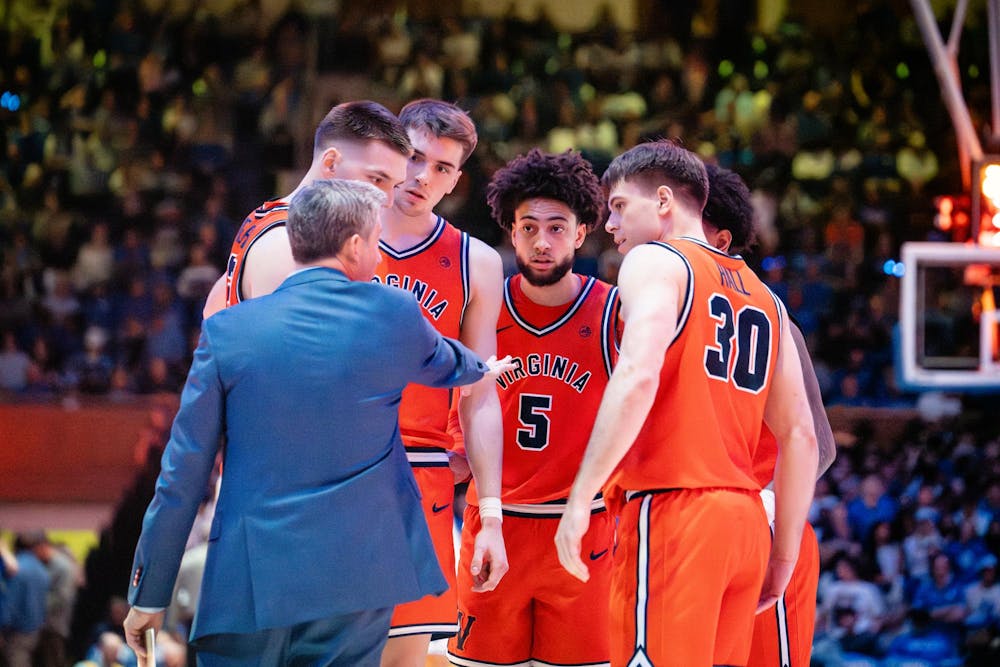
Before the 27 wins, the top-10 national ranking and the sellout crowds at John Paul Jones Arena, before any of the 2025-26 roster had played a single minute together in a Virginia uniform, Coach Ryan Odom handed each of his players a book.
“Legacy: What The All Blacks Can Teach Us About The Business Of Life,” by James Kerr details the habits and culture of the winningest team in the history of professional sports, New Zealand’s national rugby team. The team read it through the summer in a weekly Wednesday book club.
“It was my first time reading it, but it was just great to see how selfless those players are,” graduate guard Malik Thomas said. “And the things that we learned in that book were things that we still carry on during the season.”
“Carry on,” they did. Nine months later, Virginia finished the regular season 27-4 overall and 15-3 in ACC play — the most wins for a first-year coach at the University since Jeff Jones in 1990-91. The Cavaliers are the No. 2 seed in this week’s ACC Tournament in Charlotte, ranked No. 10 in the country and staring down what could be the program’s first NCAA Tournament win since cutting down the nets in 2019.
But if you ask any of the players on this year’s team where that success came from, they don’t mention the full-court press defense or the three-point shooting — they talk about the culture.
The challenge that Odom faced last year in creating a strong culture among so many new faces was largely unprecedented at the University, and is a challenge many coaches face in the “new era” of college basketball — one Coach Tony Bennett cited in his retirement.
Only three players remained from Bennett’s tenure, and Odom had 12 Charlottesville newcomers from BYU, UC Irvine, Toledo, San Francisco, North Dakota State, VCU and Kansas State — not to mention two European freshmen who had played professionally in Germany and Spain. Scattered strangers, asked to become a competitive team in a matter of weeks.
Odom had the correct instinct, though, instilling traditions and Virginia-isms to fast-track team bonding and culture building. They pointed to the championship banners in the JPJ rafters and to Bennett’s five pillars — humility, passion, unity, servanthood and thankfulness — which are still displayed on the locker room wall. He also added a sixth pillar, accountability.
And he gave the team that book.
“Here at Virginia, there's been a tradition of excellence that has existed,” Odom said. “You look at the banners up top and you see the teams that you know have been fortunate to cut down the nets … that's why we read the book. It is all about leaving the jersey in a better place, and connecting them back to their past, which is the tradition that Virginia basketball is.”
Kerr’s book is one that details a different tradition of excellence. The All Blacks have maintained a winning percentage of 76 percent across more than a century of international competition — a record unmatched by any team in any professional sport.
Rather than attributing this kind of dominance to talent, Kerr argues it is thanks to a set of cultural principles passed from one generation of players to the next, a concept the Māori call “whakapapa” — a deep reverence for ancestry and lineage that binds the present to the past.
The book is organized around 15 lessons drawn from the All Blacks’ culture — the way they train, communicate, handle pressure and, perhaps most importantly, hold one another accountable. But a few principles embedded themselves in this Virginia team more deeply than others.
One is the idea of “sweeping the sheds.” In literal terms, it refers to the tradition that after every match, even the most senior All Blacks clean their own locker room. In Kerr’s framing, it is a statement about ego — that everyone is accountable, and no job is beneath anyone. This tenet would certainly be important for a roster filled with players who were the “go-to guys” at their previous schools, and junior wing Sam Lewis cited it immediately.
“Sweep the sheds,” Lewis said. “Just do all the little things. And we honed [in] on that, and that's what helped us [have] a winning season. Just worry about what we can control.”
Another is the conviction that character drives performance — in Kerr’s phrasing, “better people make better All Blacks.” Graduate point guard Dallin Hall, who has emerged as one of the team’s captains this year, returned to that idea repeatedly.
“I think just the focus on character and how that translates to success. That was a big part of the book,” Hall said. “Better people make better All Blacks. So that was something we focused on as a team, trying to be the type of individuals that we would like to come in and work with every day … we really enjoy what we do, we have a lot of fun, and we work really hard, and we've been able to see a lot of success. So I think that's a big principle that I'll take away for the rest of my life.”
Odom, for his part, emphasized the role that honest communication has played throughout the season. That is another principle that “Legacy” returns to again and again — the All Blacks’ insistence that a kind of radical candor within the group is necessary, as well as the belief that genuine connection requires vulnerability.
“These guys do a great job of listening, not only to their coaches, but to one another,” Odom said. “You're going to be in these moments that you're going to have to pull through … you're going to need somebody else there with you to help you do that … Devin certainly provides that, and it doesn't hurt that he's a very outgoing person, and not afraid to talk, and he's not afraid to be vulnerable and speak up in big moments, and that's been really helpful for this team.”
Despite the Cavaliers successful record, those moments have certainly occurred. Virginia opened ACC play with a triple-overtime loss at Virginia Tech on New Year's Eve — a game in which the Cavaliers attempted a school-record 45 three-pointers and still came up short. In early March, they were dismantled 77-51 at No. 1 Duke. In between, there have been a variety of close calls that certainly had the potential to fracture a less connected group.
“We've pretty much been through a lot of situations,” Thomas said. “We've experienced a blowout loss, and we just experienced a blowout win. We've experienced a close game and everything in between. So we've been doing a great job of just learning how to stick with our process … and just sticking with one another.”
Freshman forward and ACC First-Team Thijs De Ridder, who arrived after playing professionally with Bilbao Basket, offered his perspective on the team’s chemistry.
“This group is so tied to each other, off the court and on the court,” De Ridder said. “I mean, I played a couple years [professionally], and I’ve never been in a group this tight.”
But the final key principle that this Cavalier side seemed to remember from the summer reading was about leaving the jersey in a better place than you found it — the central thesis of all of Kerr’s other lessons. Every All Blacks squad, Kerr writes, has one life to live. Every team exists in its particular form only once, and are then replaced by the next group wearing the same jersey.
According to graduate guard Malik Thomas, Odom gave each of the players a book containing the story of their jersey from previous Virginia teams, followed by a series of blank pages.
“Those blank pages [are] for us to fill in our own story,” Thomas said. “So I think that's pretty cool, because it just puts us in the state of mind that someone wore this jersey before [us], someone's gonna wear it after us … it just goes back to just how selfless we are as a group.”
Graduate forward Devin Tillis, when asked whether he believed the group had fulfilled its obligation, did not hesitate.
“I can definitely say that I think I left the jersey in a better place. I think we did as a team,” Tillis said. “Obviously it's hard to [because] there's so much legacy behind the jersey. But, you know, in Coach Odom’s first year, I think we made a big statement. Twenty-seven-and-four in the regular season and going into the postseason, we’ve got a lot of stuff that we want to accomplish. But I think we all can say proudly that we did what we had to do in his first year.”
Read More

The Cavaliers start the fall season with a strong showing at the Kitty Harrison Invitational
By Anderson Kim | 3 hours agoVirginia women's tennis started its fall season on a high note at the Kitty Harrison Invitational.

Trial by fire greets Virginia’s young lineup in a 16th-place finish
By Joby Jung | 22 hours agoMen's golf has a respectable history with the Inverness Intercollegiate in the past, but 2026 did not go the same as the Cavaliers finished towards the bottom of the standings.

Virginia men’s tennis dominate first tournament after NCAA Championship
By Margaret Piatos and Noah Cinel | YesterdayThe adjustments did little to slow the Cavaliers as first-year Luca Preda and third-year Stiles Brockett both went undefeated in singles across a dominant three-day showing.


