Before a single swimmer touched the wall on the first finals session Wednesday, the broadcast booth had already conceptualized the story of the 2026 NCAA DI Women's Swimming and Diving Championships.
“Virginia doesn’t have superstars this year,” the commentators said.
The Walsh sisters — the most decorated duo in collegiate history — are gone. The Walsh sisters accounted for 18 combined individual NCAA titles throughout their collegiate careers. Gretchen scored 231 out of a possible 240 individual points and went a perfect 16-for-16 relay titles across her four years. Alex won individual championships in five different events and was part of five straight team titles.
Nobody serious thought their departure would cost Virginia the title — the Cavaliers had been ranked No. 1 in the CSCAA poll all season long and were favored in every projection. But the reasoning went that this would finally become a team race that was a foregone conclusion for the last five years.
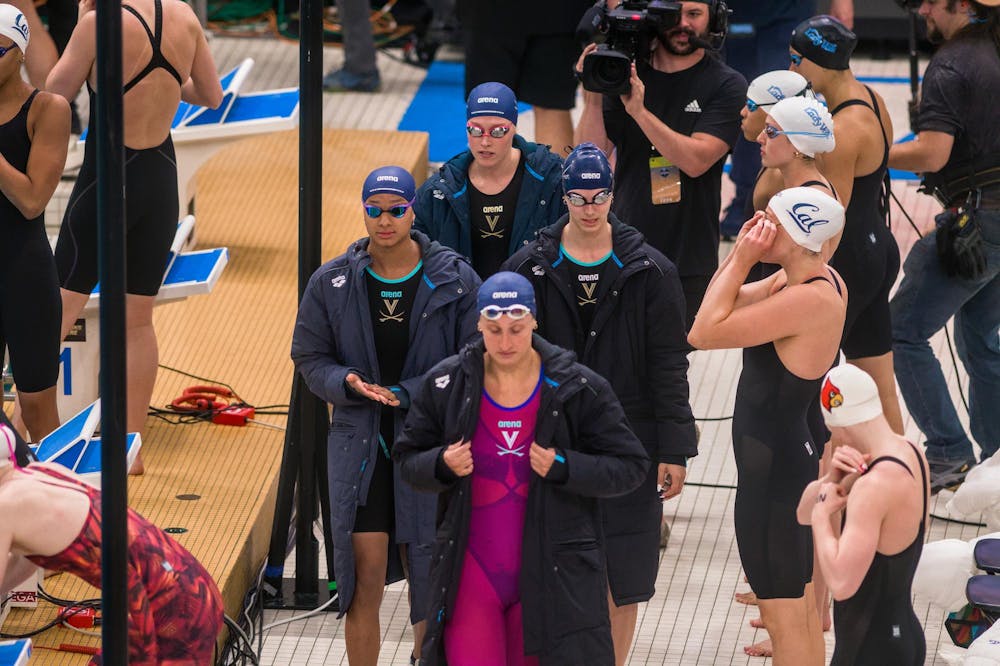
It is difficult to overstate how comprehensively the Cavalier women dismantled that narrative. Virginia scored 589 points — the most in program history and the second-highest total by any women's team in the last 20 years — swept all five relays, set an NCAA record in the 400-yard freestyle relay and had 16 of 18 swimmers place in scoring position. The Cavaliers beat second place by 208.5 points, a margin wider than every final gap from the previous five national championships.
“I think there was a lot of commentary about the team without the Walshes and without [Kate Douglass], and can they continue what they're doing?” Coach Todd DeSorbo said. “I don't think [the team] were offended by it, but I think it motivated them significantly.”
When Gretchen dove in the pool, as DeSorbo put back in September, “she was going to win — it was a matter of by how much and will she break a record.” Without her, many people assumed that the margin would shrink and the dominance would fade.
“[Gretchen] was so larger than life that [she] kind of cast a shadow on a lot of people,” DeSorbo said. “She blocked the sun … I think now that the rest of them [have] the sun shining on them, … they're able to blossom.”
This was not the diminished version of Virginia grinding out a win that many assumed might occur. This was, by nearly every measure, the most dominant championship in the program’s history with contributors across the entire roster.
“For us, we tried to take the approach that it's a blank slate this year, that we haven't won any, we're starting all over,” DeSorbo said. “Just start a new streak in a little bit of a different way, you know, where depth really will carry us through.”
Consider the 200-yard breaststroke swum Friday. Five Cavaliers — seniors Aimee Canny, Emma Weber and Zoe Skirboll alongside freshman Sophia Umstead and sophomore Leah Hayes — all placed in the top 12. Canny placed second with a 2:03.09, Weber finished eighth and the remaining three scored from their morning swims. Virginia scored 48 points from a single event, the most any team scored in any event all meet.
Or consider the prelim session that preceded it. Fifteen of Virginia’s 18 competitors scored points in a single day — 16 did throughout the entire meet. Junior Claire Curzan made an unprecedented prediction at the beginning of the season that all 18 qualifiers had the potential to score — and she came within two.
“I think we have the potential to have all of our NCAA qualifiers score at NCAAs, which has never been done before,” Curzan said to The Cavalier Daily in September.
Even if Virginia had scored zero points across all five relays — erasing 200 from its final total — the Cavaliers still would have won the championship on individual scoring alone. A Virginia swimmer made the championship final in every single event at the meet except for diving, which the University no longer sponsors.
“I was hopeful that somebody would step up,” DeSorbo said. “And it's been four, five, six, seven, eight people that have really stepped up from the returning perspective, and … I never would have thought that our first-year class would have performed as well as they have.”
One of the most dramatic indicators of this roster’s depth came on the opening night of the meet, in the 800-yard freestyle relay. This event was one that has haunted Virginia — after placing fourth in 2024 and second in 2025, it was the lone obstacle preventing them from sweeping all five relays. As swimmers are only able to compete in four relay events, Gretchen was unable to compete on the relay at NCAAs, and many credit those finishes to her absence.
But this year, Virginia found itself back at the top of the podium for the first time since 2023. Canny, freshman Madi Mintenko and sophomore Bailey Hartman all swam solidly, but by the time sophomore Anna Moesch dove in for the anchor, Michigan, Cal, Texas and Indiana were all ahead. Moesch turned in 1:13.99 at the 150-yard mark and powered home to finish her leg in a 1:39.03 — the fastest split in the event’s history. She took the Cavaliers from fifth place to first in a single 200-yard leg, and Virginia set a new meet record of 6:45.21.
"I think it just shows how much depth we have as a team,” Moesch said. “And it shows how many people, with the absence of [the Walshes], were able to step up to the plate and wanted to step up to the plate for their team."
Of course, as any meet has, there were headliners. Curzan swept the backstroke events for the second consecutive year, setting meet and pool records in the 100-yard backstroke with a 48.24 — the second-fastest performance in history, trailing only Walsh's NCAA record. The next closest finisher, Michigan’s Bella Sims, touched more than a second behind.
Saturday, Curzan went on to clock a 1:46.10 in the 200-yard backstroke after a gutsy start, positioning herself body lengths in front of the rest of the field. Her final time was just one hundredth of a second from her own American record.
Moesch nabbed her first individual NCAA title in the 200-yard freestyle in 1:39.23, a time bettered in history only by Missy Franklin’s 1:39.10 from 2015. She went on to place second in the 100-yard freestyle and eighth in the 50-yard, earning First Team All-American honors in all of her individual events.
Sara Curtis, a highly-touted recruit and Italian Olympian, lived up to her billing. The explosive freshman placed second in the 50-yard freestyle behind senior U.S. Olympian Torri Huske of Stanford, in the fastest time ever recorded by a freshman — faster than Gretchen went at the same point in her collegiate career.
“Gretchen actually said to me at one point early in the fall, [Sara] is going to break my record,” DeSorbo said.
Curtis also contributed to four relay golds — the final being the 400-yard freestyle relay that clocked 3:05.26 to break the NCAA record, one that had been set three years earlier by Kate Douglass, Alex Walsh, Maxine Parker and Gretchen Walsh.
The momentum built from the top end of the roster was contagious. Junior captain Tess Howley swam a grueling double on Saturday morning — qualifying in third for the 200-yard butterfly final and then, minutes later, touching 10th in the 200-yard backstroke with a personal best. DeSorbo erupted poolside, face red and veins popping after Howley’s performance.
“Going into the year, there was a lot of discourse about ‘Virginia is good, but can they continue to be this dominant?’” Curzan said. “And I think this year, by and above, we've exceeded everyone's expectations, including our own. The Walshes are awesome. They're the best duo in NCAA history … to be able to think that this team collectively can achieve even more than that, I think it's really, really special.”
DeSorbo arrived in 2017 to a program that had finished eighth at NCAAs the season prior. Nine seasons later, it has won six consecutive national championships — the most ever in women’s swimming, and a feat accomplished by only five other women’s programs in the history of the NCAA.
According to DeSorbo, associate head coach Tyler Fenwick pulled him aside before the trophy ceremony on Saturday night.
“Who would have thought,” Fenwick said, “in 2017 in August that we’d be sitting here winning our sixth title in a row?”
The answer, it turns out, was there all along. Not in the ‘superstars’ — though Virginia had those — but in the 18 women who collectively outperformed even the most dominant individuals the sport had ever seen.
They did it without the Walshes. They did it without a diving program. They did it without superstars. Or, more precisely, they did it with 18 of them.
Read More

Often weak this season, Pribula’s passing and receivers breakout led Virginia to victory
By Drew Dillman | 23 hours agoThough not a strong suit for the large part of the season so far, the aerial attack spearheaded the offensive domination of the Blue Hens during Virginia's 42-3 victory.

Rice secures NCAA singles bid as Cavaliers show promise in ITA All-Americans
By Margaret Piatos and Noah Cinel | YesterdayContinuing their early-season prowess, the Cavaliers put on a strong showing in Tulsa, Okla. with multiple deep tournament runs against top competition.

Virginia starts ACC play 1-1, dropping match to Georgia Tech in straight sets
By Cierra Lyles | 2 days agoOn Sunday afternoon, the Cavaliers were taken down in three straight sets by the Yellow Jackets (10-3, 2-0 ACC), losing the first and second sets 25-19, and the third set 25-16.