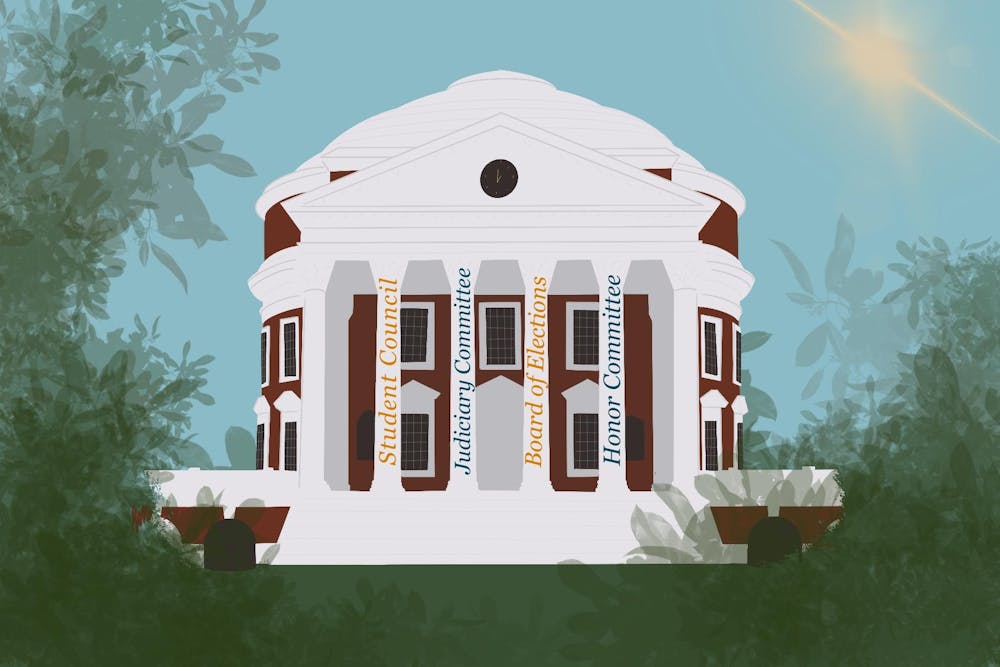
Student self-governance — one of the University’s foundational traditions — refers to a system in which students operate key institutional functions on behalf of the University. Several student organizations hold “special status” within this system, serving as delegated agents of the University and carrying out responsibilities that might otherwise be managed by administrators. These responsibilities include administering student elections, adjudicating the University’s Standards of Conduct, allocating Student Activities Fee funding for Contracted Independent Organizations and coordinating class traditions, among other duties delegated by the University.
Special Status Organizations operate within a structured partnership with the University, granting students authority while maintaining oversight through designated University advisors and governing bylaws. These governing bodies, such as Student Council, the University Judiciary Committee and the Honor Committee, form an interconnected system that sustains the University’s longstanding tradition of student-led governance and institutional participation.
Here is a closer look at student self-governance organizations at the University, beginning with the organization that administers elections for several of the governing bodies.
University Board of Elections
The University Board of Elections was established in 2003 through a student referendum and authority from the Board of Visitors to support student self-governance at the University by overseeing student elections. These elections include positions for Student Council, Honor, the UJC and Class Councils.
UBE consists of 15 students drawn from across the University and requires members to maintain academic standing and avoid conflicts of interest related to student elections. UBE is also divided into several teams that manage different aspects of the election process, including candidates, elections, rules and marketing.
UBE functions primarily as an administrative and regulatory body, overseeing more than the collection of votes. The SSO is authorized to conduct University-wide referenda and additional elections upon request while also establishing semester election calendars, administering candidate registration procedures, enforcing election rules and campaign regulations and managing the University’s online voting system.
During the fall and spring election cycles, UBE determines deadlines, oversees petition requirements and publishes candidate information and election materials for students. UBE also possesses enforcement authority related to election conduct. According to its Rules and Regulations, UBE may enact and enforce election procedures and can pursue action through organizations such as the UJC or Honor when election rules are violated. UBE members may also not publicly endorse candidates, participate in campaigns or seek elected positions that fall under UBE jurisdiction.
UBE membership is open to students through an application process rather than an election process. Information regarding recruitment, application deadlines and membership opportunities is available through UBE announcements and the organization’s website. Students may also participate in the election process by running for an elected position, voting in University-wide elections or engaging in referenda and public feedback opportunities.
Student Council
Student Council was established in 1945 to serve as the University’s primary representative body for undergraduate students. The organization convened April 25, 1945 to hold its first meeting in Madison Hall, beginning a system of formalized student representation that remains a central component of the University’s tradition of student self-governance. While Student Council continues to operate under an updated version of its original constitution, the organization’s structure and responsibilities have expanded in response to changing student needs.
According to Student Council’s website, the organization seeks to “protect and improve the rights, opportunities and quality of life of every student at the University.” Through legislation, student advocacy and collaboration with University administrators, Student Council functions as a liaison between students and University stakeholders — including the Board.
Student Council is composed of a representative body and the Executive Board who work to represent and advocate for student interests.
The representative body functions as Student Council’s legislative branch and includes elected students from the University’s various schools as well as representatives for first-year, transfer and international students. Representatives are responsible for addressing student concerns and introducing and voting on legislation.
Student Council representatives consider resolutions and policy proposals concerning University issues, such as library operating hours, tuition and fee concerns, transportation and parking issues and student healthcare affordability.
The Executive Board oversees the organization’s broader operations. Executive Board positions include the president, vice president for administration, vice president for organizations, chair of the representative body, chief of cabinet, chief of coalitions, chief of support and access services and director of University relations.
Student Council also allocates and manages funding for CIOs through the SAF — a mandatory payment with tuition from all University students to support CIOs across Grounds. Through its Organizations Branch, Student Council reviews funding requests and determines allocations that allow organizations to sponsor speakers, host events and conduct its programming.
Additionally, Student Council develops initiatives intended to improve student resources and accessibility, particularly through the Support and Access Services. SAS is a Student Council branch founded in 2021 to provide resources for students at low or no-cost, including programs such as Airbus, Cavalier Health and Cavalier Career Closet.
Student Council meetings are open to members of the student body and include opportunities for individuals to sign up for public comment. According to Student Council’s bylaws, meetings are held every Tuesday at 6:30 p.m. Students may address representatives regarding legislation under consideration or raise concerns regarding University issues. Student Council also maintains publicly accessible databases of legislation and meeting materials on their website.
University Judiciary Committee
The University Judiciary Committee is a student-run judicial body established through a 1955 agreement between the Board and Student Council. The organization was granted authority to investigate and adjudicate violations of University policy and student conduct standards. In 1970, the Board adopted the original Standards of Conduct, which were revised in spring 2001 and in fall 2011. The UJC’s mission statement is “to maintain and promote a community of respect, safety and freedom” at the University.
Unlike representative organizations such as Student Council — which focus on advocating for student voices — the UJC operates as a judiciary body responsible for enforcing the University’s Standards of Conduct. UJC investigates allegations of misconduct and conducts hearings involving individual students and CIOs accused of violating University policies. Any member of the University community — including students, faculty, staff or community members — may file a complaint with UJC.
UJC’s jurisdiction covers alleged violations of the University’s Standards of Conduct — which address conduct that may interfere with the rights, safety and educational experiences of members of the University community. However, the UJC does not oversee all forms of student misconduct. UJC operates separately from Honor — which addresses cases involving lying, cheating and stealing.
UJC does not hear cases involving certain issues such as sexual misconduct cases — which are handled by the Office of Equal Opportunity and Civil Rights — or University motor vehicle violations — which fall under the scope of the University Department of Parking and Transportation. In addition, the UJC does not have jurisdiction over Student Council or Honor.
UJC consists of 27 representatives from the 12 undergraduate and graduate schools who are elected during the spring election cycle, serving one-year terms beginning April 1. Representatives act as judges during UJC trials and are responsible for policy and procedures.
In addition to representatives, UJC includes student support officers who serve as counselors, investigators and educators. Counselors act as advocates for both complainants and accused students during UJC proceedings. Investigators compile impartial factual records and evidence related to UJC cases. Educators conduct outreach intended to increase awareness of the UJC’s procedures and mission.
UJC cases are heard by trial panels composed of student judges who evaluate evidence, hear testimony and determine findings and sanctions. If a student is found responsible, sanctions can be intended to be educational and rehabilitative rather than purely punitive. These sanctions can range from written warnings to suspension or expulsion in more serious cases.
UJC additionally includes the First-Year Judiciary Committee — a subsidiary body composed of first-year undergraduate students who hear cases involving other first-year students. According to the UJC’s website, this provides first-year students with peer accountability involving individuals navigating similar transition experiences at the University.
UJC representatives meet every other week Sunday evenings throughout the academic year to discuss UJC policies and procedures, while the Executive Committee meets twice weekly Wednesdays and Sundays. The UJC’s trial schedule varies based on active cases and investigations, with hearings convened as needed depending on reported conduct cases. Information regarding UJC’s recruitment cycles are released at the beginning of every academic year.
Honor Committee
The Honor Committee serves as the student-run body responsible for maintaining and administering the University’s Honor System. Honor is tasked with maintaining the “Community of Trust” — which reflects the expectation that members of the University community act with honesty, integrity and mutual respect, supporting shared accountability across Grounds.
According to Honor’s website, the principles of the Honor System are often attributed to Thomas Jefferson’s educational philosophy, which emphasized student responsibility within a residential academic community. Amid tensions between students and faculty regarding expectations of student conduct and discipline on Grounds, concerns regarding student behavior intensified following the November 1840 shooting of Law Prof. John A. G. Davis by a student while Davis attempted to address a disturbance on the Lawn.
Also at this time, faculty received an increase in reports of students’ academic dishonesty, and the University adopted the Honor System in 1842. Law Prof. Henry St. George Tucker introduced a resolution proposing that students certify on all examinations that they had “derived no assistance during the time of this examination from any source whatsoever.” According to Honor’s website, the resolution was initially intended for classroom conduct, but students assumed responsibility for maintaining a student-run Honor System. Today’s Honor pledge asks students to certify they have “neither given nor received unauthorized assistance” on assignments and exams.
The Honor System currently defines an Honor Offense as an act of lying, cheating or stealing committed knowingly. Cases are evaluated based on three criteria, which includes whether a prohibited act occurred, whether the student knew or reasonably should have known their conduct violated Honor principles and whether tolerating the conduct would undermine the Community of Trust.
Honor consists of elected student representatives, alongside support officers who may act as investigators, advisors or educators. Investigators collect information and evidence regarding alleged offenses. Advisors assist students navigating the process and educators conduct outreach and programming intended to increase understanding of the Honor System across Grounds.
The Honor System previously operated under a single-sanction model — which meant that any student found guilty of lying, cheating or stealing faced the automatic two semester leave of absence at the time from the University. The model imposed the same consequence for all violations regardless of the severity of circumstances. In 2023, Honor adopted a multi-sanction model — which allows for a range of sanctions depending on the circumstances of a case. Possible sanctions include educational seminars, probation, suspension or dismissal.
During the academic year, Honor generally meets every Sunday at 7:00 p.m. in Newcomb Hall 480, with meetings open to students and University community members except for confidential case discussions, which are conducted in a closed session. Honor also convenes over the summer and holds monthly meetings via Zoom. Public comment opportunities are provided during open sessions. Honor also maintains publicly accessible summaries of Honor proceedings and meeting minutes on their website.
Honor is scheduled to meet June 28 and July 26 at 7:00 p.m., with public access to the Zoom link available upon request from Genny Freed, Honor chair and rising fourth-year College student.
Class Councils
Class Councils and the Fourth-Year Trustees are class-based student leadership organizations that serve as representative bodies for each undergraduate class at the University. These organizations consist of First-Year Council, Second-Year Council, Third-Year Council and Fourth-Year Trustees, with each organization focusing on programs and initiatives tailored to the experiences and needs of its respective class year.
Class Councils primarily focus on class engagement and coordination of programming. Each council plans activities intended to strengthen class participation and organize events throughout the academic year. These programs can include social events, professional development initiatives, wellness programs and class traditions.
As examples of each council’s events, the FYC hosts the First-Year Formal — a formal social event for first-year students to gather and celebrate their transition into the University community. The SYC hosts the Second-Year Dinner Series — a series of structured dinners hosted by the Second-Year Council designed to foster class connection and engagement among second-year students.
The TYC hosts the Ring Ceremony — an event held in the fall for third-year students who wear their class rings with the engraving of Minerva facing inward while they are still attending the University. Following Final Exercises, the ring is turned to face outward to showcase their status as a University graduate. Fourth-Year Trustees host Valedictory Exercises — an end-of-year celebration to recognize graduating students and mark the transition toward Final Exercises.
Class Councils and the Fourth-Year Trustees are led by elected officers and committee members who oversee various roles, including event planning, community outreach and student engagement. Members of Class Councils can participate in committee work and planning efforts throughout the year. Fourth-Year Trustees maintain additional responsibility related to graduation activities and fourth-year class events and also commit to remaining involved with the U.Va. Alumni Association for five years following graduation.
Class Councils hold weekly general body meetings Sundays during the academic year. Each council meets for one hour. The Trustees meet from 1:00 p.m. to 2:00 p.m., TYC from 2:00 p.m. to 3:00 p.m., SYC from 3:00 p.m. to 4:00 p.m., and FYC from 4:00 p.m. to 5:00 p.m. Members also participate in separate committee meetings that occur on a weekly basis or as needed.
Inter-Fraternity Council
The Inter-Fraternity Council was established in 1936 as the student-run governing body for the University’s 26 social fraternities, overseeing member chapters and coordinating the formal fraternity recruitment process. The IFC is led by a Governing Board composed of nine Executive Committee members and seven at-large members, who oversee policies related to recruitment, conduct and risk management. According to the IFC’s website, the organization is “committed to fostering brotherhood, leadership and academic excellence.”
In addition, the IFC enforces prohibitions on hazing and maintains disciplinary processes for chapters that violate the IFC Standards of Conduct through its IFC Judiciary Committee — which is responsible for reviewing alleged violations, conducting hearings and determining appropriate sanctions that include probation, loss of social privileges or suspension.
Students can become involved in IFC-affiliated Greek life through formal recruitment — which takes place at the beginning of the spring semester. Registration opens in August, and formal recruitment begins before the start of spring classes. During recruitment, students register through the IFC and participate in a series of events hosted by individual fraternities to meet members and learn about each chapter. At the conclusion of the process, students may receive and accept a bid to join a fraternity.
Some chapters also elect to participate in informal recruitment — known as Continuous Open Bidding — during the fall semester and after spring formal recruitment. COB allows chapters to recruit members at any time of the year with shorter and less structured activities.
Inter-Sorority Council
The Inter-Sorority Council was established in 1975 as the student-run governing body for the University’s 14 social sororities, overseeing the community of Panhellenic chapters on Grounds. The ISC is responsible for organizing and regulating formal recruitment — which is held annually and open to all eligible undergraduate women. According to the ISC’s website, the ISC’s mission is the empowerment of a diverse group of women through the promotion of academic excellence, inclusivity, sisterhood, mutual respect and accountability.
The ISC also works to ensure consistency across chapters by setting standards and expectations related to membership processes, community conduct and participation in Panhellenic life. The ISC is led by an elected Executive Board and committee chairs who oversee key functions such as recruitment, finance, judicial affairs, internal operations and community relations.
The ISC’s primary recruitment process also takes place each spring semester. Registration opens in August, and primary recruitment begins a few days before the start of spring classes. Participants register through the ISC and attend a series of events hosted by individual sororities to learn about each chapter. At the conclusion of the recruitment process, students may receive and accept a bid to join a sorority. Some ISC chapters also participate in COB.

Jaylynn Perez is a third-year College student from Chesapeake, Va., majoring in government and Public Policy and Leadership. She currently serves as a news senior writer and video staffer, after previously serving as senior associate editor for the news desk. She enjoys covering topics such as University governance and local politics.
Read More

Tao Tan discusses financial future of U.Va., rising college tuition trend nationwide
By Lily Kostro | 6 hours agoTan explained how tuition costs will shape the future of academic institutions such as the University.

U.Va. Health cuts scribe hours as AI documentation tools expand across Health System
By Vrinda Vashisht | 6 hours agoScribes in the undergraduate medical scribe program said in interviews with The Cavalier Daily that a new emergency department schedule that began Sept. 15 has reduced or eliminated certain scribe shifts and has decreased scribe availability to clinicians in the Emergency Department.

How does the Honor Committee manage its endowment?
By Isabela Delgado | YesterdayThe Honor Committee manages an endowment upwards of $200,000, and for its 2026-27 academic term, it has budgeted $204,500 — just over its available endowment.