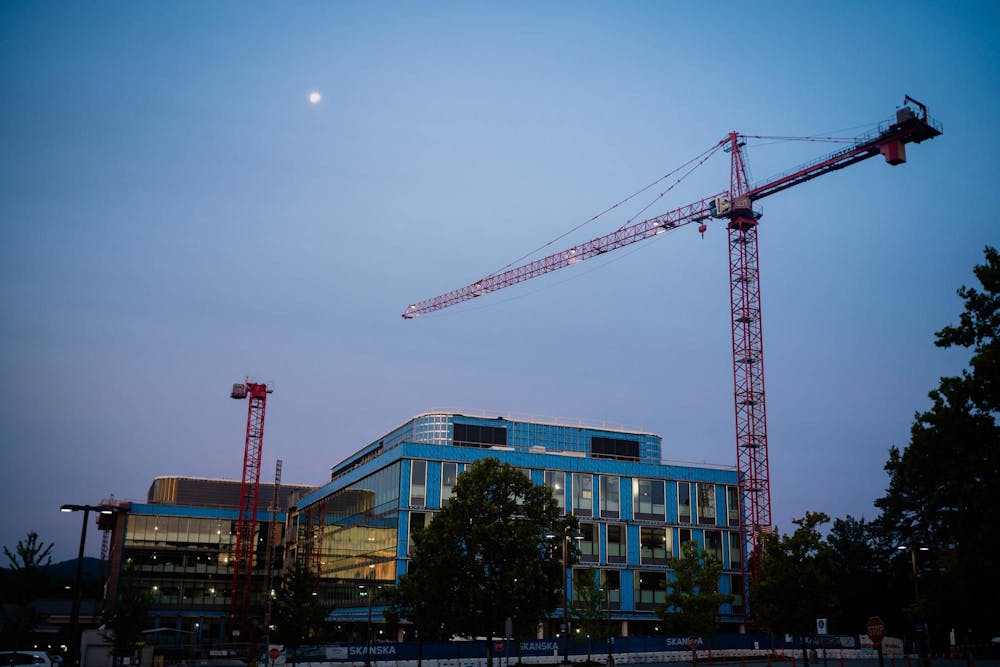
The University is moving forward with its plans for a new research data center at Fontaine Research Park, expanding the project by roughly $30 million as demand for artificial intelligence and high-performance computing continues to grow throughout the Commonwealth.
The project has grown since it was initially approved by the Board of Visitors in June 2025 as a $72 million, two-story data center facility. At the time, University officials described the facility as necessary to support the University’s growing high-capacity computing needs.
A data center is a facility that houses computer servers used to store and process digital information. Because servers generate heat as they operate, facilities require cooling systems to prevent overheating — some of which use water to remove heat. Data center electricity use is measured in megawatts, and higher power capacity generally requires more electricity to operate the facility and its cooling systems.
The Fontaine Data Center construction continues as Virginia local and state officials consider how to accommodate continued data center development and address the facilities’ demands with land, electricity and water infrastructure. State officials as well as Prince William, Henrico and Loudon Counties have worked throughout the year to slow data center growth — the General Assembly enacted a data center electricity consumption tax, the Prince William County Board of Supervisors voted against the Dulles South Innovation Center and Loudoun County is considering a pause in data center development. It is unclear how these policies might affect the University’s facility.
The original Fontaine Data Center proposal included four megawatts of computing capacity, with the ability to expand to 16 megawatts.
By March, U.Va. Health Information Technology had joined the Fontaine Data Center project with plans to locate its data center within the facility. The Board’s Buildings and Grounds Committee — which oversees maintenance and construction of University buildings and is responsible for matters related to the University land use — approved the facility’s schematic design March 5.
The Board’s Finance Committee subsequently approved a $30 million addition to the project in June to accommodate U.Va. Health’s data center on the third floor, increasing the project’s total cost from $72 million to $102 million. The expanded facility will cover approximately 53,000 square feet, and according to a June Board of Visitors presentation, construction is anticipated to begin in 2027 and finish in early 2029.
In an email statement to The Cavalier Daily, University Spokesperson Bethanie Glover said that the Fontaine Data Center project will be funded through a combination of institutional funds, repayment from institutional resources and strategic fund allocations. She further stated that the Medical Center’s funding will cover the additional $30 million for the third floor that was approved in June by the Board.
The facility will initially provide four megawatts for Research Computing and 0.5 megawatts for U.Va. Health IT, the website also states, with plans to scale up to 17 megawatts as demand increases in the future.
The Fontaine Research Park is a University-owned property near U.S. Route 29 and Fontaine Avenue that houses U.Va. Health offices and other University facilities. The park has undergone several recent developments, including the construction of the Paul and Diane Manning Institute of Biotechnology, a parking garage and Fontaine’s Central Energy Plant. The data center will be located next to the energy plant, allowing the two facilities to share energy infrastructure, according to the website.
According to the Finance Committee’s June agenda, the University’s existing data centers — including the University Data Center on Ivy Road — are expected to exceed available capacity by 2029 as demand for high-performance computing hardware increases. According to Josh Baller, associate vice president for Research Computing at the University, once the Fontaine Data Center is operational, the University plans to decommission one existing data center, leaving three operational facilities.
Fontaine Data Center — a smaller facility amid the Commonwealth’s data center boom
The Commonwealth has become a major center for data storage and computing infrastructure, and the Fontaine Data Center facility comes during this period of rapid growth. According to the Virginia Economic Development Partnership, the Commonwealth hosts the largest data center market in the world — with approximately 35 percent of all data centers across the world.
Northern Virginia has more than 250 data centers — with the highest concentration of data centers in the world. According to the Northern Virginia Regional Commission, Northern Virginia’s data centers generate more than $1 billion in tax revenue for local governments, while the state’s data center industry is expected to require 11,000 megawatts of electricity by 2035 — nearly four times its 2022 demand.
The data center at Fontaine, however, will be smaller than many of the commercial data centers being constructed across Northern Virginia. According to the Regional Plan Association, the average data center is approximately 100,000 square feet. At 53,000 square feet, the Fontaine Data Center is 47 percent smaller than the average size for data centers.
Glover said that the Fontaine Data Center will ensure the University is prepared for the increasing role that computation plays in modern research, which she said will enable the recruitment and retention of faculty at the “pinnacle of their fields.” According to Glover, the data center is part of the University’s “ongoing modernization of the systems supporting patients and clinicians at U.Va. Health” and will make sure that the University is “at the forefront of patient care.”
Sustainability in Fontaine’s energy usage
According to University Architect Alice Raucher, the Fontaine Data Center is designed to reuse heat degenerated by its computing equipment — Fontaine will capture and reuse excess waste heat produced by its computers, rather than simply releasing this heat into the atmosphere.
Separately, the NVRC has studied district energy systems that would transfer residual heat generated by data centers to nearby buildings and public facilities.
At Fontaine Research Park, the Central Energy Plant for the park will provide cooled water to the data center, while heat generated by the data center will be returned to the plant and used to produce hot water for other buildings throughout Fontaine Research Park.
Once the data center reaches its full 16-megawatt Research Computing capacity, the facility, according to Raucher in a March UVA Today article, could generate enough recovered heat to provide all of the heating needs for Fontaine Research Park.
Changes in data center regulations for counties across the Commonwealth
In July, the Prince William County Board of Supervisors voted unanimously against the Dulles South Innovation Center — a proposed data center campus that would have covered approximately 1,940 acres near the Loudoun County border. The project would have spanned 43 million square feet of data center space across more than 250 parcels currently designated largely for agriculture and forestry.
The decision came after another major Prince William County data center project — the Prince William Digital Gateway — was abandoned following a legal battle over the county’s approval process. The project — which was backed by Quality Technology Services Data Centers and Compass Datacenters — could have included as many as 35 data centers near Manassas National Battlefield Park.
Prince William County is also in the midst of revising its data center zoning regulations — an initiative recommended in June. The county is considering requiring new data center projects outside designated development areas to obtain a “Special Use Permit” — which would give county officials greater authority to evaluate individual proposals.
Meanwhile, Loudoun County considers its pause despite being the center of Virginia’s data center industry. The Loudoun County Board of Supervisors voted in July to begin the process of pausing new data centers while the county develops new zoning regulations. The proposed pause would not affect existing data centers but would give the county time to reconsider how future projects should be evaluated.
Loudoun County officials have also established an Electrical Infrastructure Working Group to examine the electrical infrastructure that will be needed over the next five to seven years. While data centers have provided tax revenue, local officials are weighing those economic benefits against demands on land use and electricity.
The costs associated with data center growth have also become a local concern in Henrico County, where officials are facing higher electricity expenses for public buildings and schools. Henrico is home to 37 operating data centers, with plans for at least 17 additional facilities, according to the Washington Examiner. However, the county tightened its data center regulations in June.
In a June 26 email to county employees, Henrico County Manager John Vithoulkas asked employees to reduce electricity use by turning off lights and computers, unplugging unused chargers and applicants and taking other steps to conserve energy. The request came as electricity rates for facilities increased by approximately 25 percent July 1. Vithoulkas said this would increase costs by an estimated $5 million during the next fiscal year.
Data center regulation changes across the Commonwealth writ large
In July, Gov. Abigail Spanberger (D) also urged the State Corporation Commission to require data centers to pay for transmission infrastructure needed because of their electricity use. The administration proposed a “but-for” approach, in which data centers would pay for infrastructure that would not have been needed if not for their demand for electricity.
The transmission infrastructure could include transmission lines and substations. Transmission lines carry electricity over long distances, and substations would help move electricity from high-voltage transmission lines to local power systems. Under the current Commonwealth system, some costs of building and maintaining the electric grid are included in utility rates paid by different types of customers. The administration’s proposal would instead identify infrastructure that was built specifically because of a data center and require that facility to cover the costs.
On July 31, the State Corporation Commission approved Dominion Energy to jointly develop a new set of electricity rates that would require data centers to pay for certain new transmission infrastructure associated with their electricity demand.
The new data center electricity consumption tax took effect July 1. The new tax charges qualifying data center facilities with a tax of $0.011 per kilowatt-hour of electricity consumed. The tax is scheduled to remain in effect through June 2028, with the first collection occurring in September 2026.
Commonwealth residents express concerns regarding industrial water use
Water availability has also emerged as a concern, particularly in Eastern Virginia, due to water used by data centers and other large industries.
In June, Spanberger urged Virginians to voluntarily conserve water as the Commonwealth experienced its driest period since 1941. According to the June 18 release, precipitation across the state was approximately eight inches below average. The release encouraged residents, farmers and industries to reduce water use and warned that continued drought conditions could lead to water restrictions.
A state-commissioned report released in July found that groundwater levels in Eastern Virginia are expected to decline and recommended tighter regulations on large industrial water withdrawals. The study examined potential data center water use and found that a facility using evaporative cooling could have difficulty securing reliable groundwater supply under current conditions. The report did not, however, attribute the region’s groundwater concerns to data centers.
Under the 2026 state budget, the Virginia Department of Environmental Quality is required to establish criteria for identifying “cooling water scarcity areas” where evaporative cooling — the process of liquid water becoming water vapor which lowers air temperature — could reduce the quality or quantity of water available for other uses. Beginning in 2027, new data centers in the Eastern Virginia Groundwater Management Area that apply for certain DEQ air permits will be required to use air cooling, 100 percent recycled water or stormwater, closed-loop cooling systems or other approved technologies by the department.
Amid these community concerns regarding water, the Commonwealth has moved to collect more information about data center water use. Senate Bill 553 — which was sponsored by Sen. Kannan Srinivasan (D-Loudoun) — requires water users that provide water to customers offsite to report the amount of water provided to different customers beginning in 2027, including water provided to data centers.
In an interview with Virginia Public Media, Mike Rolband, director of the Virginia Department of Environmental Quality, previously said that the information collected from waterworks operators — workers who manage the volume of water needed for data centers and control humidity — would help state officials better understand data center water consumption and assist with water supply planning, particularly during droughts.
What does the Fontaine data center mean for the University?
It remains unclear how Virginia’s new data center policies will affect the University’s facility. The state’s electricity consumption tax and rules for assigning transmission costs target qualifying data center facilities, but it is unclear whether Fontaine, a University-owned research facility, falls within those definitions.
According to the Fontaine Data Center website, the project is expected to go out for construction bids — which is the process where contractors compete for a project by submitting cost proposals — in the fourth quarter of 2026.

Jaylynn Perez is a third-year College student from Chesapeake, Va., majoring in government and Public Policy and Leadership. She currently serves as a news senior writer and video staffer, after previously serving as senior associate editor for the news desk. She enjoys covering topics such as University governance and local politics.
Read More

Tao Tan discusses financial future of U.Va., rising college tuition trend nationwide
By Lily Kostro | 15 hours agoTan explained how tuition costs will shape the future of academic institutions such as the University.

U.Va. Health cuts scribe hours as AI documentation tools expand across Health System
By Vrinda Vashisht | 15 hours agoScribes in the undergraduate medical scribe program said in interviews with The Cavalier Daily that a new emergency department schedule that began Sept. 15 has reduced or eliminated certain scribe shifts and has decreased scribe availability to clinicians in the Emergency Department.

How does the Honor Committee manage its endowment?
By Isabela Delgado | YesterdayThe Honor Committee manages an endowment upwards of $200,000, and for its 2026-27 academic term, it has budgeted $204,500 — just over its available endowment.