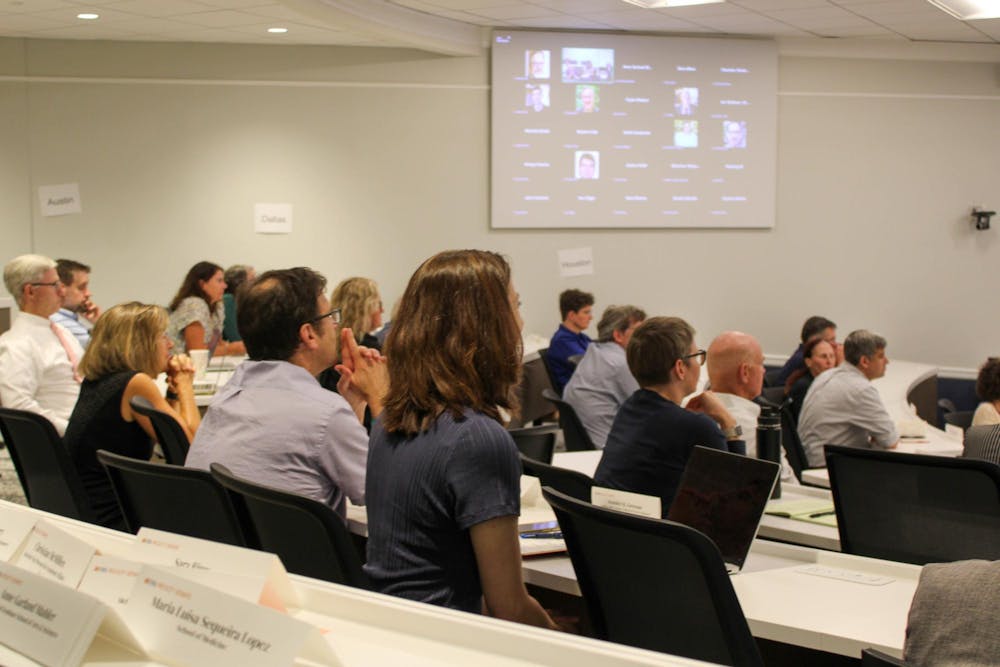
The Faculty Senate’s Executive Council met with the provost search committee Friday to discuss the Faculty Senate’s desired qualities in the University’s next permanent provost, including experience with research, a commitment to academic freedom and the ability to build trust across the University community. Brie Gertler, interim executive vice president and provost, also provided updates on the University’s developing approach to artificial intelligence. Gertler presented the University’s current AI strategy at the full Board of Visitors meeting Sept. 18.
As part of its agenda, the Executive Council also heard updates from Jeri Seidman, faculty representative of the Board and associate professor of commerce, regarding the ongoing review of the presidential search audit process and the University’s compliance reporting to the U.S. Department of Justice.
The Executive Council is a body within the Faculty Senate composed of elected faculty representatives that helps coordinate the full Faculty Senate’s agenda, oversee its committees and address issues between full Faculty Senate meetings.
In August, the University formalized the provost search committee — a 12-member group tasked with seeking, interviewing and recommending candidates for the executive vice president and provost. University President Scott Beardsley appointed Gregory Fairchild, dean and chief executive officer of U.Va. Northern Virginia, as the committee chair in July.
Fairchild said meeting with the Executive Council was part of a broader series of conversations with University stakeholders. According to Fairchild, the committee held three faculty listening sessions the week of Sept. 18 with faculty recommended by University deans. He also noted the committee has met with deans and vice presidents across the University.
“In each of these conversations, we are finding that we learn a lot about what people are looking for in a new permanent provost,” Fairchild said. “Me and the [provost search committee] are here because we care to hear what you have to say.”
The provost search committee also includes, but is not limited to, Board member Michael Biscelgia, Board Rector Carlos Brown, Education Prof. Michael Kennedy, fourth-year College student Mariam Parray and Vivian Riefberg, Walentas Jefferson Scholars Foundation professorship chair. Members of the Executive Search Group — the University’s internal search firm — were also present at the meeting.
After introducing the committee members participating in the meeting, Fairchild opened the discussion to questions from the search committee for Executive Council members about the qualities they want in the University’s next provost.
Brown asked whether the new provost should have a STEM research background to support the University’s commitment to expanding its research portfolio. In response, Assoc. Architecture Prof. Jessica Sewell said research should be viewed broadly across disciplines and that a STEM background should not be required. Additionally, Aaron Bloomfield, Faculty Senate chair and Engineering professor, and Patrick Jackson, associate Medicine professor, agreed that the next provost should be familiar with the University’s research funding process.
The search committee also asked Executive Council members how the next provost should approach academic freedom across disciplines. Nursing Prof. Kimberly Acquaviva said the committee should assess whether candidates would consistently defend academic freedom regardless of personal political views. She suggested using behavioral questions about controversial research topics to gauge how candidates would respond to attacks on scholars whose work may be politically unpopular.
Assoc. Art History Prof. Eric Ramírez-Weaver further noted that the provost’s responsibility extends beyond protecting academic freedom at the University and that the next provost should recognize the University’s position as a major public research institution and work to encourage a variety of perspectives in research.
“Fundamentally, this is about someone who can listen, someone who can collaborate, someone who can respect the diversity of perspectives but also, simultaneously, the expertise [of faculty],” Ramírez-Weaver said.
As part of its questions, the search committee asked Executive Council members to identify what they view as the University’s most significant challenges and which could be addressed by the next provost. Sewell identified building trust in University administration as a major concern among faculty. She said that the University is experiencing a “crisis of trust” and that the next provost should recognize that trust must be earned rather than assumed.
Bloomfield identified academic integrity as another major challenge facing the University, particularly as AI becomes more common in coursework. Bloomfield said there are estimates that between 30 and 40 percent of students in some classes may be cheating on assignments. He attributed some cheating to required general education courses, suggesting that students may be more inclined to cheat in classes they are less interested in taking.
Fairchild said that the search committee’s listening sessions will continue beyond Friday’s meeting and encouraged faculty to recommend candidates and provide additional feedback.
Gertler also provided updates to the Executive Council on the University’s current approach to AI, following previous discussions at the September full Board meeting. She said that the University has not released a University-wide statement on AI, despite a number of other universities releasing similar statements. Gertler further noted that she has drafted a statement but has been “skeptical” to release it because many universities are all in the “same boat,” addressing similar questions about AI in topics such as teaching, research, responsible use, intellectual property and data protection.
Gertler said she does not intend to promote AI use but believes students should understand the technology and make informed decisions about whether to use it.
“We want to prepare our students for entering the world that they will be entering,” Gertler said. “We want to be teaching them about the perils of this technology as well as the promise… [and] to be alert to the potential effects on individual well-being and the environment.”
The Executive Council also discussed how the University should approach AI in individual courses. Gertler said she does not want the University to establish a single approach requiring all faculty to use or prohibit AI in their classrooms. Instead, she said individual instructors should be able to determine how the technology fits into their courses based on their learning objectives.
Seidman provided the Executive Council with an update on the Board’s review of the presidential search process. The Board launched the review in March after affirming Beardsley’s selection as the University’s 10th president. The Board’s Audit, Compliance and Risk Committee was tasked with reviewing how the search was conducted.
In response to a question from Law Prof. Andrew Block about the review’s timeline, Seidman said that the review has taken longer than originally expected and is not yet finished. She said that the Board has not determined what form the final deliverable will take or whether it will be a public report. She said that she believes the Board hopes to complete the process before its December meetings but has not set a firm date for its conclusion.
“What I can tell you so far is that it has been incredibly thorough, incredibly thoughtful and incredibly deep,” Seidman said. “I think they were surprised at how long it’s taking because they’ve just engaged so deeply.”
The Executive Council also discussed the University’s ongoing compliance reports to the Justice Department. Politics Prof. Leonard Schoppa asked Seidman about the status of the reports. Seidman said she believes the University’s compliance review is entering its “last phases.” She noted that the University may still need to report on new programs or changes in federal requirements that require additional compliance reviews, but said future reports are expected to become shorter as there are fewer compliance updates for the University to provide to the Justice Department.
The University’s most recent report — publicly released July 8 — was five pages compared to seven pages for both its first two quarterly reports. The report outlined changes to faculty and staff hiring practices and the elimination of several Diversity, Equity and Inclusion-related programs and roles across multiple University schools and the administration.
Bloomfield led a discussion with the Executive Council on how the Faculty Senate will determine its priorities for the academic year. However, members did not finalize a list of issues Friday. The Executive Council discussed potentially assigning topics to specific Faculty Senate committees. Members said the Executive Council could identify issues it believes the Faculty Senate could address and then work with committees to determine which topics fit within each committee’s existing responsibilities.
The full Faculty Senate will meet Oct. 9 at 2 p.m. and the Executive Council will reconvene Oct. 30 at 2 p.m.

Jaylynn Perez is a third-year College student from Chesapeake, Va., majoring in government and Public Policy and Leadership. She currently serves as a news senior writer and video staffer, after previously serving as senior associate editor for the news desk. She enjoys covering topics such as University governance and local politics.
Read More

U.Va.’s Larry Sabato weighs in on midterms, issues warnings for Democrats ahead of 2028
By Luca Bailey | 39 minutes agoSabato shared his insights into how the country’s 2026 midterm elections are unfolding heading into the final weeks of the campaign.
Parking on Grounds — what has changed this semester?
By Charlotte Gabriel | 22 hours agoAccording to University students interviewed by The Cavalier Daily, several expressed frustration with high parking prices on Grounds, as well as the difficulty in finding available parking in general.

Student Council connects with University’s Strategic Planning Committee
By Lucia Gambacini and Reilly Auld | 23 hours agoThe Council also heard updates from Executive Board members regarding the upcoming Fall 2026 elections and new investments in free Sexually Transmitted Infection testing kits for students.