Editor’s Note: This article is a humor column.
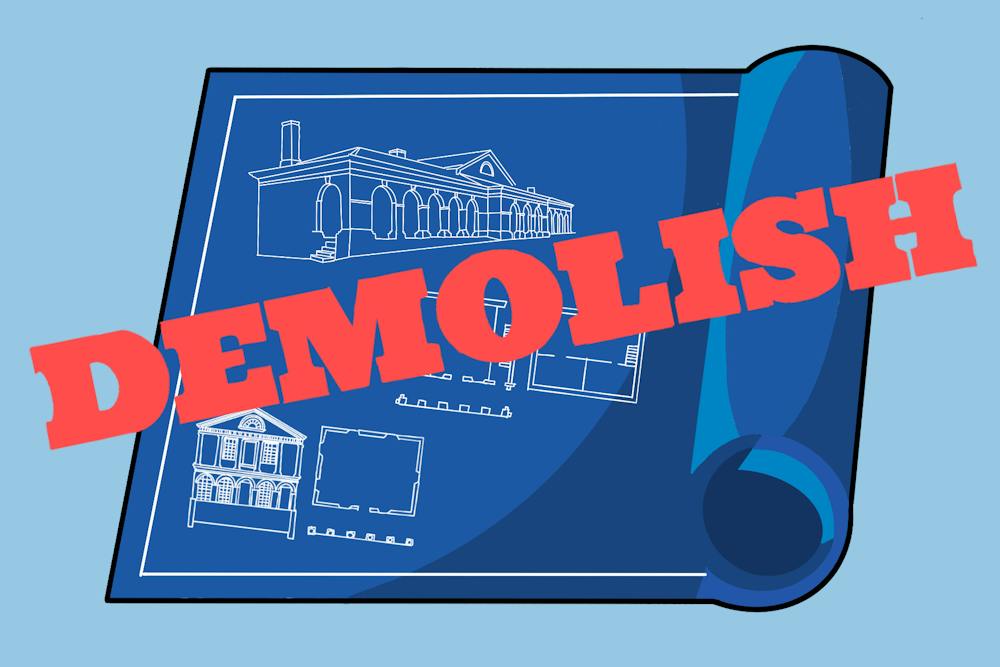
On Sept. 17, University President Scott Beardsley sent a letter to the community announcing that Thomas Jefferson’s Academical Village — including the Rotunda and all surrounding Lawn rooms and Pavilions — is set to be demolished at the end of the academic year. Despite its status as a UNESCO World Heritage Site and backlash from the community, Beardsley urges that this decision is the culmination of a need to expand the University’s image in light of an everchanging landscape of student life and pre-professional growth.
In the opening paragraph of the letter, Beardsley described the decision as one made at “his own discretion” and “for the better of the University.” With no apparent evidence that the Board of Visitors — or anyone, really — formally approved the demolition plan, students and faculty questioned its validity. When asked for confirmation of any such approval, Beardsley did not care to go into any detail.
“Well, I’m the president,” Beardsley said.
Many students less concerned with the political and economic state of the University cited sentimental and tradition-based reasons for their upset.
“The Academical Village is the cornerstone of the University,” third-year Engineering student Brick Bybrich said. “There are at least 15 things on the fourth-year bucket list every year that require the Rotunda. What am I supposed to do next year, streak Lambeth Field?”
“I was bid-promised 28 East during my first year,” second-year College student Lonnie Rume said. “It’s been in my Hullabahoo family for generations. This is a disastrous announcement.”
Despite overwhelming disagreement with Beardsley’s decision, several members of University leadership came to his aid to defend the change.
“Although I’m unsure when Scotty came up with this plan, the University has really been overdoing it with the red brick anyways,” Archie Texture, dean of the School of Architecture, said. “I think scaffolding and no clear infrastructural plan is the new look for the University.”
When asked about what will replace the Academical Village, most deans were unsure and started spitballing their own opinions and ideas.
“I vote for a 1515 satellite house with even bigger windows,” Mack Anical, dean of the School of Engineering, said. “Or another burger place. Maybe a 7 Day. Potentially some more luxury student housing, or another parking lot. I think we’re lacking all those things.”
Beardsley shared some of the ideas he has come up with.
“I’ve kept the nature of my plans close to my chest and have heard feedback from my colleagues who wish they were consulted about these plans,” Beardsley said. “However, a new data center is the front-running option in my mind, so it’ll likely be the plan that goes. Shannon and Clem are just near the Lawn, and with every student having a Claude or ChatGPT tab open at all times, a data center would be pretty cost-effective.”
The letter was sent just in time for Justice Amy Coney Barrett’s visit to the University to discuss her book “Listening to the Law.” Despite a lack of correlation between the purpose of her visit and the announcement, she was still asked about the controversial decision by an audience member at her talk.
“I mean, I think people should just trust the judgement of those who are appointed,” Barrett said. “Especially when those appointing them can make the decision so fast.”
The audience member inquired further, asking about what she believes is the best replacement for the Academical Village.
“You know, when I first got here I was really confused why my monogram was everywhere in Charlottesville,” Barrett said. “At first, I asked myself, ‘Why are these people slapping my initials on liquor stores?’ But now, I actually think it’s a great way to connect with the students here and shed some positive light on my legacy. For that reason, I think the Rotunda should be replaced by an ABC store. We the People, ammiright?"
The final notable point of criticism against this significant alteration to Grounds is how it will affect travel times for students, especially by vehicle. With existing concerns about Charlottesville’s driveability given the variety of construction projects in the city, students, faculty and townies alike expressed outrage regarding how this project will contribute.
When asked for potential solutions to this inevitable obstacle, Beardsley was concise.
“Drive a VEO!” Beardsley said.
Read More

National Geographic Wild Exclusive: Hoos in their natural habitat
By Sofia Cooper | 2 days agoWith each new batch of first-years, new species emerge.
GUIDE: Navigating dorm life as a first-year — explained in ‘Love Island’ terms
By Nafeesa Naz | September 16, 2026Thus, I am pleased to introduce you to my fool proof method of approaching dorm life — the Love Island Method.

LIVE TRACKER: The 2026 U.Va. Dine summer offseason
By Owen Andrews | September 9, 2026For the first time ever, The Cavalier Daily will follow the arrivals and departures of U.Va. Dine’s menu items during this summer offseason.