
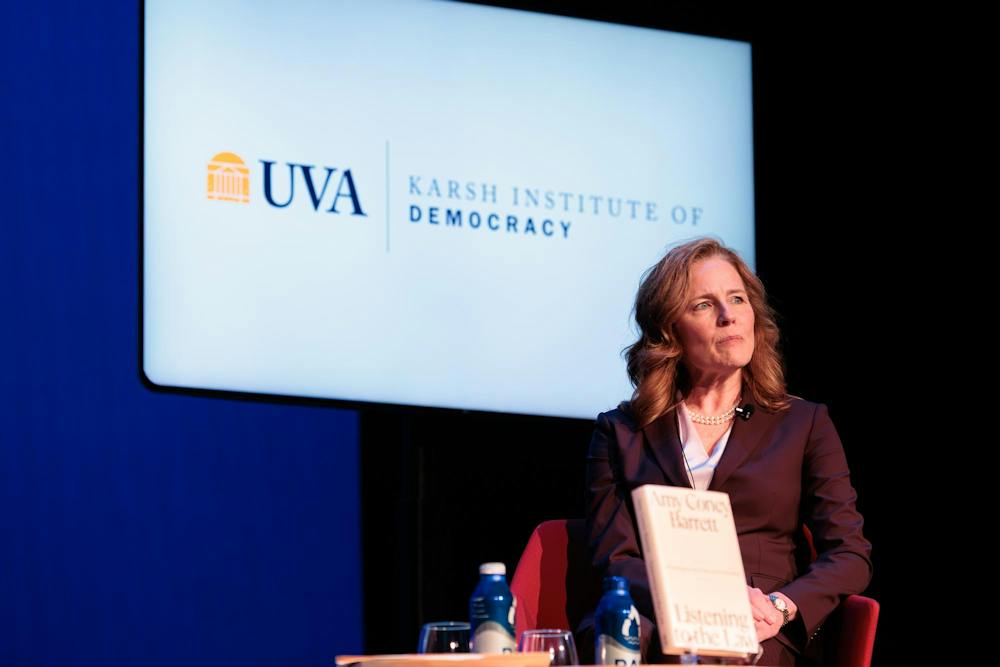
U.S. Supreme Court Justice Amy Coney Barrett spoke at a sold-out University event Thursday evening in Culbreth Theatre. She reflected on how the role of the Supreme Court Justice has evolved since she clerked for former Supreme Court Justice Antonin Scalia and how she approaches legal issues.
The Karsh Institute for Democracy hosted the event in partnership with U.Va. Law’s Karsh Center for Law and Democracy. John Jeffries Jr., David and Mary Harrison distinguished professor of law, moderated the event. The event began with a discussion between Barrett and Jeffries, and Barrett concluded the event by answering audience questions.
Barrett published her memoir, “Listening to the Law: Reflections on the Court and Constitution” in 2025. In the memoir, she shares her story of what it is like being a Supreme Court Justice and how she approaches interpreting the Constitution. Throughout Thursday’s conversation, Barrett referenced her book and expanded on its contents.
Barrett said one reason for writing her book was because many might disagree with the Supreme Court’s rulings. However, she said that even if they disagree with the majority opinion, she wants individuals to understand and evaluate the Supreme Court’s reasoning for its decision.
“One thing I wanted to communicate [in my book is that] you may disagree with the Court's decisions, and surely you will disagree with some, or maybe even many,” Barrett said. “Before you disagree with the Court, I really think you have to look at the Court's reasoning. Look at the opinion that the court has written and ask yourself, ‘Does this logic hold up?’”
Barrett served as a law clerk for Scalia from 1998 to 1999, a visiting associate professor of law at the Law School in 2007 and professor of law at Notre Dame Law School from 2002 to 2017. Barrett was appointed to the Supreme Court by President Donald Trump in 2020.
Speaking on the evolution of the Supreme Court, Barrett explained how the Supreme Court has evolved to rely on the emergency docket more in recent years. The emergency docket, also known as the shadow docket, is a procedure in which the Supreme Court expedites the review of certain decisions while not providing legal rationale for the ruling.
She said that the increased dependency on the emergency docket is in part due to the increased number of executive orders, because executive orders spark immediate legal action. Since 2025, Trump has signed 284 executive orders, more than the number of executive orders Trump signed in his first administration, which was 220, or former President Joe Biden’s administration, which saw 162.
“The way that the Court does its … work is pretty slow.” Barrett said. “We have a very lengthy process that's designed to really look at cases from all sides, talk about them with our law clerks, with one another … this interim docket is much faster. Things don't come up fully briefed. Sometimes we have arguments, but that's rare, and the decision doesn't finally dispose of the case.”
Continuing the discussion with Jeffries, Barrett said she does not often consider legislative history — how a piece of legislation came to be and the legislative intent behind statute — in rulings. She said that when Scalia was on the Supreme Court, legislative history was heavily weighted in rulings, but he argued that all that matters is the statutory text — the language of a law enacted by legislation.
Legislative history is important for understanding the Constitution, Barrett said, but she does not agree with the argument that legislative history can always be used as grounds for interpreting a statute. She also said that legislative history often represents the views of the minority, rather than the views of Congress as a collective.
“Sometimes, when a member of Congress thinks that he or she doesn't have the votes to get something into the statute, well, the next best thing ... is to say, ‘Well, I got it in the legislative history,’” Barrett said.
Jeffries also asked Barrett her reaction to the methodology of the Supreme Court which he said has changed a lot in recent years. He explained that while some justices like Supreme Court Justice Clarence Thomas once relied on originalism, Thomas has more recently utilized the history and tradition test.
Tests are a tool of judicial review that look at the constitutionality of actions or laws, and the history and tradition test looks at the Constitution in reference to its historical practice. The originality test looks at the language of the Constitution in the context of the time it was written. Barrett said that the second amendment is often analyzed with the history and tradition test because the right to bear arms predated the Constitution.
Barrett said that she rejected a history and tradition argument in Watson v. Republican National Convention, which was decided in June 2026, in which the plaintiff argued that federal election day statutes require ballots to be received by election day, based on historical practice. In the majority opinion, she said that the historical practice could not be tied to election-day statutes. The Supreme Court therefore ruled that federal statutes do not preempt Mississippi’s law stating mail-in ballots can be received so long as they are postmarked by election day and received within five days after election day.
Barrett reflected on how the Supreme Court makes rulings and said upholding the law is most important, even if she may not think it is the most just solution, as she explained what is most “just” is subjective to each justice.
She said that the Supreme Court looks at the Constitution and tries to understand if which party — the Supreme Court, President, legislature or states — has the authority to make the decision in question. She said that she tries to remove her personal bias, and at a time when the Supreme Court approval rating — Americans’ approval of the Court — is at a record low, Barrett said that while the Supreme Court should be aware of public opinion, it cannot let public opinion influence its decisions.
“The only thing that's within my control that I can do to try to maintain the public's confidence in the Court is to continue doing the job as I see it, honestly,” Barrett said. “The Court can't do its business with an eye towards the public opinion polls. The Court needs to be aware of what's happening in the country … The job is to apply the law.”
Fourth-year Commerce student Jordan Gross attended the event to learn more about law, and said she wanted the opportunity to hear from a Supreme Court justice. She said that she found it unique how Barrett balances her beliefs and her role.
“I thought it was really interesting what Justice Barrett said, how she interprets the law and how [her] decision making comes into that,” Gross said. “Especially in today's political context, the world is very polarized, people have a lot of different opinions.”
Barrett shared her experience as a justice in a world where her role is also that of a public figure. She said that due to the rise of the internet, justices have become public figures, and they have lost their privacy. Barrett has 24-hour police coverage at her house and a security detail with her at all times and that has made it difficult for her to live a normal life, she explained.
“When I meet new people, I'm very guarded. It's hard to have new friends — I mostly have old friends because the old friends are the ones who I've known for a long time and I can trust,” Barrett said. “I think it's a lonely job … part of it is just you are making people unhappy all of the time.”
Barrett said that despite the troubles she has faced — for example, being constantly in the public eye — she is glad she is able to contribute to the nation.
“It's a great privilege to engage in the public service that I do. … I consider this public service a great privilege to try to safeguard the Constitution and uphold the rule of law,” Barrett said. “I think it's very important [and] humbling work. [It] is rewarding to know that I'm doing something that I hope really makes a difference and that matters to the rule of law.”

Edward Christopher is a staff writer on the news desk as well as a member of the advertising team for The Cavalier Daily. He is a second-year Commerce student from Northern Virginia. Edward enjoys covering state politics and University developments.
Read More

Buildings and Grounds Committee approves a U.Va. Health hospital renovation
By Grace Little | 3 hours agoThe Board of Visitors’ Buildings and Grounds Committee convened Thursday afternoon to approve the U.Va. Health Transitional Care Hospital renovation and the namings of 13 exterior spaces at Aggarwall Hall.
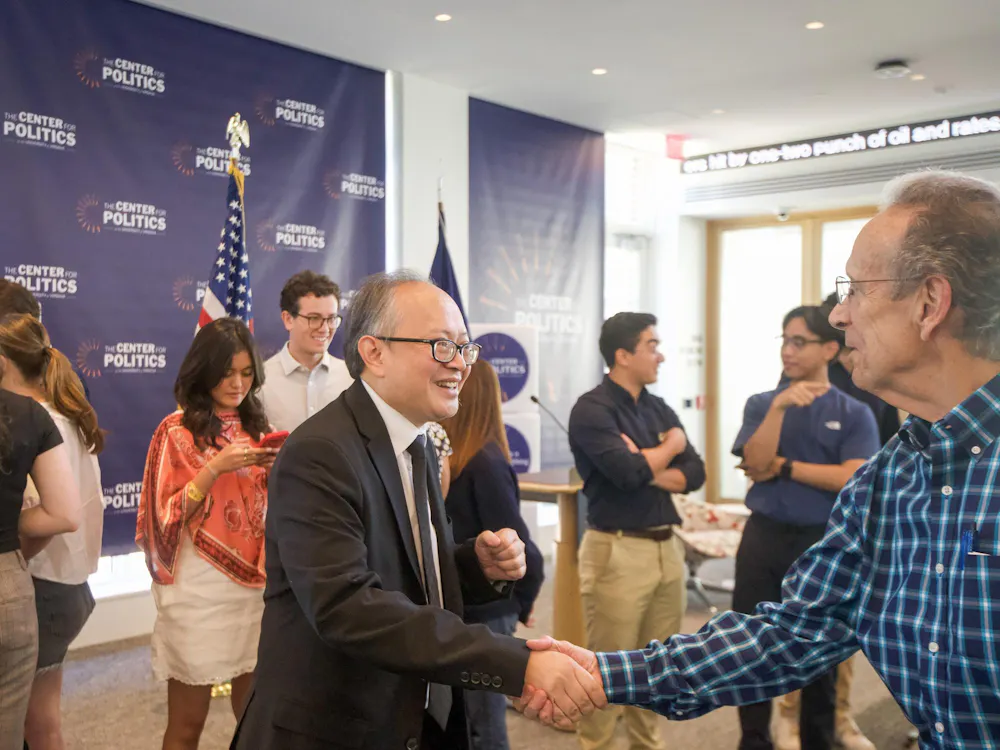
Ambassador of Thailand to the US speaks on Thai economy, conflict with Cambodia
By Edward Christopher | 3 hours agoChindawongse spoke about his home country’s history with the U.S., relations with other nations in Southeast Asia and Thailand’s economy and social progress.

Honor Committee continues discussion of changing appeals process
By Isabela Delgado | YesterdayThe proposed change would allow the Committee to better determine whether a sanctioned student's appeal is legitimate and would establish new qualifications that an appeal would need to meet to be allowed to continue through the appeal process.


